

The UK had 285 e-money firms on the register in 2025 — 260 authorised EMIs and 25 small EMIs. One had its authorisation revoked that year. Twenty-five cancelled voluntarily.
That ratio is the single most useful fact for a buyer. Forced revocation is rare and slow; quiet surrender is common. A licensed entity coming to market is far more likely to be one whose owners have already concluded the permission is not worth the cost of keeping than one about to be shut down in public. The eight signs below are drawn from the enforcement record in the UK and Lithuania, and every one of them is checkable before you sign — alongside the wider due diligence checklist for a licensed fintech.
1. A requirement already sits on the public register
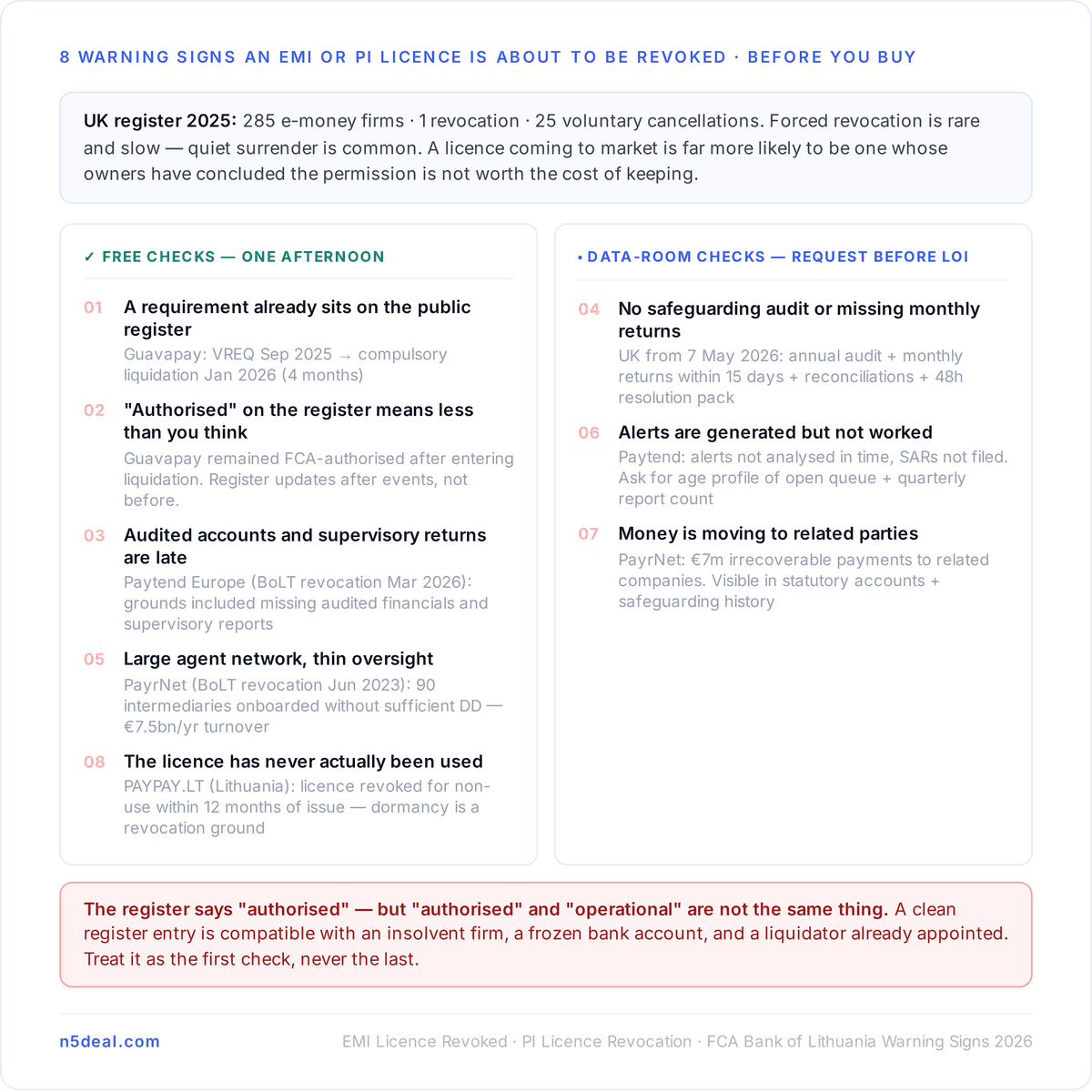
The FCA imposed a voluntary requirement on Guavapay Limited on 17 September 2025, restricting what the firm could do. The company entered compulsory liquidation on 21 January 2026, four months later. A VREQ is agreed rather than imposed, but firms rarely have a real choice, and it appears on the register for anyone to read. If the target carries a requirement restricting onboarding, e-money issuance or any core activity, the endgame has already started and the seller knows it.
2. The register still says "authorised" — and that means less than you think
Guavapay remained FCA-authorised after entering liquidation. The register records the legal status of a permission, not the operating condition of the business behind it, and it updates after events rather than before them. Treat the register as the first check, never the last. A clean entry is compatible with an insolvent firm, a frozen bank account and a liquidator already appointed.
3. Audited accounts and supervisory returns are late
When the Bank of Lithuania revoked the e-money licence of PAYTEND EUROPE, UAB on 3 March 2026, one of the stated grounds was that the firm had not submitted audited financial statements for 2024 or its mandatory supervisory reports within the required timeframes. Late filings are the cheapest signal in the whole process — they are public, they are dated, and they usually precede the substantive findings rather than follow them. A target that cannot file on time is telling you what its compliance function actually looks like from the inside.
4. There is no safeguarding audit, or the monthly returns are missing
From 7 May 2026, UK EMIs and PIs holding more than £100,000 in relevant funds must arrange an annual independent safeguarding audit and file the report with the FCA within four months of period end. Monthly safeguarding returns are due within 15 business days of each month end, internal and external reconciliations must be performed each reconciliation day, and a resolution pack must be retrievable within 48 hours. Ask for the last twelve monthly returns and the most recent audit opinion. If either is missing, you are not buying a compliant payment licence — you are buying a remediation project with a deadline attached.
5. A large agent or distributor network with thin oversight
The Bank of Lithuania revoked UAB PAYRNET’s licence on 22 June 2023 for serious, systematic and multiple violations. Among them: 90 intermediaries onboarded with insufficient due diligence. The firm was fifth in Lithuania by turnover, handling around €7.5bn a year. Volume and a long agent list read as commercial strength in a teaser and as unmanaged third-party risk in a regulator’s file. Count the agents, then ask how many were reviewed in the last twelve months and by whom.
6. Alerts are generated but not worked
Paytend’s revocation record states that alerts indicating potentially suspicious activity were not analysed thoroughly or in time, and that suspicious transaction reports were not filed where indicators warranted them. This is measurable in a data room: ask for the age profile of the open alert queue and the number of reports filed in each of the last eight quarters. A monitoring system that produces alerts nobody closes is worse than no system, because it documents the firm’s own knowledge of what it failed to act on.
7. Money is moving to related parties
PayrNet was insolvent at revocation, with liabilities exceeding assets, partly because of €7m in irrecoverable payments to related companies. Own funds miscalculation was a separate stated ground. Related-party flows are visible in the statutory accounts and in the safeguarding account history, and they move a deal from opportunistic to distressed regardless of what the seller calls it. Check whether the safeguarded pool and the corporate account ever touched.
8. The licence has never actually been used
Lithuania revoked the payment institution licence of UAB PAYPAY.LT because the company had not used it within twelve months of issue — dormancy is a revocation ground in its own right, not merely a supervisory concern. A licence marketed as "clean, no legacy customers, no history" is describing the exact condition that makes it revocable, and a dormant entity also has no payment history for the incoming bank to assess, which matters when the bank account changes owner.
How to use the eight
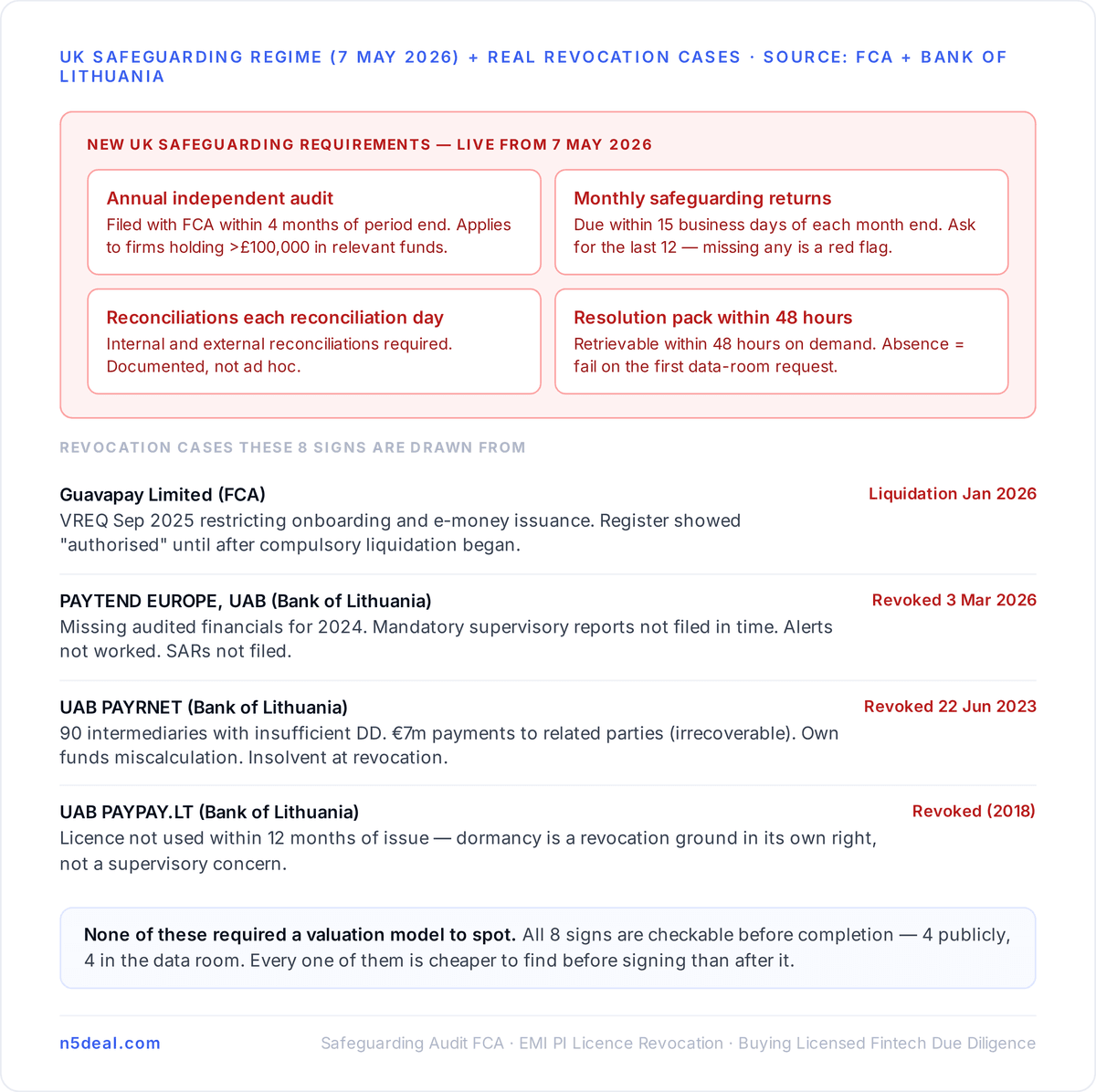
Four of these are free and take an afternoon: the register entry and any requirement on it, the filing history, the agent list, and whether the entity has ever processed. The other four need the data room: safeguarding returns and audit, the alert queue, the report count, and the related-party ledger. None of them require a valuation model, and all of them are cheaper than discovering the answer after completion. If the entity clears all eight, the remaining question is price — and what comparable licensed entities are asking is the place to answer it.
Disclaimer
This page is for informational purposes only. It does not constitute legal, financial, or regulatory advice. Readers should consult qualified professionals before making any decisions.
Regulatory actions, dates and findings cited above are taken from published decisions and notices of the Financial Conduct Authority and the Bank of Lithuania and from press reporting, as at 13 September 2026. Enforcement records are summarised, not reproduced in full, and requirements differ by jurisdiction and change over time. Nothing here is an assessment of any current or former licence holder.
N5Deal is an M&A marketplace operated by M&A Tech Group LTD. It is not a regulated financial institution and does not provide investment, legal or tax advice. Nothing on this page is an offer, solicitation or recommendation to buy or sell any business, licence or financial instrument.
Comments
Frequently Asked Questions
Clear, concise info to help you understand the process!