

Bank account change of control licensed fintech is the operational question that most buyers ask too late — after the regulatory change-of-control assessment is approved, after the purchase price is paid, and after the first attempt to process a transaction fails because the safeguarding bank is still completing its beneficial ownership review. The legal entity that holds the bank account does not change when ownership transfers. The company is the same company. The account number is the same account number. But the bank's relationship with that entity changes fundamentally the moment its beneficial ownership structure changes — and the outcome of that change is not automatic, not guaranteed, and not the same across every banking relationship the company holds.
Key Takeaways
Bank account change of control licensed fintech is an operational risk that sits outside the regulatory change-of-control process — the FCA or Bank of Lithuania approves the transaction, but the bank holding the safeguarding account makes its own independent decision about the new beneficial owner
Ownership of payment providers moves through mergers and acquisitions, and the entity holding client money can change without a single euro moving — but the legal protections attached to that money can shift with the entity's ownership structure
Banks conduct KYB — Know Your Business — on the new beneficial owner when control changes. Three outcomes are possible: the account is maintained after light-touch re-verification, the account is maintained after enhanced due diligence that takes 4 to 12 weeks, or the account is closed on change of control regardless of how satisfactory the new owner's profile is
A safeguarding account closure post-acquisition leaves an EMI unable to hold client funds, process transactions, or issue new IBANs until a replacement safeguarding arrangement is established — a gap that can take 2 to 6 months to close with a new banking partner
Card scheme memberships, SEPA participation, and correspondent banking relationships each have their own change-of-control notification procedures and their own KYB assessment processes — none of them are automatic on regulatory approval
What the Bank Is Required to Do
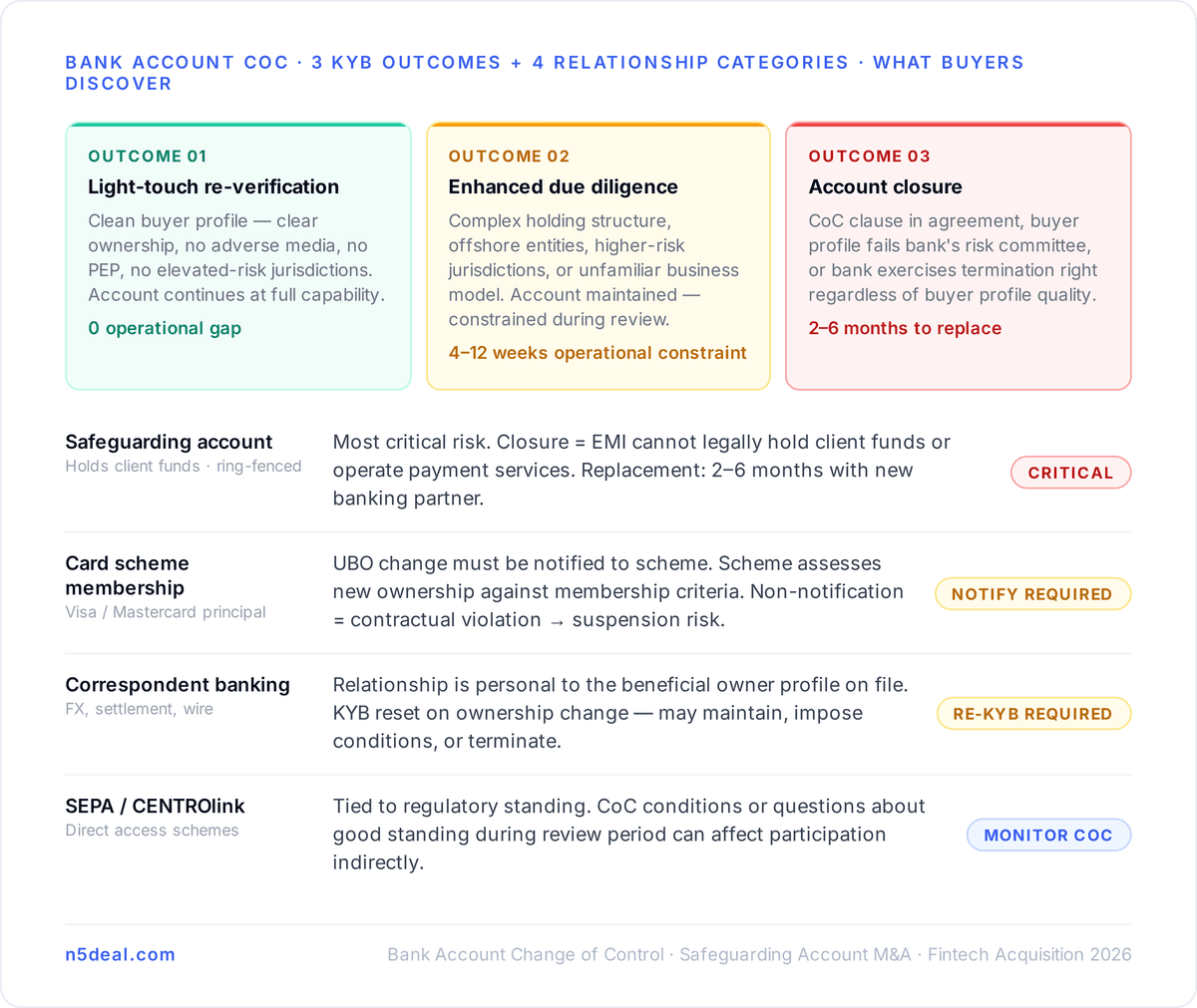
A bank that holds an account for a licensed fintech company is required under EU AMLD obligations and equivalent national AML frameworks to monitor the beneficial ownership of its business customers on an ongoing basis. When beneficial ownership changes, the bank's KYB obligation triggers: it must identify and verify the new beneficial owner, screen against sanctions and PEP databases, and conduct a fresh risk assessment of the business relationship.
The AMLA, operational since 1 July 2025, has strengthened these requirements. Information must be updated regularly, particularly when there are changes in ownership structure. The risk score calculation — which determines the level of due diligence applied — resets with the new ownership profile. A company that was classified as medium risk under its previous owners may be reclassified as high risk under new owners with a more complex ownership structure, different jurisdictions of origin, or beneficial owners who require enhanced due diligence under the bank's own internal policies.
This process is entirely independent of the regulatory change-of-control assessment conducted by the supervising authority. The FCA may have issued non-opposition to the acquisition. The Bank of Lithuania may have approved the incoming owner. Neither approval binds the bank to maintain the account relationship.
The Three Outcomes and What Drives Each
The first outcome is account maintenance after light-touch re-verification. The new beneficial owner presents clean KYB documentation — clear ownership structure, no adverse media, no PEP status, no sanctions hits, no jurisdictions the bank has elevated risk policies for. The bank updates its records, reclassifies the relationship if needed, and the account continues operating. This is the outcome most buyers assume will happen. It occurs in straightforward transactions where the buyer's own profile is clean and straightforward.
The second outcome is account maintenance after enhanced due diligence. The new beneficial owner presents a more complex profile — a multi-layer holding structure, offshore entities in the chain, beneficial owners from jurisdictions the bank treats as higher risk, or a business model the bank's compliance team finds unfamiliar. The account is not closed, but it is placed on enhanced monitoring while the bank completes its review. Transactions may be restricted. New IBAN issuance may be suspended. The review takes 4 to 12 weeks, during which the acquired company's operational capability is materially constrained.
The third outcome is account closure. Some banking agreements include explicit change-of-control clauses that give the bank the right to terminate the relationship on a change in beneficial ownership — and some banks exercise that right regardless of the incoming owner's profile. Others close accounts when the KYB assessment of the new owner produces a result the bank's risk committee will not accept. Identifying which accounts carry these clauses and which banks have a track record of exercising them is a due diligence step that must be completed before LOI, not after signing.
Safeguarding Accounts: A Category Apart
A safeguarding account is not an operating account. It holds client money — funds belonging to third parties — and the EMI regulations require that it be held separately from the company's own funds, ring-fenced against the company's insolvency. When a licensed EMI changes ownership, the safeguarding bank must assess the new beneficial owner against its own risk criteria. The bank is not safeguarding the company's money. It is safeguarding client money — and its obligation to protect those clients against the company's insolvency does not diminish because the company has a new owner.
A safeguarding account closure post-acquisition leaves the EMI in a position where it cannot hold client funds in compliance with its regulatory obligations — which means it cannot legally operate its core payment and e-money services until a replacement safeguarding arrangement is in place with a new banking partner. Establishing a new safeguarding relationship takes 2 to 6 months. During that period, the acquired company is operationally paralysed. Buyers who did not identify the safeguarding bank's change-of-control policy before close discover this on the first day of ownership.
Correspondent Banking, Card Schemes, and SEPA
A correspondent banking relationship is institutional and personal — it runs between the licensed entity and the correspondent bank's relationship team, informed by the beneficial owner profile that the correspondent bank has on file. A change in beneficial ownership requires the correspondent bank to update its KYB records, re-screen the relationship, and reassess the risk classification. The correspondent bank may maintain the relationship, impose new conditions, or terminate it.
Card scheme memberships — Visa and Mastercard principal or affiliate member status — have their own change-of-ownership notification procedures. A change in ultimate beneficial ownership must be notified to the scheme. The scheme then assesses whether the new ownership structure meets its membership criteria. Non-notification is a contractual violation that can result in membership suspension.
SEPA participation through direct access — such as Lithuania's CENTROLINK system — is tied to the regulatory standing of the licensed entity. A change of ownership that triggers conditions in the regulatory approval, or that causes the licensed entity's good standing with the supervising authority to be questioned during the review period, can affect SEPA participation indirectly.
What to Verify Before Close
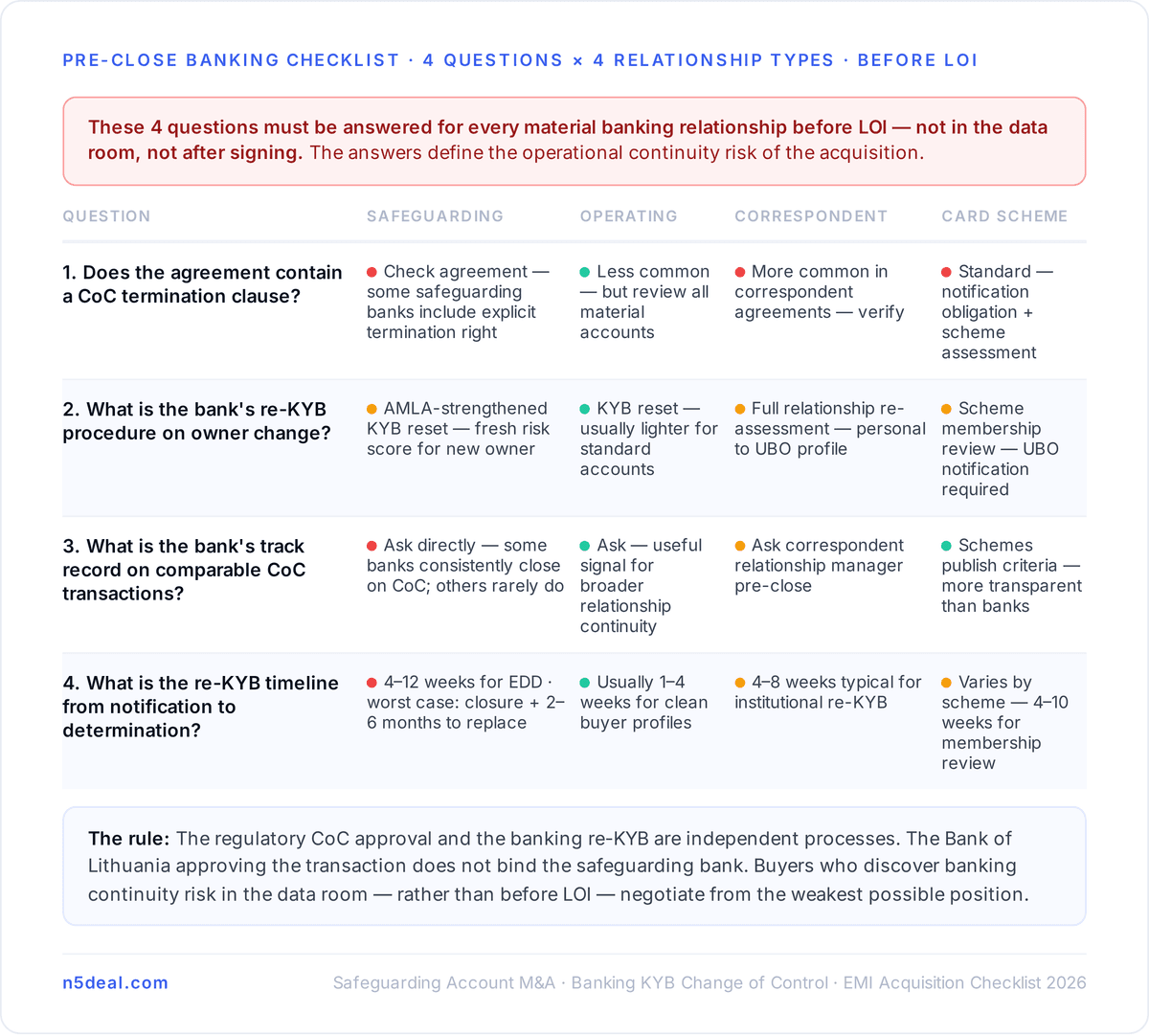
For every banking relationship the acquired entity holds, the buyer needs four answers before signing: does the account agreement contain a change-of-control clause that allows termination; what is the bank's documented re-KYB procedure for changes in beneficial ownership; what is the bank's track record on this question with comparable transactions; and what is the timeline for the re-KYB review from notification to determination. Those four answers, across every material banking relationship — safeguarding, operating, correspondent, and scheme — define the operational continuity risk of the acquisition. For buyers evaluating licensed fintech assets with documented banking relationship status, N5Deal presents this information as part of the pre-listing screening process. A full catalogue is at n5deal.com.
Disclaimer
This page is for informational purposes only. It does not constitute legal, financial, or regulatory advice. Readers should consult qualified professionals before making any decisions.
Comments
Frequently Asked Questions
Clear, concise info to help you understand the process!