

Fintech due diligence red flags are not always dramatic. The ones that produce the largest post-close surprises are often quiet — a revenue line that concentrates quietly above 40%, a compliance programme that runs on the founder's judgment rather than documented procedures, a key contract that terminates on change of control and never surfaced in the data room. Compressed due diligence windows of under 30 days correlated with post-close surprises across 18 transactions in 2024 and 2025, with average deal value destruction of 11.3% — the primary failure modes being incomplete IT system audits and undisclosed customer concentration risk. The nine below are the warning signs that consistently appear in those compressed processes, structured as a checklist for buyers who want to find them before LOI rather than after.
Key Takeaways
Fintech due diligence red flags are structural rather than transactional — they trace back to how the business was built, not how the deal was negotiated
Acquirers maintaining dedicated regulatory counsel during the diligence phase cut post-close remediation costs by 44% versus those addressing regulatory findings after closing
The seller's supervisory correspondence file is the single most informative document in a licensed fintech diligence process — its absence from the voluntary disclosure is itself a red flag
Unclear ownership of core technology, missing or incomplete IP assignment agreements with employees, and architecture that cannot scale without major rework are among the most common red flags — cloud costs growing faster than revenue and security controls that exist mostly on paper also erode buyer confidence quickly
Revenue concentration, contract assignability, and founder-dependent compliance are the three items most consistently discovered after LOI in licensed fintech acquisitions — all three are identifiable before it
Red Flag 1: Supervisory Correspondence the Seller Doesn't Volunteer
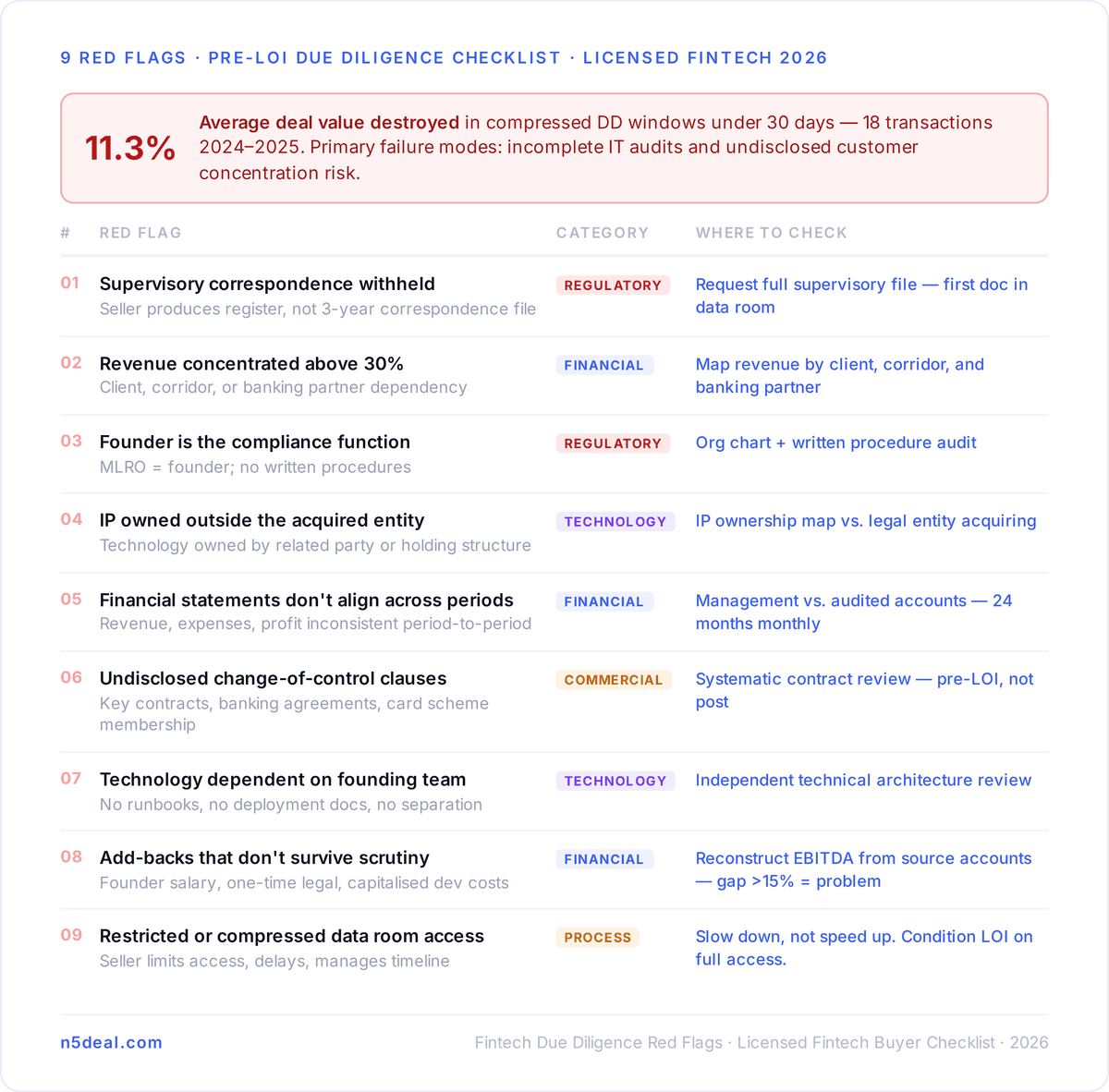
The seller provides the licence register extract. They do not volunteer the supervisory correspondence file. In a clean asset, there is no reason to withhold the correspondence — it confirms what the register already shows. A seller who produces the register but delays, conditions, or refuses access to the correspondence file is signalling that the correspondence contains something the register does not show: an open remediation requirement, a governance concern raised by the regulator, or a condition attached to the authorisation that limits the scope of permitted activities.
Request the full supervisory correspondence file for the preceding three years as the first document in the data room, not the last.
Red Flag 2: Revenue Concentrated Above 30% in One Relationship
Overdependence on a single customer or supplier is a direct red flag — if a company relies too much on one key customer or vendor, losing that relationship could be disastrous. In licensed fintech, the banking partner relationship adds a second dimension: if the safeguarding or correspondent banking arrangement is terminable on change of control, the revenue it supports can be eliminated before the buyer has had a chance to replace it.
Map revenue concentration by client, by corridor, and by banking partner — not just by customer. All three can represent a single point of failure.
Red Flag 3: The Founder Is the Compliance Function
The MLRO is the founder. The AML programme has no written procedures that exist outside the founder's judgment. The compliance calendar runs in the founder's head. This is not a compliance programme — it is a personal capability that disappears at close. Regulators expect a documented, independently operational compliance function from the incoming operator, and will inspect for it before permitting full operation post-acquisition.
A compliance programme is an institutional asset only when it can run without the people who built it.
Red Flag 4: IP That Lives Outside the Entity Being Acquired
Unclear ownership of core technology and missing or incomplete IP assignment agreements with employees are among the most common red flags in technology M&A. In licensed fintech, this surfaces as a product built on technology owned by a related party — a separate software company controlled by the founder, a personal holding structure, or an undocumented licence arrangement that was never formalised. The entity being acquired holds the licence. The technology powering the licensed product is owned elsewhere.
Map IP ownership — software, proprietary algorithms, brand assets, data — against the legal entity before any valuation discussion begins.
Red Flag 5: Financial Statements That Don't Align Across Periods
Inconsistent or inaccurate financial statements — where revenue, expenses, or profit numbers do not match up across reports — raise concerns about a lack of financial control. In licensed fintech, this is compounded by the structure of financial services revenue: transaction income, float income, subscription fees, and interchange each have different recognition timing, and commingling them in a single revenue line makes period-to-period comparison unreliable.
Compare management accounts against audited financials at monthly granularity for 24 months. The discrepancies between the two reveal where the presentation diverges from the underlying economics.
Red Flag 6: Change-of-Control Clauses in Key Contracts Not Disclosed
Key client contracts. Banking partnership agreements. Card scheme memberships. SWIFT or SEPA participation. Technology licence agreements. Each of these may contain a change-of-control provision that terminates the agreement automatically or triggers a consent requirement. Lack of contract assignability — where a company relies on key contracts that cannot be transferred to a buyer — is a direct red flag in M&A diligence.
A systematic contract review for change-of-control provisions should be completed before LOI. The findings either become disclosure items or negotiation protections — not post-signing surprises.
Red Flag 7: Technology That Cannot Run Without the Founding Team
Architecture documented only in the CTO's head. No runbooks. No deployment documentation. No separation between the product and the people who built it. In fintech this is compounded because the technology is also the compliance infrastructure: transaction monitoring rules, KYC logic, and escalation pathways that are embedded in the code without documentation transfer equally opaque from the buyer's perspective.
Security controls that exist mostly on paper erode buyer confidence quickly — and cloud costs growing faster than revenue signal risk the buyer would inherit at close. Request a technical architecture review by an independent party with specific attention to documentation completeness and operational continuity without the founding team.
Red Flag 8: Add-Backs That Cannot Be Substantiated
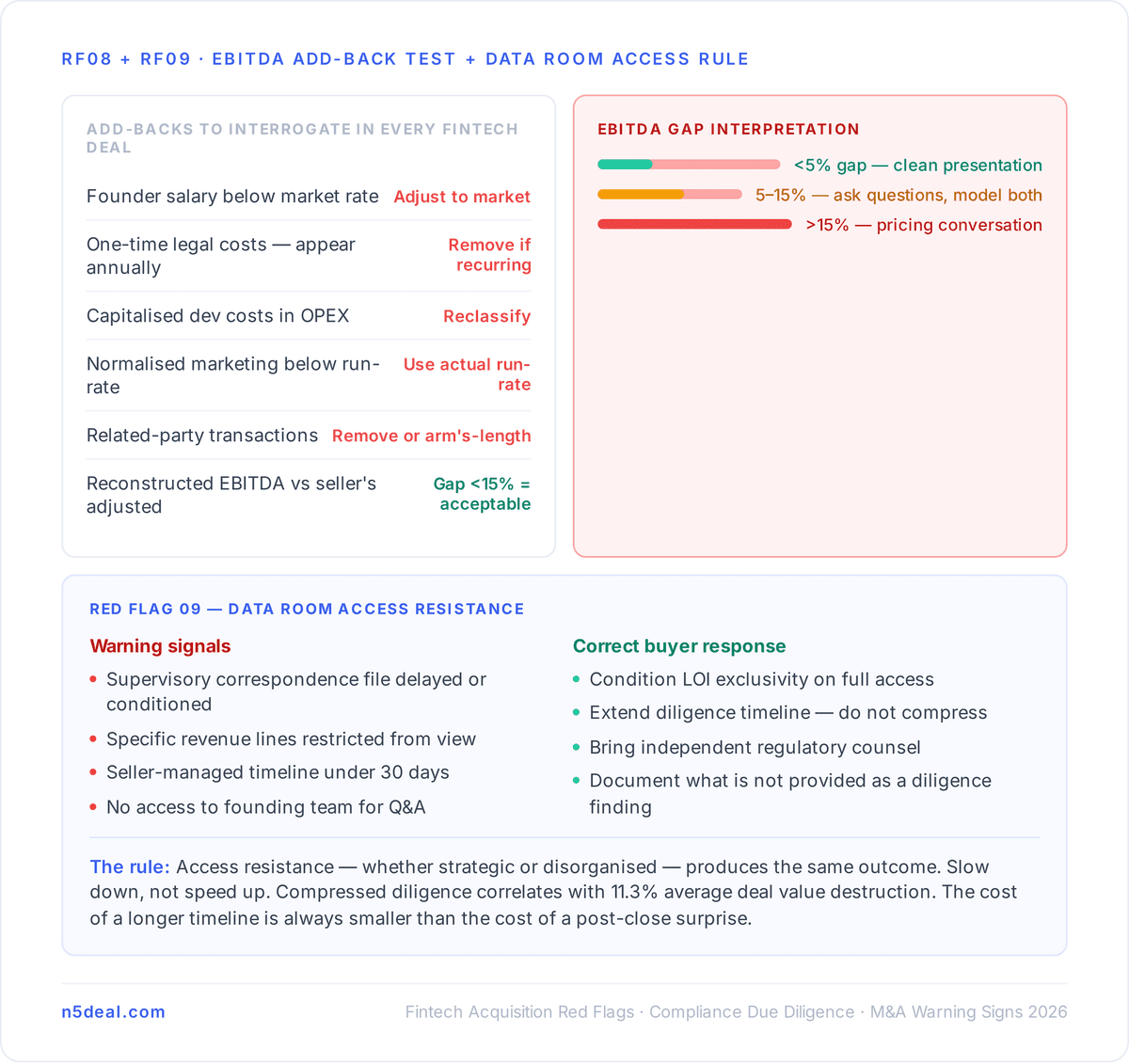
Excessive founder compensation, related-party transactions, and deferred maintenance on critical systems used to artificially inflate short-term profitability are warning signs in technology M&A. In fintech, the most common add-backs to interrogate are: founder salaries adjusted below market rate on the assumption the buyer will install a cheaper operator, one-time legal costs that appear in every period, capitalised development costs that belong in operating expense, and marketing spend normalised to a run rate the business cannot actually maintain.
Reconstruct EBITDA from audited accounts and management accounts at monthly granularity, then compare against the seller's adjusted figure. A gap above 15% is a pricing conversation.
Red Flag 9: Resistance to Access During Diligence
A seller who limits data room access, delays providing the supervisory correspondence file, restricts access to specific revenue lines, or manages the diligence timeline on a compressed basis is creating the conditions that produce post-close surprises. Due diligence is not just "should I buy" — it is "can I run it on Monday." Confirming the transition plan, knowledge transfer, systems access, vendor and customer introductions, and banking and payroll cutover before close, not after, is the standard that serious acquirers apply.
Access resistance is not always strategic — sometimes it reflects disorganisation rather than concealment. Either way, it is a signal that the data room does not contain what a complete diligence process requires, and the buyer's response is the same: slow down, not speed up.
Conclusion
Fintech due diligence red flags are all knowable before LOI — the question is whether the buyer has built the process to find them in advance or will find them under time pressure in the data room. For buyers evaluating licensed fintech assets with pre-screened documentation across regulatory standing, compliance history, and financial quality, N5Deal presents assets with the information these nine items require at the screening stage. A full catalogue of available assets is at n5deal.com.
Disclaimer
This page is for informational purposes only. It does not constitute legal, financial, or regulatory advice. Readers should consult qualified professionals before making any decisions.
Comments
Frequently Asked Questions
Clear, concise info to help you understand the process!