

Distressed Fintech Assets: How to Buy Low Without Buying Trouble
Distressed fintech assets acquisition is one of the highest-leverage strategies in financial services M&A — and one of the most reliably misunderstood. Buying low does not mean buying cheap. Between 2024 and 2025, a confluence of macroeconomic pressures, regulatory scrutiny, and overleveraged business models pushed numerous fintech companies into insolvency. For opportunistic PE firms, these collapses represent not just risk but a calculated opportunity to acquire undervalued stakes in private companies through bankruptcy-driven sales. The firms that execute distressed fintech acquisitions successfully are the ones that understand exactly why the asset is distressed — and whether that reason is fixable without the fix costing more than the discount.
Key Takeaways
Distressed fintech assets acquisition requires separating financial distress from operational or regulatory distress — only one of those is straightforwardly fixable post-acquisition
Private equity-backed companies accounted for 54% of large bankruptcies in recent years — the distressed fintech opportunity set is real, active, and PE-dominated at the upper end
A distressed EMI or PI licence is worth substantially less than a clean one if the distress originated from compliance failures — the licence may be suspended or under supervisory action at the moment of acquisition
The most reliable distressed fintech bargains are operationally sound companies with financial structure problems — over-leveraged balance sheets, misaligned equity, or founder disputes — not companies with compliance or technology problems
Due diligence on distressed assets runs under time pressure and with incomplete information — the buyer who structures the most thorough pre-LOI screen is the one who avoids the liabilities embedded in the discount
Why Fintechs Become Distressed: Three Categories With Different Risk Profiles
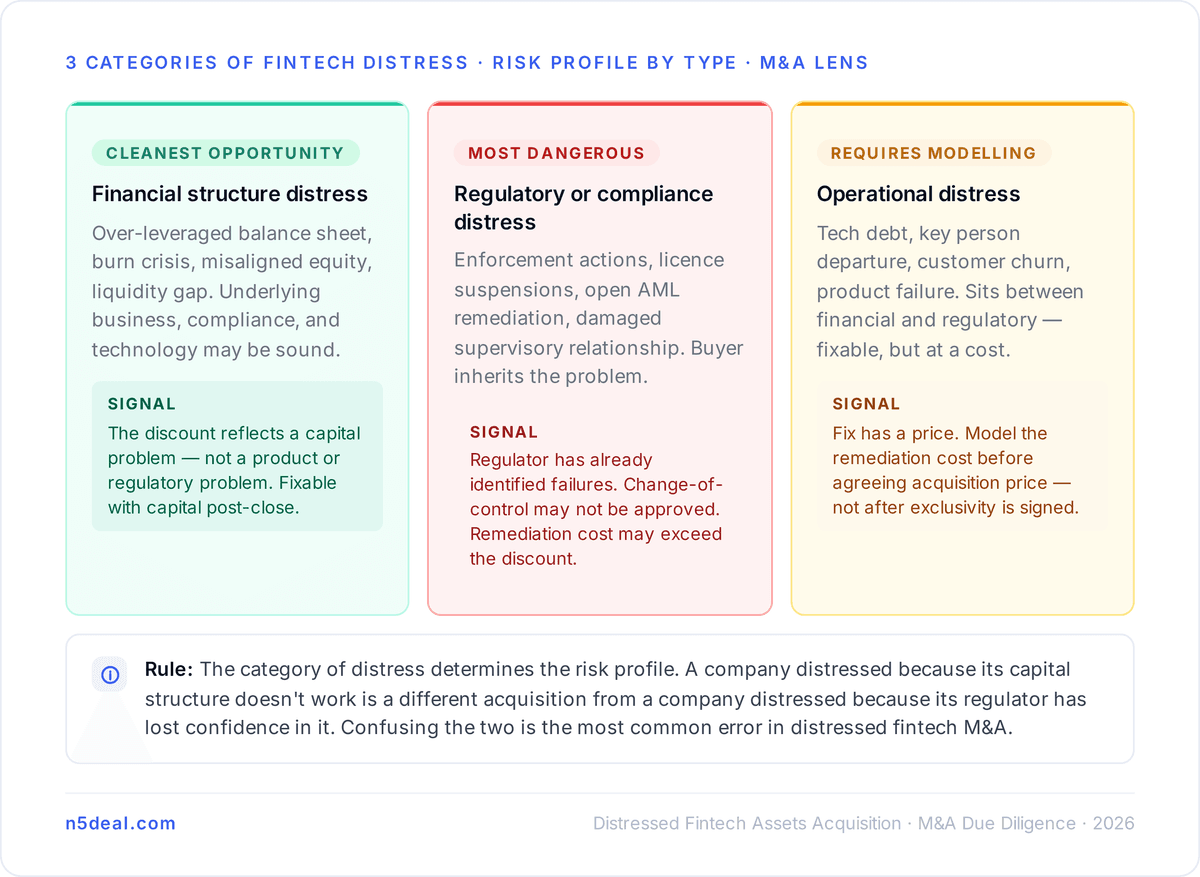
Not all distressed fintech assets are created equal. The category of distress determines the risk profile of the acquisition, the post-acquisition workload, and whether the discount is a genuine opportunity or a price tag that reflects an unfixable problem.
Financial structure distress — over-leveraged balance sheets, unsustainable burn rates, misaligned equity structures, or liquidity crises — produces the cleanest acquisition opportunity. The underlying business, compliance infrastructure, and technology may be sound. The company is distressed because the capital structure doesn't support its operating costs, not because the product or the regulatory standing is broken. Linqto's portfolio of stakes in private firms — valued at over $500 million — became a target for PE firms seeking to liquidate or restructure assets despite the company's Chapter 11 filing. The asset value was real; the corporate structure around it wasn't. That's the cleanest category of distressed acquisition.
Regulatory or compliance distress — enforcement actions, licence suspensions, open remediation requirements, or unresolved AML failures — is the most dangerous category. A company in regulatory distress is selling the licence at a discount because the regulator has already identified problems with how that licence is being maintained. A buyer who acquires the entity inherits those problems, including the obligation to complete any outstanding remediation before the regulator will approve the change of control. The discount reflects the remediation cost at minimum — and if the supervisory relationship is severely damaged, the change of control may not be approved at all.
Operational distress — technology debt, key person departures, customer churn, or product failure — sits between the two. Operational problems are fixable with capital and management, but the fix has a cost that needs to be modelled before the acquisition price is agreed.
The Five Questions That Separate Bargains From Liabilities
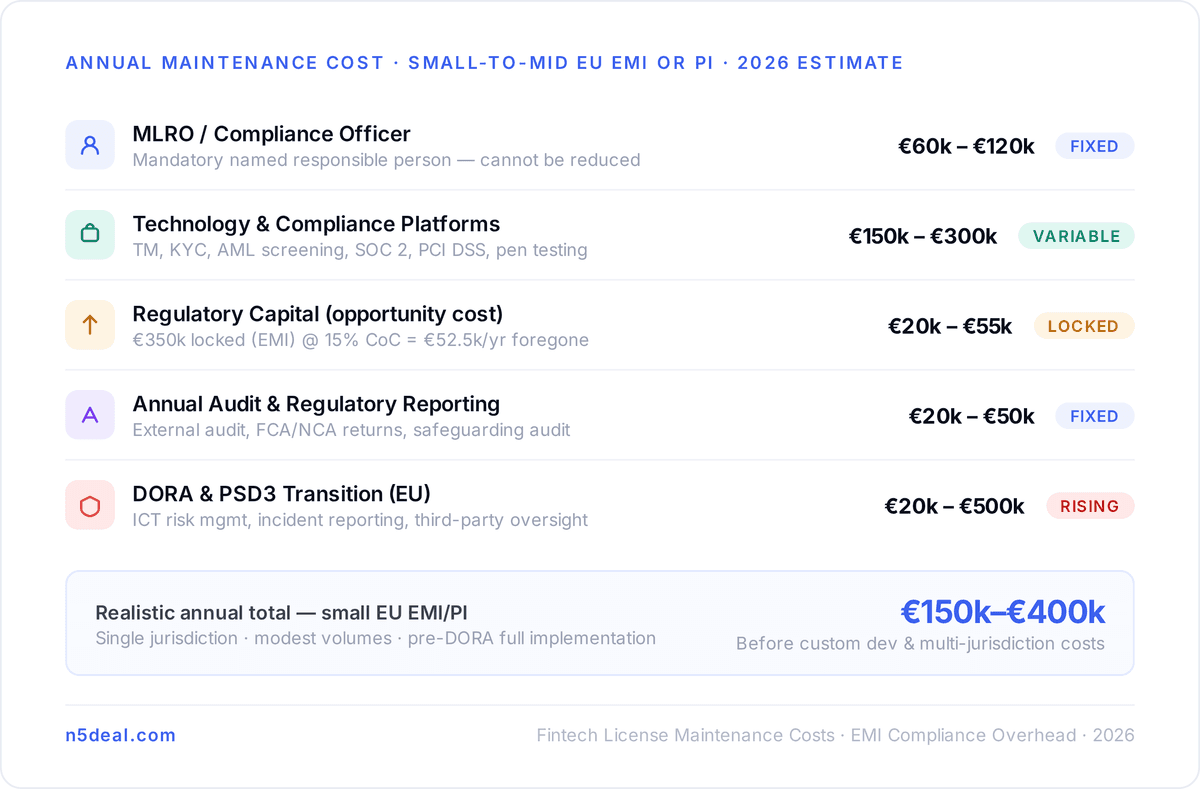
The due diligence that distinguishes a successful buying distressed fintech strategy from one that transfers problems rather than value centres on five questions that need answers before an LOI is signed.
1. Is the licence currently active, restricted, or under supervisory action? A distressed fintech whose licence has been suspended, restricted to limited activities, or placed under formal remediation requirements is not an attractive acquisition. The discount reflects a licence that cannot be deployed commercially until the regulatory problem is resolved — which takes time, cost, and supervisory cooperation that the acquisition itself may complicate.
2. What is the reason for the financial distress? Overleveraged balance sheet and founder equity disputes are fixable with capital. Revenue model collapse and market exit are not. A company that is distressed because it was built on a revenue model that no longer works — interchange fees compressed, BaaS partner terminated, regulatory arbitrage closed — is not worth a premium based on its historical revenue. Solid, a BaaS API provider, defaulted on $7 million in cash reserves in April 2025, leaving its distressed API infrastructure ripe for acquisition. The API infrastructure had value; the business model around it had failed. The buyer who understood that distinction could acquire the infrastructure at a rational price. The buyer who confused infrastructure value with business model viability would have overpaid.
3. What are the third-party dependency risks? Distressed fintechs often have counterparty relationships — banking partners, card scheme memberships, safeguarding arrangements — that are contingent on the company meeting financial covenants or compliance standards. A company in distress may have already received termination notices from these counterparties that haven't been disclosed in the limited information available to buyers. Post-acquisition, those terminations would destroy the operating model at exactly the moment the buyer needs it to function.
4. What does the management team know that the data room doesn't? In a distressed process, the data room is assembled under time pressure by a management team that has other priorities. The gaps in documentation are not always intentional — but they are consistently present. The most important due diligence in a distressed acquisition is direct conversation with management about what happened and why. The answers to those conversations contain the risk information that isn't in the data room.
5. Can the change of control be approved? In a regulated fintech acquisition, the change of control approval process requires the acquiring entity to demonstrate regulatory fitness to the supervising authority. A distressed company whose regulator has already formed a negative view of the entity's management and compliance culture is a high-risk change-of-control application. Some distressed acquisitions fail not because the asset isn't worth buying but because the regulator doesn't approve the new owner.
What the Best Distressed Fintech Buyers Do Differently
Strategic PE investments in distressed fintechs offer high returns through operational overhauls, though require rigorous due diligence on asset scalability and regulatory compliance. The buyers who execute distressed fintech acquisitions successfully operate with a specific discipline that others don't.
They separate asset value from corporate value. The licence, the technology infrastructure, the customer relationships, and the team are assets that can be priced independently of the corporate distress. A buyer who models each asset separately — and assigns a realistic remediation cost to each problem — pays a price that reflects what they're actually acquiring rather than a discount from a headline valuation that may not be meaningful.
They move faster than the timeline requires on regulatory due diligence. In a distressed process, there is rarely enough time for a full compliance review before an exclusivity decision. The buyers who consistently acquire the better assets are those who conduct preliminary regulatory screening before the formal process begins — identifying the licence status, supervisory correspondence history, and open regulatory items early enough to make an informed exclusivity decision.
Conclusion
Distressed fintech assets acquisition rewards preparation more than speed. The discount available in a distressed process is real — but it's only a discount if the problems that caused the distress are not embedded in what the buyer is acquiring. Financial structure problems are fixable. Compliance failures, broken technology, and market model collapse are not, or not cheaply. The buyers who build value from distressed fintech positions are those who ask the five questions clearly before committing — and who structure their offer to reflect what they know rather than what they hope. For buyers screening licensed fintech assets — including those coming to market through motivated seller situations — N5Deal provides structured asset documentation that allows preliminary regulatory and operational assessment before formal processes begin.
Disclaimer
This page is for informational purposes only. It does not constitute legal, financial, or regulatory advice. Readers should consult qualified professionals before making any decisions.
Comments
Frequently Asked Questions
Clear, concise info to help you understand the process!