

EMI SEMI PI SPI payment licence comparison starts with a question most founders skip: what does the product actually do at the transaction level, and at what volume? The four licence categories are not a spectrum from simple to complex — they are a matrix of capability versus scale, where the small-regime options (SEMI and SPI) offer the same product scope as their full equivalents but with volume caps that create a regulatory cliff the moment the business outgrows them. Mismatching the licence to the product is what hurts. A PI issued for a product that stores balances is a compliance gap. An EMI applied for when an SPI would cover the product for the next two years is an over-capitalisation. The decision is a product-and-volume analysis, not a prestige ranking.
Key Takeaways
EMI SEMI PI SPI payment licence comparison is a product-and-volume decision — the dividing line between EMI and PI is whether the product stores customer value as e-money; the dividing line between full and small-regime licences is monthly volume and whether EU passporting is required
Full PI capital ranges from €20,000 to €125,000 depending on payment services provided; full EMI requires €350,000 plus 2% of average e-money outstanding and a supervisory buffer most regulators push toward 120–150% of the regulatory minimum
SPI and SEMI carry no EU passporting rights — the commercial cost of that limitation compounds at scale; a product that is domestic at launch but intends EU distribution should plan the upgrade path before selecting the small-regime entry point
Under PSD3, expected to apply from 2027–2028, EMI and PI authorisations will merge into a single Payment Institution framework — existing licences are grandfathered for 24 months; the current EMI/PI distinction remains material for decisions made in 2026
SPIs have no minimum capital requirement in most Member States and no safeguarding requirement for client funds in some jurisdictions — unlike full PIs, EMIs, and SEMIs, which all require client funds protection through segregated safeguarding accounts
Full PI: What It Covers and What It Doesn't
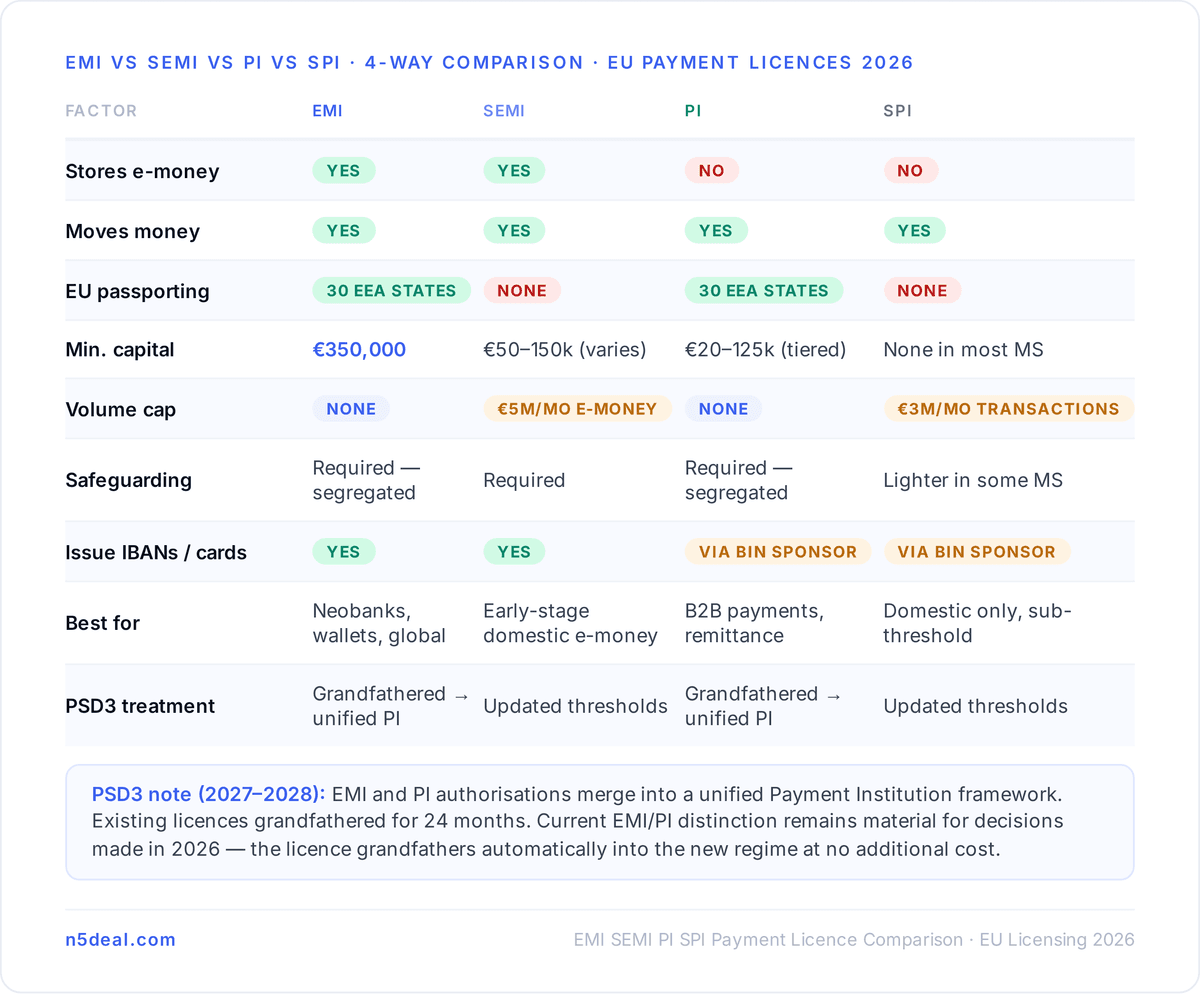
A Payment Institution is authorised for the Annex I payment services under PSD2: transfers, direct debits, acquiring, money remittance, payment initiation, account information services, and payment accounts used for executing payment transactions. A PI moves money. It does not store value. The practical test is whether the product holds a redeemable customer balance between transactions — if yes, the model crosses into EMI territory regardless of how the balance is labelled.
Capital requirements are tiered by the services provided: €20,000 for money remittance, €50,000 for payment initiation services, €125,000 for the full scope of Annex I payment services. These are initial capital floors. Beyond initial capital, payment institutions face ongoing own-funds requirements under Methods A, B, or C — which scale with payment volume — meaning growth in transaction volume directly increases capital needs. Three-year recapitalisation planning is not optional; it is the point at which the EMI's higher initial capital can become the more capital-efficient option at scale.
A full PI carries EU-wide passporting rights across all 30 EEA member states. Client funds must be held in safeguarded accounts — segregated from the firm's own funds and protected against the firm's insolvency. A PI cannot lend, take interest-bearing deposits, or issue e-money.
Full EMI: Same Services Plus Stored Value
An EMI is authorised for everything a PI can do, plus the issuance of e-money: electronically stored monetary value, issued on receipt of funds, representing a claim on the issuer, accepted by parties other than the issuer. Most neobanks and wallet products in Europe operate on EMI authorisations — Revolut, Wise, and Paysera all launched as EMIs, not banks.
Initial capital is €350,000 under EMD2 — significantly higher than the PI floor. Ongoing own-funds requirements add 2% of average e-money outstanding, and most regulators push toward maintaining 120 to 150% of the regulatory minimum as a supervisory buffer. For products with high e-money outstanding relative to transaction volume, this makes EMI capital requirements substantially more demanding than PI equivalent calculations.
An EMI carries full EU passporting, can issue prepaid cards and IBAN accounts with stored balances, and can access the full scope of PSD2 payment services. It cannot take deposits, lend from its own balance sheet, or treat client funds as its own — safeguarding requirements apply, typically through segregated accounts with an approved credit institution.
Small PI (SPI): Entry Point with a Volume Ceiling
A Small Payment Institution is available in Member States that exercised the Article 32 PSD2 option — most visibly Lithuania, Ireland, Poland, France, the Czech Republic, and the UK. The SPI provides the same Annex I payment services as a full PI, with monthly transaction volume capped at €3 million in most jurisdictions.
The SPI is the lightest entry point into regulated payment services. Most Member States impose no minimum capital requirement. In some jurisdictions, SPIs are not required to safeguard client funds in the same manner as full PIs — a significant difference in operational burden at the early stage. The SPI is seen as a transition path for new market participants, with an upgrade path to full PI as volume grows.
The commercial limitation is passporting: an SPI has no EU passporting rights. A product that is domestic at launch but intends EU distribution must upgrade to a full PI before cross-border operations can legally commence. Building toward the full PI from the outset — or acquiring a full PI rather than an SPI — avoids the regulatory transition cost that hits at the worst commercial moment: when the business is scaling and the team's attention is elsewhere.
Small EMI (SEMI): E-Money Issuance Below the Volume Threshold
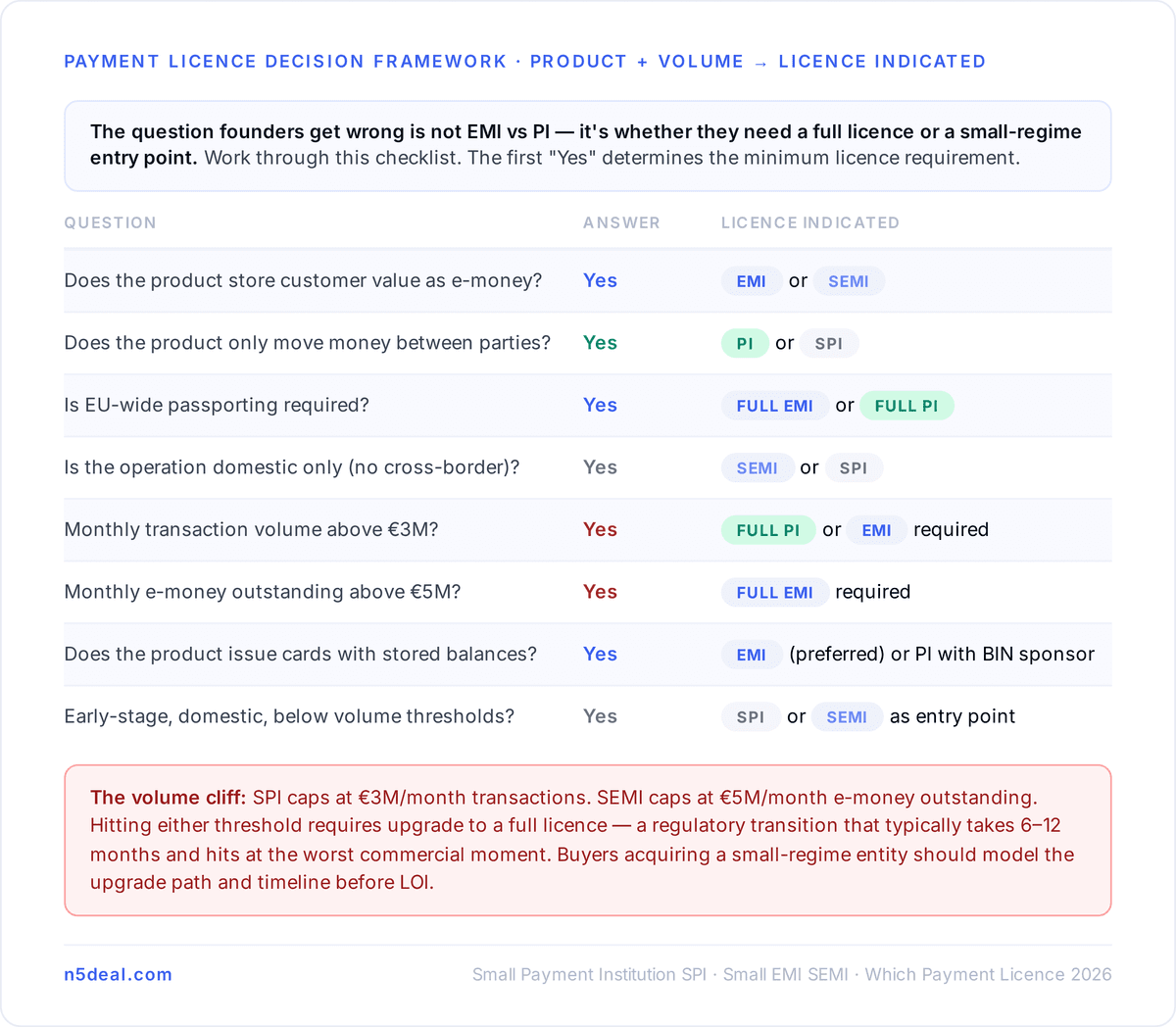
A Small Electronic Money Institution is the e-money equivalent of the SPI — available in Member States that exercised the Article 9 EMD2 option. The SEMI provides the same e-money issuance capability as a full EMI, with average outstanding e-money capped at €5 million per month.
Capital requirements for the SEMI are reduced compared to the full EMI — typically in the range of €50,000 to €150,000 depending on jurisdiction, substantially below the full EMI's €350,000 floor. The SEMI carries the same absence of EU passporting rights as the SPI. A product issuing e-money in a single domestic market at sub-threshold volumes has a compelling case for SEMI as an entry point; a product planning EU distribution does not.
Acquisition costs for SEMI entities are lower than for full EMIs, reflecting both the lower capital position and the absence of passporting rights. For buyers evaluating which entity to acquire, the SEMI is the correct acquisition target only when the intended commercial scope genuinely fits within the volume cap and the domestic-only constraint.
The PSD3 Transition and What It Means for Decisions Made Now
Under PSD3 and the accompanying Payment Services Regulation, EMIs become a sub-category of Payment Institutions — the Electronic Money Directive 2 is repealed and its provisions merged into a single Payment Institution framework. The practical impact for existing licence holders is a 24-month grandfathering period after PSD3 enters into force. For new applicants in 2026, applying under the current EMD2/PSD2 framework is still correct — the licence grandfathers automatically into the new regime without reapplication. The 2026 window is a particularly good time to apply precisely because processing occurs under the familiar current framework while the licence transitions into the new one at no additional cost.
The SPI and SEMI small-regime categories will also be addressed under PSD3, with their volume thresholds and governance requirements updated to align with the unified framework. Founders choosing between a small-regime entry point and a full licence in 2026 should factor the PSD3 transition into the upgrade path planning.
Conclusion
EMI SEMI PI SPI payment licence comparison resolves to a product-and-volume audit with a passporting overlay. Map what the product stores and moves, confirm the monthly volume trajectory, and verify whether EU distribution is a genuine roadmap item or a theoretical aspiration. For buyers evaluating which licence category to acquire across EU jurisdictions, N5Deal catalogues licensed entities across all four categories with documented authorisation scope and jurisdiction. A full overview of available assets is at n5deal.com.
Disclaimer
This page is for informational purposes only. It does not constitute legal, financial, or regulatory advice. Readers should consult qualified professionals before making any decisions.
Comments
Frequently Asked Questions
Clear, concise info to help you understand the process!