

Synapse filed for Chapter 11 in 2024. Evolve Bank paid $11.9m to settle the fallout from its data breach the same year. Blue Ridge Bank only had its consent orders terminated in 2025. Between them they cost the banking-as-a-service category its credibility with exactly the buyers it needed most.
What survived that period has one thing in common, and it is not technology. Every provider below either holds a banking permission in its own name or has been bought by an institution that does. The middleware model — sell access to somebody else’s bank, own none of the regulatory risk — is the part that stopped winning enterprise deals, which is the practical version of the argument in our report on the twelve capabilities behind a BaaS stack. Ranked by the strength of the evidence that enterprises are actually buying.
1. ClearBank — the numbers nobody else in Europe is publishing
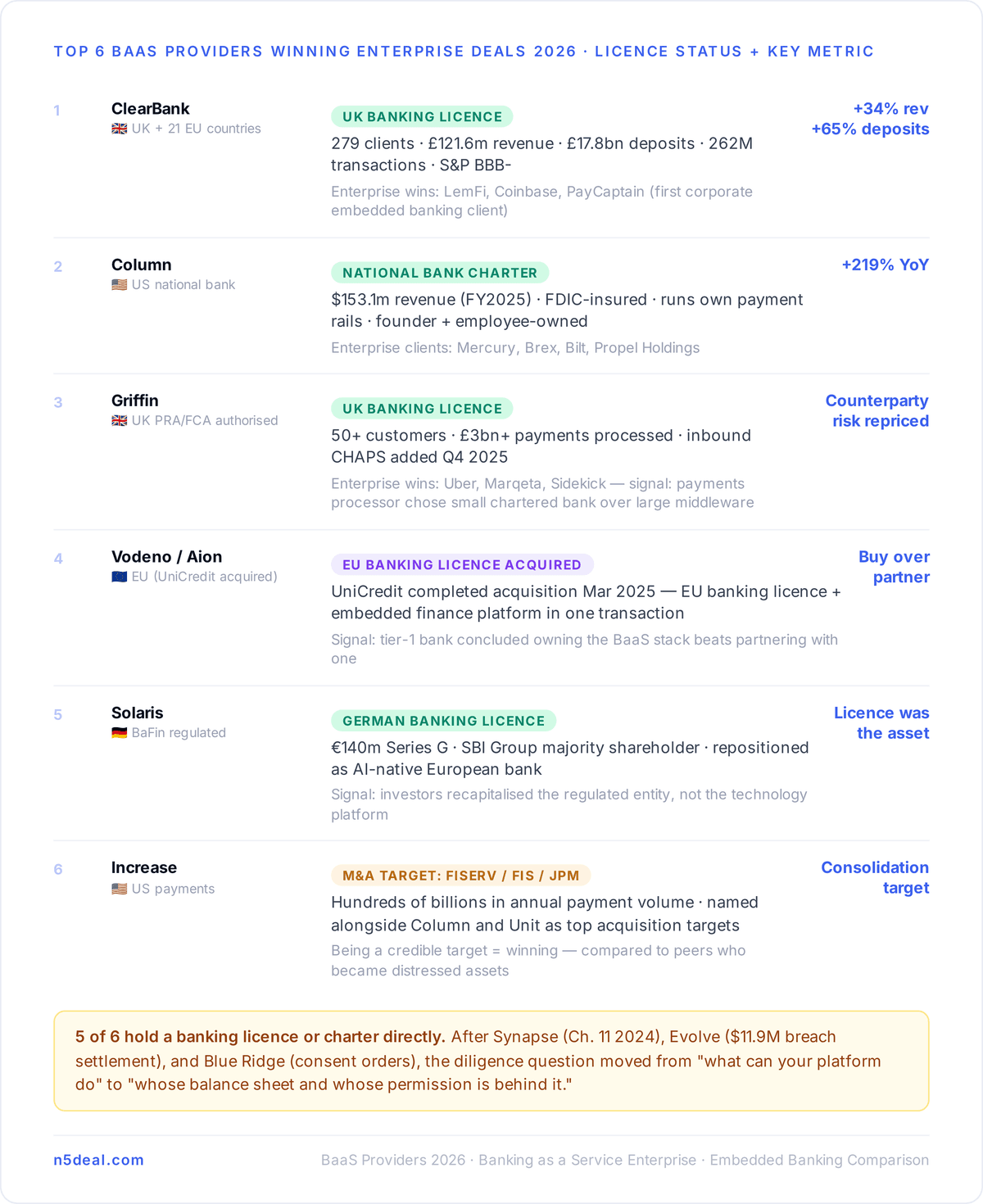
ClearBank ended 2025 with 279 clients, 61 of them added during the year, and grew its embedded banking partners from six to nine. Group normalised revenue rose 34% to £121.6m, UK pretax profit 53% to £12.2m, and fee-based income reached 75% of the total. It managed 17 million bank accounts against 13 million a year earlier, held £17.8bn of customer deposits, up 65%, and processed 262 million scheme transactions, up 57%. It holds a UK banking licence, carries an S&P BBB- investment-grade rating, had passported into 21 EU countries by early 2026 and opened a Paris branch. Named 2025 additions include LemFi, Coinbase and PayCaptain, its first corporate embedded banking partner.
2. Column — a bank the founders bought outright, growing 219%
Column reported $153.1m of revenue for 2025, up 218.8% year on year and split roughly $83m interest income to $70m non-interest. The structure is the story: William and Annie Hockey put around $50m of their own money into acquiring Northern California National Bank in 2021, and the company remains entirely founder- and employee-owned with no external investors. It is a chartered national bank with FDIC insurance running its own payment rails, not a layer on top of somebody else’s. Mercury, Brex, Bilt and Propel Holdings are on it. The contrast with the European model is the subject of how banking licences differ between Europe and North America.
3. Griffin — the smallest name with the biggest logos
Griffin is authorised by the PRA and regulated by the FCA and PRA as a UK bank. It scaled past 50 customers in 2025 and processed over £3bn in payments, adding inbound CHAPS in Q4. What earns it a place on an enterprise list at that size is who it onboarded: Uber, Marqeta and Sidekick. A payments processor choosing a small chartered bank over a large middleware platform is the clearest signal in this category that buyers have repriced counterparty risk rather than capability.
4. Vodeno and Aion Bank — the model’s logical endpoint
UniCredit completed its acquisition of Aion Bank and Vodeno in March 2025, taking a European banking licence and an embedded finance platform in a single transaction. This is what "winning" looks like at the top of the market: not a bigger client list, but an outcome where a major bank concludes that owning the BaaS stack beats partnering with one. For anyone weighing the same question from the other side, it is a live example of the build, buy or partner decision resolving decisively towards buy.
5. Solaris — recapitalised, refocused, still holding the licence
Solaris raised €140m in a Series G that made Japan’s SBI Group its majority shareholder, and has since repositioned itself as a European AI-native bank. It belongs on this list for a different reason from the others: it is the clearest case of a provider whose German banking licence was the asset worth rescuing when the growth story stopped working. Investors did not recapitalise a technology platform. They recapitalised a regulated entity with a platform attached, and the distinction is the whole lesson of the 2024–25 shakeout.
6. Increase — volume without the noise
Increase processes what industry analysis describes as hundreds of billions of dollars in annual payments volume, and is named alongside Column and Unit as one of the three most likely acquisition targets in the coming round of BaaS consolidation — with Fiserv, FIS, JP Morgan and US Bank cited as the probable buyers. Being a credible target is itself a form of winning in this category, given how many of its 2023 peers became distressed assets instead.
What the six have in common
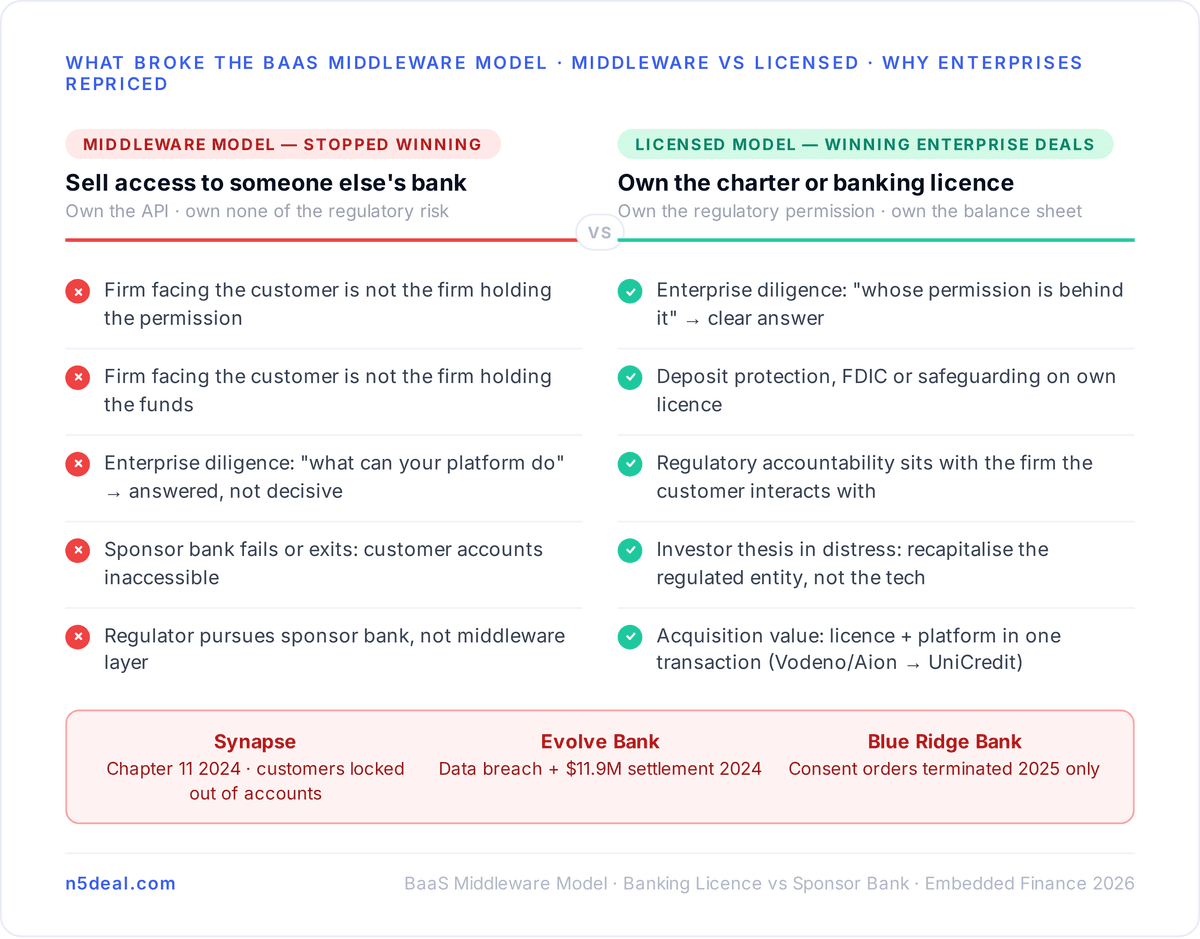
Five of the six hold a banking licence or charter directly; the sixth is the consolidation target the chartered players are expected to buy. None of them is winning on API design. After 2024, an enterprise buying embedded banking is underwriting a regulated counterparty, and the diligence question moved from "what can your platform do" to "whose balance sheet and whose permission is behind it". That is why a UK bank licence, a US national charter or an EU credit institution has become the entry ticket to this market rather than an optional extra — and why which licence category an entity holds now determines what it can sell. Licensed entities currently for sale are priced on the same logic.
Disclaimer
This page is for informational purposes only. It does not constitute legal, financial, or regulatory advice. Readers should consult qualified professionals before making any decisions.
Company figures, licence statuses and transaction details cited above are taken from published company results, provider announcements and press and analyst reporting as at 13 September 2026, and relate in several cases to the financial year ended 31 December 2025. Inclusion in this list is not an endorsement, a recommendation or an assessment of any provider’s financial condition, and readers should verify current regulatory status directly with the relevant regulator.
N5Deal is an M&A marketplace operated by M&A Tech Group LTD. It is not a regulated financial institution and does not provide investment, legal or tax advice. Nothing on this page is an offer, solicitation or recommendation to buy or sell any business, licence or financial instrument.
Comments
Frequently Asked Questions
Clear, concise info to help you understand the process!