

A corridor gets priced when buyers compete in it. Until then the asset trades at whatever the seller can argue for, which is usually less than it will be worth once the regulatory calendar forces the issue. Four of the five corridors below have a fixed date attached — a deadline, a regime commencement, a re-authorisation window — and the fifth has none, which is its own kind of signal.
The point is not that these are the biggest markets. It is that in each one, a dated event between now and the end of 2027 will convert a soft demand for a licensed entity into a hard one, and the assets are being sold today on the soft number.
1. The EU re-papering corridor: EMIs sold ahead of PSD3
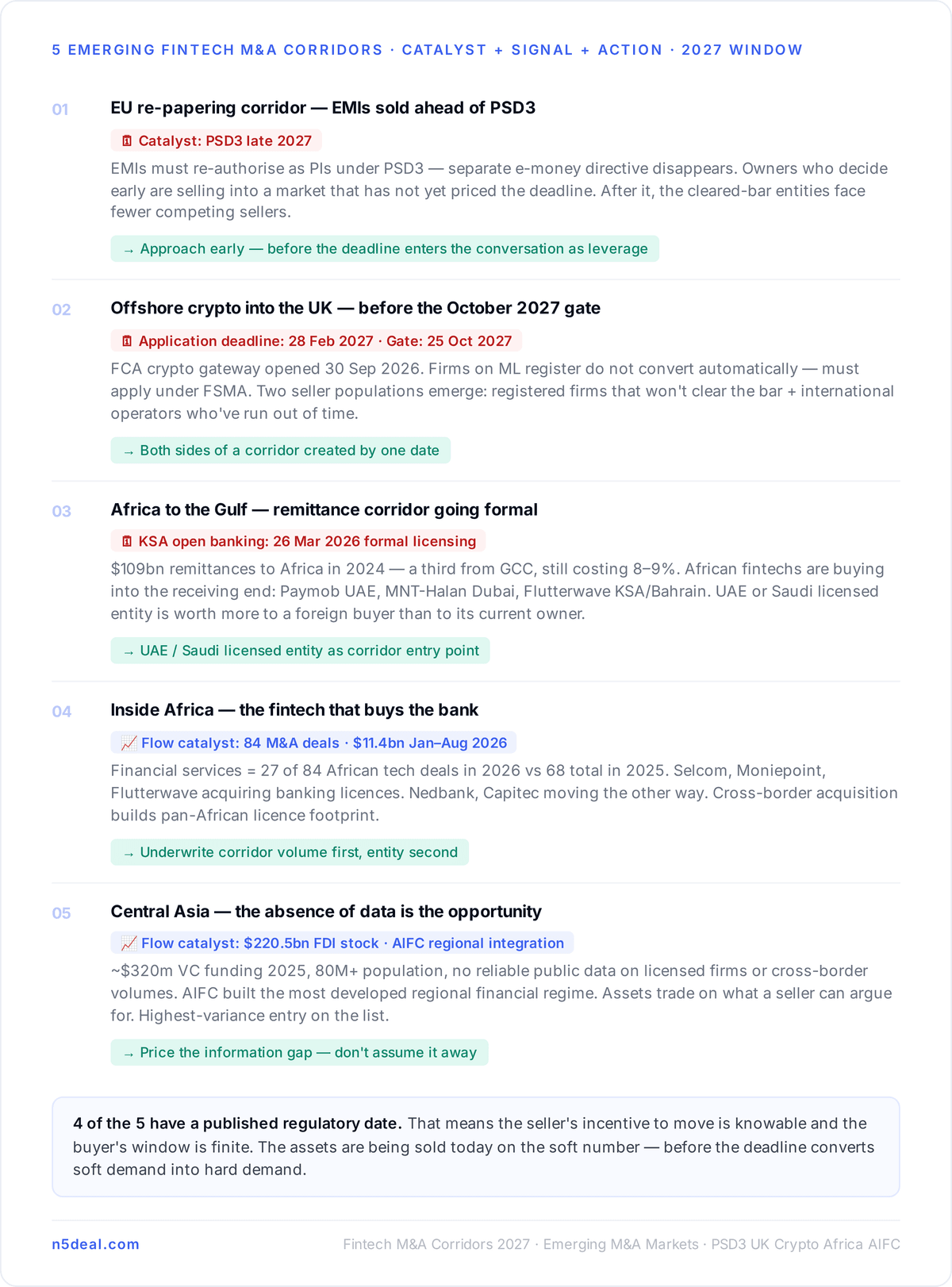
PSD3 and the Payment Services Regulation reached provisional political agreement in November 2025, with Council approval on 23 April 2026 and the regime expected to come into force by late 2027. The structural change matters more than the date: the separate e-money directive disappears, EMIs become a sub-category of payment institutions, and existing e-money institutions must be re-authorised as PIs rather than simply carried across. Every EU EMI therefore faces the same question in 2027 — spend on re-papering, or sell to someone who will. Owners reaching that decision early are selling into a market that has not yet priced the deadline, which is why the distinction between EMI, PI and SPI is about to matter commercially rather than just technically.
2. Offshore crypto into the UK, before the October 2027 gate
The FCA’s cryptoasset authorisation gateway opened on 30 September 2026. Applications close on 28 February 2027 and the regime commences on 25 October 2027. Firms currently on the UK’s money-laundering cryptoasset register do not convert automatically — the FCA has been explicit that they must secure authorisation under FSMA. Firms applying after 28 February but before commencement may only service existing contracts and cannot take new customers; firms that do not apply must stop. That produces two populations at once: registered firms that will not clear the bar and become sellers, and international operators that want UK access and have run out of time to apply. Both sides of a corridor, created by one date, and it is the practical subject of the 18-month countdown for UK crypto operators.
3. Africa to the Gulf, on the back of remittances
Remittances to Africa reached $109bn in 2024, roughly a third of it originating in the GCC, where three to five million African migrants work. Traditional cash transfers on those routes still cost 8–9%. African fintechs have started buying and licensing their way into the receiving end rather than partnering into it: Paymob secured a full UAE Central Bank licence in 2025 and operates across the UAE, Saudi Arabia and Oman, MNT-Halan launched in Dubai, and Flutterwave entered Saudi Arabia and Bahrain in 2024. Saudi Arabia moved open banking from sandbox to formal licensing on 26 March 2026. The corridor is being built by operators one licence at a time, which is exactly the condition in which a UAE or Saudi licensed entity is worth more to a foreign buyer than to its current owner.
4. Inside Africa: the fintech that buys the bank
African tech recorded 84 M&A deals worth $11.4bn in disclosed value between 1 January and 17 August 2026, against 68 deals in the whole of 2025. Financial services accounted for 27 of the 84 — about a third. What makes it a corridor rather than a trend is the direction: Selcom, Moniepoint, Flutterwave and Wave have been acquiring banking licences while keeping founder control, and traditional banks have been moving the other way, with Nedbank buying iKhokha and Capitec buying Walletdoc. Nedbank also agreed $850m for Kenya’s NCBA Group. Kenya, South Africa, Nigeria and Egypt are not the same market, and cross-border acquisition between them is how a pan-African licence footprint now gets assembled — the pattern behind the African fintech M&A wave.
5. Central Asia, where the absence of data is the opportunity
Central Asia drew roughly $320m of venture funding in 2025 across a region of more than 80 million people, with inward FDI stock of $220.5bn as of 2024. The Astana International Financial Centre has built the region’s most developed financial regime, and regional integration on payments is now an explicit policy theme. What is missing is the thing that would let a buyer underwrite a deal: there is no reliable public figure for licensed fintech firms, cross-border payment volumes or deal count. That gap is the whole point of listing it — corridors get priced when the data exists, and the assets here are still trading on what a seller can argue for. Treat it as the highest-variance entry on this list and diligence it as you would any under-covered jurisdiction.
How to act on a corridor before it prices
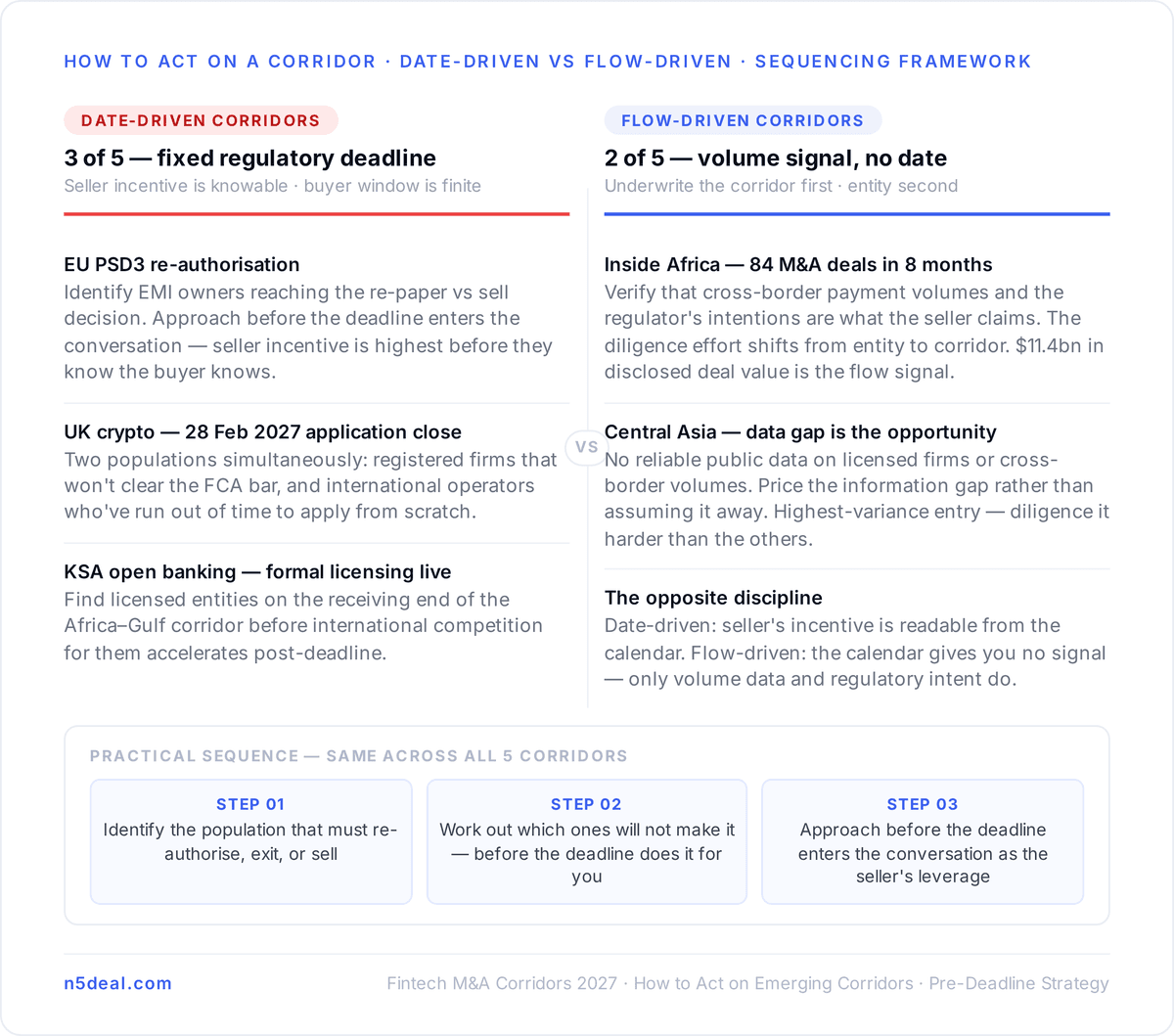
Three of these five turn on a date the regulator has already published, which means the seller’s incentive to move is knowable and the buyer’s window is finite. The practical sequence is the same in each: identify the population that must re-authorise or exit, work out which of them will not make it, and approach them before the deadline enters the conversation as leverage. On the two that turn on flow rather than a date — Africa–Gulf and Central Asia — the discipline is the opposite: underwrite the corridor volume first and the entity second. Which licence a buyer should acquire first is the same question in every corridor, and the current listings are where the answer gets tested against price.
Comments
Frequently Asked Questions
Clear, concise info to help you understand the process!