

Underrated fintech jurisdictions 2026 are not inferior jurisdictions — they are jurisdictions with genuine regulatory frameworks that receive a fraction of the licensing traffic because the conventional advice always points to the same five names. Lithuania. Ireland. Cyprus. Malta. Netherlands. Every credible advisory firm opens with one of those five. What they rarely discuss is Latvia, which offers the same EU passporting under a single regulator with a national mandate to grow its licensed fintech population by a third before year end. Or Gibraltar, which built the world's first DLT licensing framework in 2018 and processes applications in 16 to 24 weeks with 0% capital gains tax. Or Kazakhstan's AIFC, where 0% corporate income tax is constitutionally protected until 2066. The ten below each have a specific commercial reason to exist for the right operator — and most of them remain undersupplied with qualified applicants precisely because nobody talks about them.
Key Takeaways
Underrated fintech jurisdictions 2026 are not second-tier — several carry the same EU passporting rights as Lithuania and Ireland, at lower application competition and shorter real-world timelines because fewer qualified applicants are in the queue
Latvia issued its first MiCA CASP licence in December 2025 and introduced a new specialised credit institution licence in January 2026 with €1M capital — a fraction of the €5M floor for a standard banking licence
Kazakhstan's AIFC offers 0% corporate income tax, 0% individual income tax, and 0% VAT on qualifying activities — protected by constitutional statute until 2066, not a standard tax incentive subject to political change
Gibraltar pioneered DLT regulation in January 2018 — the first bespoke licensing framework for distributed ledger technology in the world — and processes applications in 16 to 24 weeks at 12.5% corporate tax with 0% capital gains tax
Romania has the highest broadband penetration in the EU, a growing Bucharest fintech ecosystem, a 16% flat corporate tax rate, and EU passporting through the National Bank of Romania — and almost nobody applies there
1. Latvia — Latvijas Banka
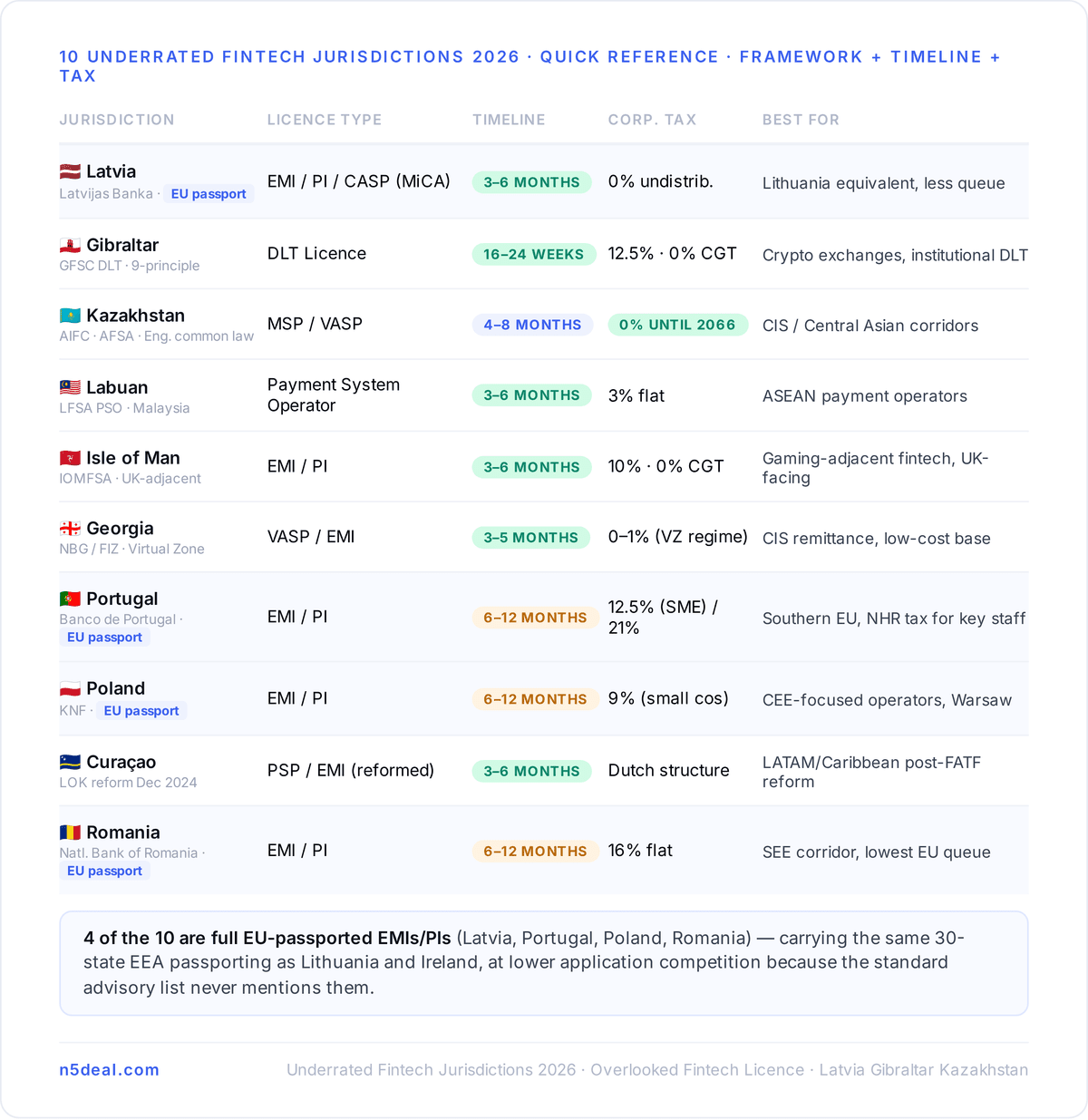
Latvia is the Baltic jurisdiction that most founders overlook in favour of Lithuania — and that is precisely where its strategic value lies. While Lithuania processes more EMI applications, Latvia offers the same EU passporting, the same PSD2/EMD2 framework, and a three-month statutory review clock under a single regulator — Latvijas Banka, which absorbed all financial supervision functions in January 2023. Latvia's government has mandated growing its licensed fintech population by one third compared to 2025 levels. The first MiCA CASP licence was issued in December 2025 to BlockBen SIA, confirming Latvia as an active authorisation jurisdiction. A new specialised credit institution licence introduced in January 2026 caps initial capital at €1M versus €5M for a standard bank — designed specifically for neobanks and digital-first institutions. Corporate tax follows the Estonian model: 0% on undistributed profits, 20% on distributions. Best for: founders who want Lithuania-equivalent EU passporting with lower application competition and a regulator that actively wants more applicants.
2. Gibraltar — GFSC DLT Framework
Gibraltar pioneered bespoke DLT licensing in January 2018 — the first jurisdiction in the world to create regulations specifically designed for distributed ledger technology service providers. The GFSC's nine-principle approach is substantive rather than bureaucratic: the regulator evaluates against nine technology and operational principles rather than prescriptive rules, allowing firms with robust operational frameworks to move faster. Timeline runs 16 to 24 weeks. Capital is approximately £100,000 typical. Corporate tax is 12.5%. Capital gains tax is 0%. Bullish exchange, major OTC desks, and institutional crypto firms operate under Gibraltar DLT authorisations. The GFSC is accessible — the DLT team demonstrates advanced technical knowledge and willingness to engage in open dialogue throughout the application process. Best for: crypto exchanges, custodial wallets, and institutional DLT businesses that need a tier-1 credibility signal at a fraction of EU licensing cost.
3. Kazakhstan — AIFC Money Services Provider
The Astana International Financial Centre operates under English common law — the same legal framework as the UK, Singapore, Hong Kong, and the Cayman Islands — with a constitutionally protected 0% tax rate on corporate income, individual income, and VAT for AIFC participants until 2066. This is not a standard tax incentive subject to political change — it is constitutionally protected for over four decades. From October 2025, the AFSA's new Payment and Money Services Rules explicitly authorise digital asset payment services, covering digital asset remittances, digital asset acquiring, and non-custodial payment initiation involving digital assets. Timeline is 4 to 8 months. Kazakhstan's strategic position provides direct access to CIS and Central Asian payment corridors that few other jurisdictions cover. Best for: operators targeting Uzbekistan, Kyrgyzstan, Azerbaijan, and other CIS markets where AIFC authorisation provides credibility that neither EU nor offshore frameworks deliver.
4. Labuan, Malaysia — LFSA PSO
Labuan's Financial Services Authority licenses Payment System Operators under a framework that processes applications in 3 to 6 months, requires MYR 500,000 capital (approximately €100,000), and applies a 3% fixed corporate tax on audited net profits. Labuan is Malaysia's offshore financial centre — a distinct regulatory environment from Bank Negara Malaysia, with genuine regulatory oversight and an established record of licensing international payment businesses. ASEAN access, English legal documentation, and Malaysian banking infrastructure make it a credible Southeast Asian regulatory home for operators who need a regulated structure in the region without Singapore MAS's 12-month timeline and significantly higher standards. Best for: ASEAN-focused payment operators, e-wallet issuers targeting the Malaysian and regional corridor, operators pairing with a Cyprus MiCA CASP for EU clients.
5. Isle of Man — IOMFSA
The Isle of Man Financial Services Authority issues EMI and payment institution licences under its own regulatory framework — UK-adjacent, English common law, British Isles credibility. Timeline is 3 to 6 months. Corporate tax is 10%. Capital gains tax is 0%. The Isle of Man has deep roots in e-gaming payment infrastructure — a commercial ecosystem that has built a well-developed banking and payment service provider network that crypto-adjacent and gaming fintech operators can access immediately. The IOMFSA is technically capable and genuinely dialogue-oriented. No EU passporting applies, but UK financial services arrangements provide a degree of access to British markets that offshore jurisdictions cannot match. Best for: gaming-adjacent fintech, UK-oriented operators who need a credible British Isles licence without London FCA complexity and cost.
6. Georgia — National Bank / Free Industrial Zone
Georgia is the most underrated jurisdiction for crypto-adjacent businesses in 2026. Formation takes 3 to 5 days for under $1,000. The Virtual Zone regime applies 0% tax on qualifying IT and crypto activities. Strong EMI banking options exist. EU-adjacent with no EU regulatory burden. The National Bank of Georgia registers virtual asset service providers under a national framework, and the Tbilisi Free Industrial Zone provides accelerated setup for technology and financial services companies. Corporate tax is 1% flat on turnover or 0% under the Virtual Zone regime for qualifying operators. CIS corridor access — remittance flows into Russia, Armenia, Azerbaijan — is the primary commercial rationale. Best for: CIS remittance operators, crypto-adjacent businesses wanting lowest-cost legitimate operating base in the region, founders validating a product before committing to EU licensing costs.
7. Portugal — Banco de Portugal
Lisbon is Europe's fastest-growing technology hub, Portugal has the most advanced fibre broadband penetration per capita in Southern Europe, and the Banco de Portugal has actively positioned itself to attract fintech EMI and PI applicants. Corporate tax reform provides a 12.5% rate on the first €25,000 of profit for SMEs, with 21% above that. The Non-Habitual Resident regime applies preferential tax rates to foreign income for qualifying key personnel — making Lisbon a low-friction destination for international founding teams. EU passporting applies. The regulator operates in English in practice for international applicants. Timeline is 6 to 12 months. Best for: Southern European market operators, international founding teams who want EU passporting and a lifestyle-quality regulatory home that isn't yet oversubscribed with applications.
8. Poland — KNF
Poland is the sixth-largest EU member state by population, the largest economy in Central and Eastern Europe, and home to a Warsaw fintech ecosystem that produces more than 700 fintech startups. The KNF (Polish Financial Supervision Authority) issues EMI and PI licences with EU passporting in 6 to 12 months. Corporate tax is 9% for small companies meeting turnover thresholds, making it the lowest effective corporate tax rate for qualifying operators in the EU outside Malta's refund mechanism. Lower professional fees than Western EU equivalents reflect the Warsaw legal market rather than lower regulatory standards. A Polish EMI provides the same 30-country EEA passporting as a Lithuanian or Irish equivalent. Best for: CEE-focused payment operators, operators whose primary client base is in Poland, Romania, Hungary, or the Czech Republic, cost-conscious EU licensing applicants.
9. Curaçao — Post-LOK Reform
Curaçao's National Ordinance on the Supervision of Financial Institutions took effect in December 2024, replacing the former licensing regime with a substantially reformed framework that addresses the AML criticism that had undermined the jurisdiction's credibility. The new LOK framework requires genuine capital, proper AML programmes, and real governance — the same substantive requirements that FATF expects. Timeline is 3 to 6 months. Dutch legal heritage makes it structurally familiar to European applicants. Caribbean geographic position, Dutch correspondent banking relationships, and global offshore distribution make it a credible alternative to Seychelles and BVI for operators who need a functioning PSP or EMI structure for Latin American and Caribbean corridors. Best for: Caribbean and Latin American remittance operators, global offshore payment businesses post-FATF realignment.
10. Romania — National Bank of Romania
Romania has the highest broadband penetration in the EU, a 16% flat corporate tax rate, EU passporting through the National Bank of Romania, and a Bucharest technology ecosystem that the European Commission has repeatedly identified as one of the continent's most rapidly developing. The BNR issues EMI and PI licences in 6 to 12 months. Romania's geographic position as the gateway to Southeastern Europe — Bulgaria, Moldova, Western Balkans — makes a Romanian EMI commercially rational for operators targeting those corridors from an EU-supervised base. Application competition is low because the conventional advice never mentions Bucharest. Best for: SEE corridor operators, Eastern European market-focused fintechs, operators who want EU passporting without the Lithuania queue.
Conclusion
Underrated fintech jurisdictions 2026 are not consolation prizes — they are the jurisdictions where qualified applications move faster, regulator relationships are more accessible, and acquisition pricing has not yet been pushed up by competitive demand. For buyers mapping where licensed entities in less-discussed jurisdictions are available for acquisition, N5Deal catalogues regulated assets across jurisdictions that most buyers haven't screened yet. A full overview is at n5deal.com.
Comments
Frequently Asked Questions
Clear, concise info to help you understand the process!