

EU UK license post-Brexit acquisition strategy starts with a structural fact that no amount of commercial preference can change: the two frameworks are entirely separate. A UK Authorised Electronic Money Institution no longer provides EEA passporting rights — and an EU EMI authorised in Lithuania, Ireland, or the Netherlands does not cover the UK market. Post-Brexit, UK companies can no longer pass EU licences into the UK market, and UK licences no longer grant EU market access. For a buyer who needs both, the question is not which licence is better. It is which market generates the first revenues, how long the second licence will take to acquire after the first, and what the commercial cost of operating without one market during that gap actually is.
Key Takeaways
EU UK license post-Brexit acquisition strategy requires two separate acquisitions — there is no single licence that covers both markets
The TPR ended on 31 December 2025 — any EEA payment institution that operated into the UK under temporary permissions now requires full FCA authorisation as an API or SPI to continue UK regulated business
An EU EMI passports across 30 EEA countries from a single authorisation — a UK AEMI covers the UK domestic market only
Lithuania is the fastest EU route at 6 to 12 months; Ireland takes 12+ months but carries the highest institutional credibility; the FCA processes complete applications within 3 months for a decision — making the UK the faster acquisition option when the application file is clean
Most serious dual-market operators run parallel licences — the sequencing decision determines which market is served with a gap and for how long
The EU-First Case
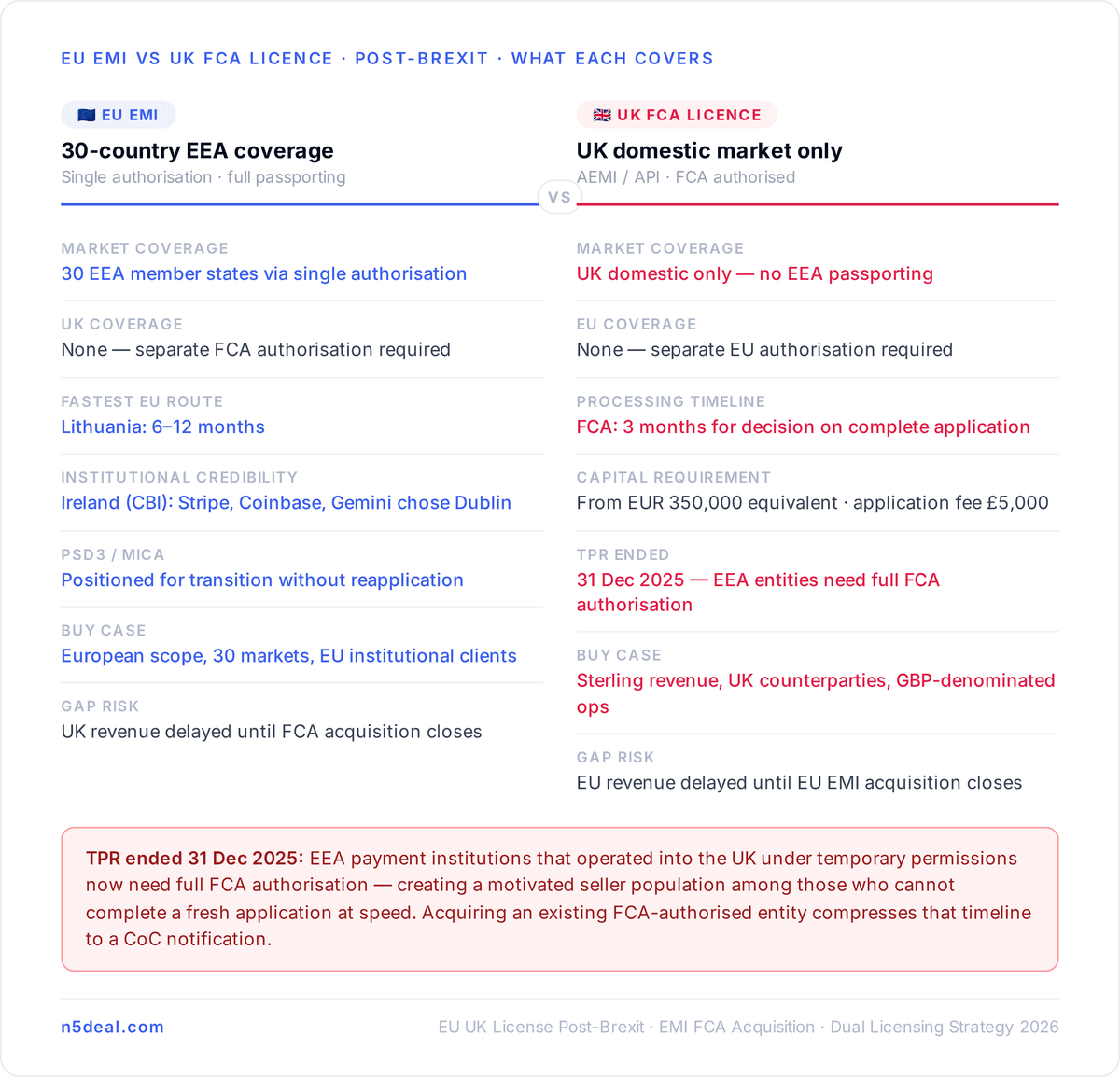
An EU EMI authorised by the Bank of Lithuania, the Central Bank of Ireland, or the Dutch DNB passports across all 30 EEA member states under a single authorisation. One licence application, one regulatory relationship, one compliance programme — and commercial access to Germany, France, the Netherlands, Poland, and 26 other markets through notification rather than reapplication.
Lithuania is the default EU choice for many fintechs because of speed and regulator accessibility — 6 to 12 months for a complete file, and the Bank of Lithuania's newcomer programme provides structured application support. Ireland is the better choice for global platforms and institutional-grade credibility — Stripe, Square, Coinbase, and Gemini chose Ireland precisely because the CBI's reputation with counterparties globally exceeds what lighter-touch EU jurisdictions provide.
The EU-first case applies to any buyer whose commercial strategy is European in scope. A fintech acquiring an EU EMI in 2026 gets immediate 30-country coverage, MiCA stablecoin compatibility through the EMT framework, and a licence structure that is positioned for PSD3 transition without reapplication. The UK can be added through a separate FCA authorisation once the EU structure is operational — the gap is commercial, not structural.
The UK-First Case
The UK-first case applies to buyers whose immediate revenue is sterling-denominated, whose institutional counterparties are UK-domiciled, or whose commercial relationships depend on FCA credibility signals that EU licences don't provide to non-EU partners.
The FCA processes complete applications within 3 months for a decision — compared to 6 to 12 months in Lithuania and 12+ months in Ireland. For a buyer who needs the UK market operational quickly and can tolerate a 9 to 12 month gap before an EU licence is functional, UK-first is the faster route to revenue. Most EMI and PI applications in the UK have an application fee of GBP 5,000 with capital requirements starting at the equivalent of EUR 350,000 — the same financial threshold as EU equivalents.
The TPR ending on 31 December 2025 has created a specific UK-first opportunity. EEA payment institutions that operated into the UK under temporary permissions are now required to hold full FCA authorisation to continue UK operations — creating a population of motivated sellers among those who need FCA status quickly and cannot complete a fresh application at speed. Acquiring an existing FCA-authorised entity compresses that timeline to a change-of-control notification rather than a fresh application.
Why Sequencing Matters in M&A
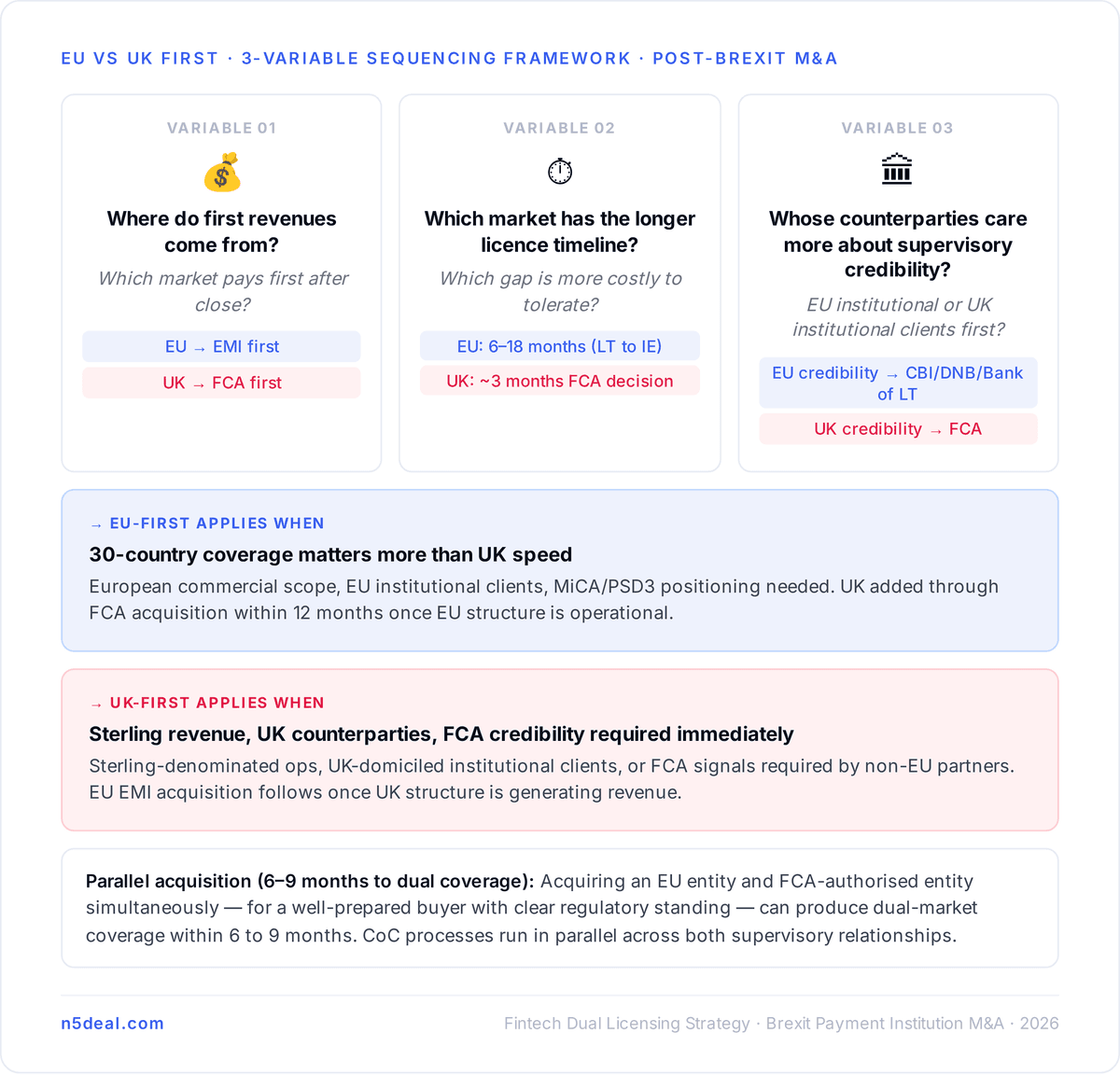
The sequencing decision has specific M&A implications that most buyers don't model before LOI. A buyer acquiring an EU EMI in 2026 with the intention of adding UK coverage within 12 months needs to model the commercial cost of the UK gap — revenue foregone, client relationships that cannot be served, and the opportunity cost of running EU operations without UK settlement capability.
A fintech wishing to operate in both the EU and the UK must apply for two separate licences — and a phased licensing strategy starting with one market and scaling toward both is the most common and cost-efficient approach for growing fintechs.
The practical framework is straightforward: identify which market generates revenue first, which market has a longer licensing timeline, and which market's counterparties care more about supervisory credibility. That three-variable analysis produces the sequencing answer — not a generic preference for EU or UK first.
For most buyers in 2026, the EU-first sequence is correct: 30 countries versus 1 in the first licence, faster institutional client onboarding through EU passporting, and a UK licence added through FCA acquisition within the following 12 months once the EU structure is operational. For sterling-centric buyers, UK-first is the right answer for the same reason stated in reverse.
Conclusion
EU UK license post-Brexit acquisition strategy is a sequencing decision, not a ranking decision. Neither licence is better — they cover different markets with the same structural separation. The buyer who models commercial geography correctly before LOI acquires the right licence first and structures the second acquisition into the deal timeline. The buyer who doesn't discovers the gap in the first operating quarter after close. For buyers mapping where both FCA-licensed and EU-licensed payment assets are available for acquisition, N5Deal catalogues licensed entities across both jurisdictions with the compliance documentation that allows preliminary assessment before formal processes begin. A full overview of available assets is at n5deal.com.
Disclaimer
This page is for informational purposes only. It does not constitute legal, financial, or regulatory advice. Readers should consult qualified professionals before making any decisions.
Comments
Frequently Asked Questions
Clear, concise info to help you understand the process!