
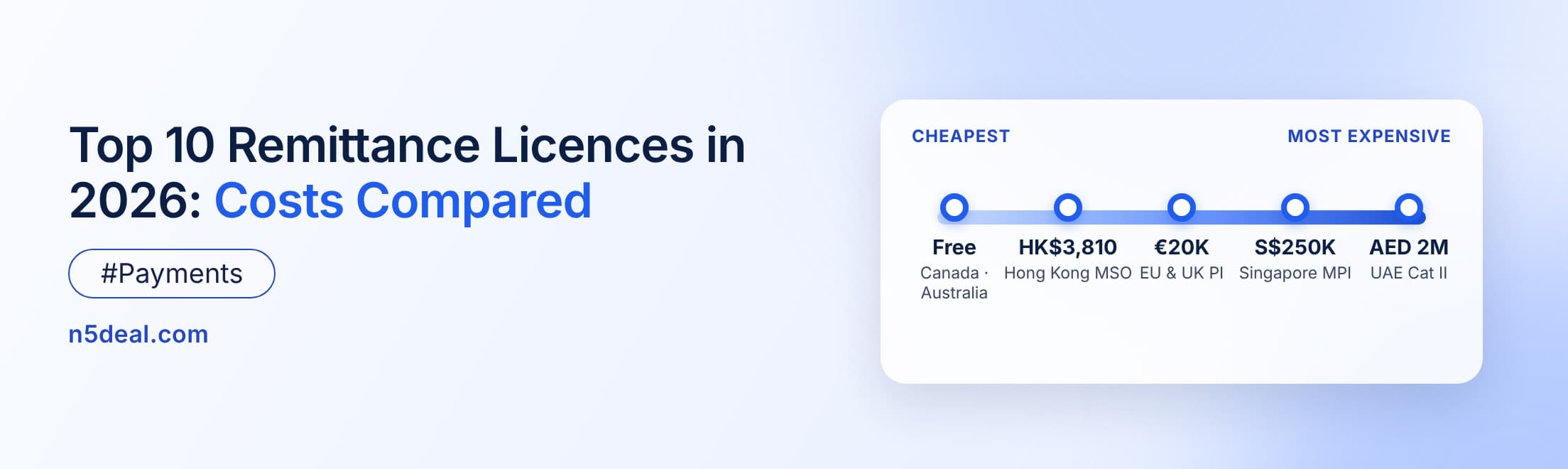
The cheapest remittance licences in 2026 cost almost nothing to obtain: Canada's FINTRAC registration and Australia's AUSTRAC registration have no capital requirement or published fee, and a Hong Kong MSO costs HK$3,810. The most expensive, the UAE, needs AED 2 million in capital. Cheap entry is not the same as a safe asset: Canada revoked 151 registrations by May 2026.
The ranking in numbers
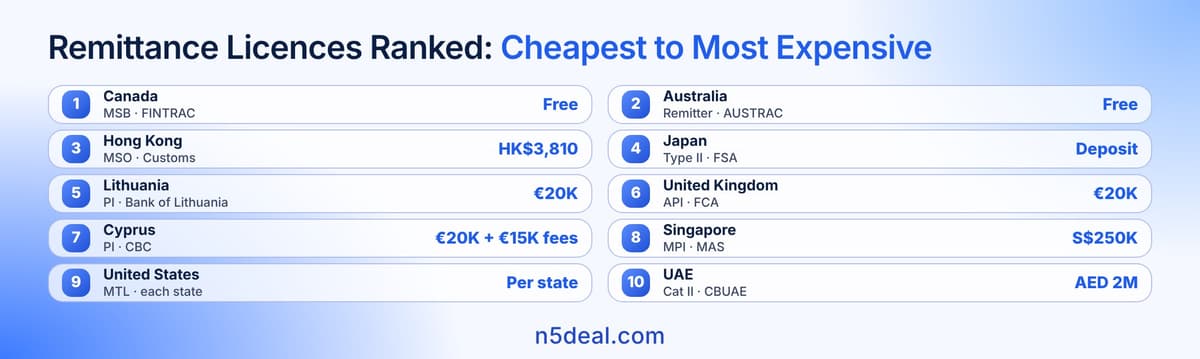
Cheapest to enter. Canada MSB, Australia remitter and Hong Kong MSO: no statutory capital in any of the three.
EU and UK floor. €20,000 initial capital for a payment institution licensed for money remittance only, the same in Lithuania, Cyprus and the UK.
Most expensive. UAE retail payment Category II at AED 2 million, then Singapore's major payment institution at S$250,000 base capital plus a security deposit of up to S$200,000.
Most fragmented. The United States: a separate money transmitter licence in each state, with 31 states on the Money Transmission Modernization Act by September 2026.
2026 enforcement. FINTRAC revoked 151 MSB registrations by 21 May 2026. MAS revoked the licence of Sir Money Changer on 15 September 2026 for letting a third party run transfers under its name.
Which remittance licences are cheapest to get?
1. Canada, MSB registration (FINTRAC). No capital requirement and no FINTRAC fee; the registration lasts two years. A firm that holds or moves end-user funds also registers with the Bank of Canada under the Retail Payment Activities Act, at C$2,500. Bill C-12 raised penalties to up to C$20 million per violation, and the 151 revocations by May 2026 compare with 23 in all of 2025. Requirements are on the Money Services Business (MSB) license page.
2. Australia, remittance registration (AUSTRAC). No capital requirement and no published fee. AUSTRAC has up to 90 days to decide, and the clock restarts each time it asks for information. Firms register as an independent remittance dealer, a network provider or a network affiliate. Since 31 March 2026, crypto exchange and transfer sit in a separate virtual asset register under the AML/CTF Amendment Act 2024.
3. Hong Kong, money service operator (Customs and Excise). No prescribed capital. The licence costs HK$3,810 plus HK$945 per fit and proper person since 15 May 2026, the first fee rise since the regime began in 2012. It lasts two years and covers money changing and remittance, but not crypto. Payment firms still use it to enter Asia: Unlimit received one in September 2026.
4. Japan, funds transfer business, Type II (FSA). No minimum capital, but every transfer obligation must be backed by a guarantee deposit, and each transfer is capped at ¥1 million. Type II is the working tier: 83 providers held it in July 2026, against 8 in the uncapped Type I.
What does an EU or UK remittance licence cost?
5. Lithuania, payment institution (Bank of Lithuania). €20,000 initial capital for money remittance and a three-month statutory decision period from a complete file. The country had 43 payment institutions, and the central bank now expects a three-person board, a CEO and an AML officer based in Lithuania.
6. United Kingdom, authorised payment institution (FCA). €20,000 initial capital for money remittance. The FCA's median new authorisation took 125 days in 2025/26. Since May 2026, every authorised PI files monthly safeguarding returns and an annual safeguarding audit.
7. Cyprus, payment institution (Central Bank of Cyprus). €20,000 initial capital, but fees of €15,000: a €5,000 pre-application review introduced on 3 August 2026 and a €10,000 formal application fee. The review alone takes 30 to 50 working days, as set out in Cyprus EMI Licence 2026: The New Pre-Application Stage.
All three EU and UK licences carry a catch. Under the agreed PSD3 text, money remittance capital in the EU rises to €40,000, and every existing EU payment institution must pass re-authorisation. The UK is outside PSD3.
Which remittance licences cost the most?
8. Singapore, major payment institution (MAS). S$250,000 base capital, plus a security deposit of S$100,000 or S$200,000 depending on monthly volume. The application fee is S$1,500 per service and the annual fee S$10,000 per service. MAS publishes no processing standard; a clean application often takes a year or more. The register listed 246 MPIs in August 2026.
9. United States, money transmitter licences (state regulators). No single licence: a firm needs one in each state where it operates, each with its own net-worth floor and surety bond, usually renewed every year. A national footprint means dozens of applications through the NMLS, and every licensing state must approve a change of control before closing.
10. UAE, retail payment services Category II (CBUAE). AED 2 million initial capital, or AED 1 million for firms under AED 10 million in monthly volume. Category II is the lowest tier that allows cross-border transfers. Since the new Central Bank law's transition ended in September 2026, unlicensed activity carries fines from AED 1 million, as covered in New CBUAE Law: Who Needs a Licence After September 2026.
Is the cheapest licence the best one to buy?
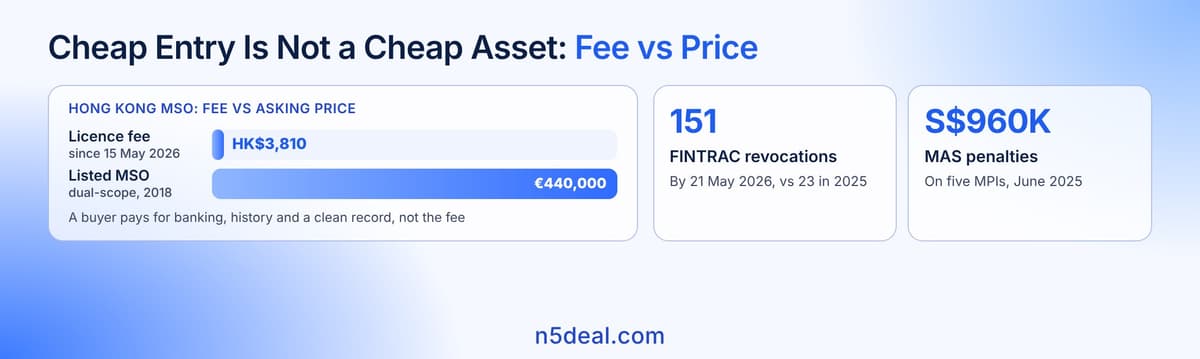
Not always. A low entry cost means more holders, and more holders means more scrutiny of each one. Canada's 151 revocations and Singapore's S$960,000 in penalties on five MPIs in June 2025 show regulators thinning out weak operators, not new ones.
What a buyer pays for is the licence plus what it has accumulated: banking, transaction history and a clean inspection record. That is why an existing Hong Kong MSO sells for far more than its HK$3,810 fee. The listing Money Service Operator (MSO) in Hong Kong asks €440,000 for a dual-scope exchange and remittance licence issued in 2018, renewed in 2025 and valid until September 2027, with a clean record.
Checklist: choosing a remittance licence
Corridor. Pick the licence where your senders are, not where licences are cheapest.
Capital. Budget the statutory minimum plus 6 to 12 months of operating costs, as MAS guidance recommends.
Banking. Confirm a bank will open a corporate account for a remitter in that jurisdiction before you apply or buy.
Crypto. Check whether the licence covers crypto; in Hong Kong, Australia and Singapore it does not, or it needs a separate registration.
Expansion. EU licences passport across the EEA; Hong Kong, Singapore, the UAE and Australia cover one market.
Change of control. Every jurisdiction on this list requires the regulator to approve or be told about a new owner; plan the timeline before signing.
Record. For an existing licence, ask for inspection reports, suspicious transaction filings and any regulator correspondence.
Disclaimer
This article is general commentary on money remittance licensing as it stood on 2 November 2026. Capital, fees and timelines are statutory minimums or published figures and vary with each business model. It is not legal, regulatory or investment advice, and nothing here guarantees a licence, an approval or a transaction outcome. Check current requirements with each regulator and take local legal advice before applying or buying.
Comments
Frequently Asked Questions
Clear, concise info to help you understand the process!