
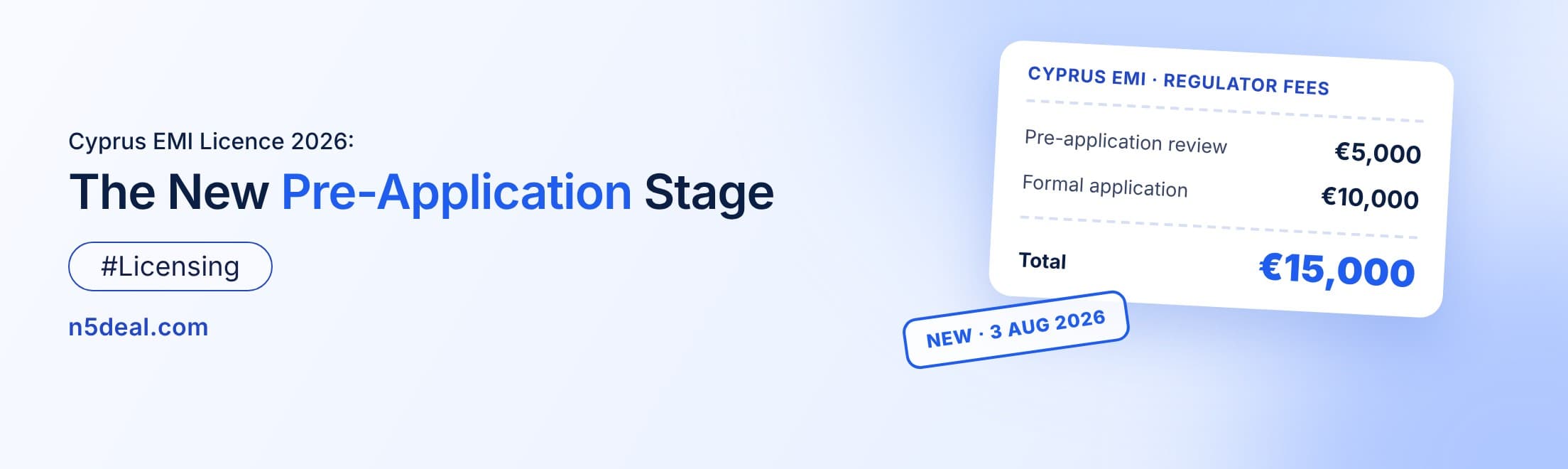
Since 3 August 2026, every EMI and payment institution applicant in Cyprus passes a paid pre-application review before filing. The Central Bank of Cyprus charges €5,000, assesses owners and business model in 30 working days, or 50 if it orders enhanced due diligence, and the formal application fee has doubled to €10,000.
Cyprus licensing in numbers
Pre-application fee. €5,000, non-refundable, paid with the CBC's prescribed pre-application document.
Pre-application review. 30 working days, extended to 50 where the CBC requires an independent enhanced due diligence report on the ultimate beneficial owners.
Formal application fee. €10,000, up from €5,000.
Statutory decision period. Three months from a complete application, with the clock stopped for information requests. Six to twelve months end to end is typical.
Capital. €350,000 initial capital for an EMI, with own funds of at least 2% of average outstanding e-money. Payment institutions need €20,000 for money remittance, €50,000 for payment initiation and €125,000 for the full range of services.
Market size. CBC payment statistics show 38 payment and e-money institutions at the end of 2025, up from 34 a year earlier.
Revocations. The CBC revoked two EMI licences in 2025.
What is the CBC pre-application stage?
It is a mandatory review of the applicant's owners and business model before a licence application can be filed. The CBC announced it on 31 July 2026 and applied it from 3 August 2026 to both EMIs and payment institutions.
The process has three steps. The applicant files the CBC's pre-application document with proof of the €5,000 fee. The CBC then assesses the reputation of the ultimate beneficial owners, the wider group and the risk profile of the business model, and may require an enhanced due diligence report from an independent provider at the applicant's cost. Finally, the CBC meets the owners and the applicant's representatives, gives its preliminary view and lists what must be fixed before a formal application.
The stage produces feedback, not a decision. Passing it does not pre-approve a licence, and the full assessment can still order enhanced due diligence later.
Why did the Central Bank of Cyprus introduce it?
To catch problems with owners' reputation before applicants spend months on a full file, and to make its expectations clearer. The change follows the CBC's strategy for e-money and payment institutions announced in December 2024, which created a dedicated directorate to supervise the sector.
The same reform tightened the back end of the process: an application left unanswered after CBC comments is now treated as withdrawn after a set period. Together with the higher fee, the reform targets the incomplete or speculative files that slowed earlier reviews.
How long does a Cyprus EMI licence take now?
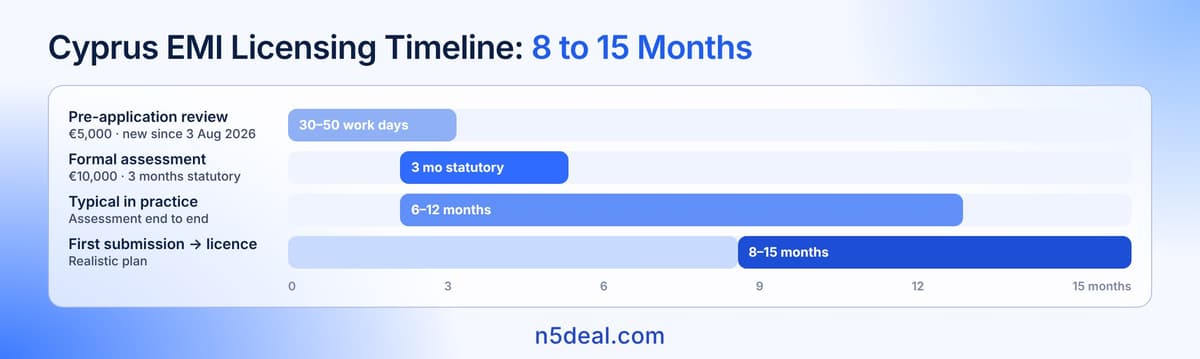
Add the pre-application stage to the existing timeline: 30 to 50 working days before filing, then a three-month statutory period from a complete application that, in practice, stretches to six to twelve months. A realistic plan for a new EMI in Cyprus is eight to fifteen months from first submission to authorisation.
Substance requirements add their own time. The head office and management must be in Cyprus, with local premises, staff and a Cyprus-based anti-money-laundering compliance officer. Hiring and onboarding them usually runs in parallel with the pre-application stage. The Electronic Money Institution License in Cyprus page lists the full requirements.
How does Cyprus compare with Lithuania, Ireland and Malta?
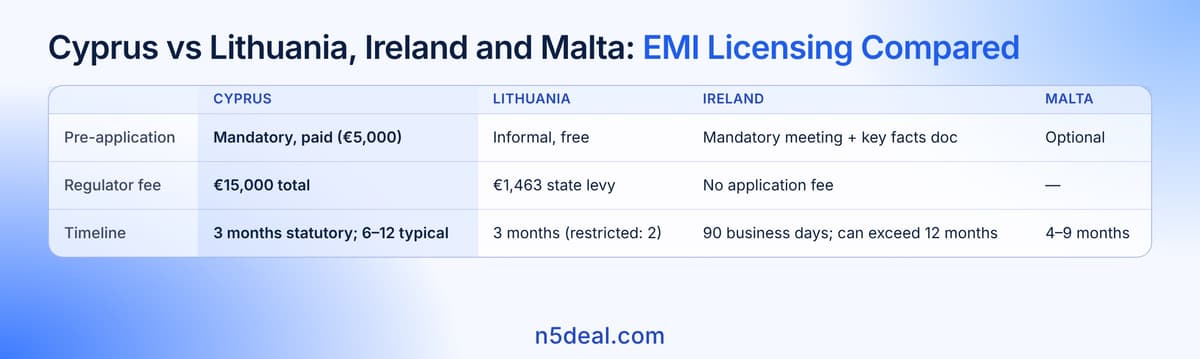
Cyprus is now the only one of the four with a paid pre-application stage, and its regulator fees total €15,000.
Lithuania. Three months from a complete file, or two months for a restricted EMI licence. The state levy is €1,463, and the Bank of Lithuania encourages informal early contact without a fee.
Ireland. A pre-application meeting and a 15- to 20-page key facts document are mandatory, but there is no application fee. The Central Bank's service standard is 90 business days for assessment, and it says the whole process can take more than twelve months.
Malta. Pre-application consultation is optional, and authorisation typically takes four to nine months from a complete file.
The wider comparison of the three Mediterranean and Baltic options is in Lithuania vs Malta vs Cyprus: Which EMI Licence Wins in 2026.
Is it faster to buy an existing Cyprus EMI?
Usually. An acquisition skips both the pre-application stage and the new-licence assessment, and needs prior CBC approval of the buyer as a new qualifying holder instead. The buyer's owners face the same reputation test the pre-application stage now applies to new applicants, so the source of funds and group structure must be ready before signing.
PSD3 affects both routes. Under the text agreed in April 2026, existing EMIs and payment institutions must file for re-authorisation within 21 months of its entry into force and may keep operating for up to 27 months. A licence bought now carries that filing with it, as set out in EMI Licence Under PSD3.
Checklist: before filing the Cyprus pre-application document
Owner file. Identity, reputation, source of wealth and source of funds for every ultimate beneficial owner, plus the group chart.
EDD readiness. Assume the CBC may order an independent enhanced due diligence report and budget for it.
Business model. Products, target markets, expected volumes, safeguarding method and banking partners, written for a risk assessment.
Local substance. Cyprus office, management based in Cyprus and a named anti-money-laundering compliance officer.
Capital. €350,000 for an EMI, available and evidenced, with a plan for own funds above 2% of outstanding e-money.
Meeting preparation. Owners attend the CBC meeting, so brief them on the business plan and controls.
Response capacity. Unanswered CBC comments can lead to deemed withdrawal, so assign someone to reply within the deadlines.
Buy-or-apply check. Compare an eight- to fifteen-month application with the change-of-control route on an existing licence.
Find a Cyprus EMI
Authorised EMIs in Cyprus and across the EU are listed in N5Deal's catalogue of licensed companies for sale. If you own a Cyprus EMI or payment institution, the new pre-application stage makes existing licences scarcer: a free valuation shows what that is worth.
Disclaimer
This article is general commentary on Cyprus e-money and payment institution licensing as it stood in October 2026. It is not legal, regulatory or investment advice, and nothing here guarantees an authorisation, approval or transaction outcome. CBC procedures and fees may change; check current requirements with the Central Bank of Cyprus and take advice from a qualified lawyer before applying or buying a regulated entity.
Comments
Frequently Asked Questions
Clear, concise info to help you understand the process!