

Under the PSD3 text agreed in April 2026, the EMI stops being a separate licence and e-money becomes a service of a payment institution. Existing EMIs must file for re-authorisation within 21 months of entry into force and may operate for up to 27. Buying an EMI today means inheriting that filing.
What changes for an EMI: today versus the agreed PSD3 text
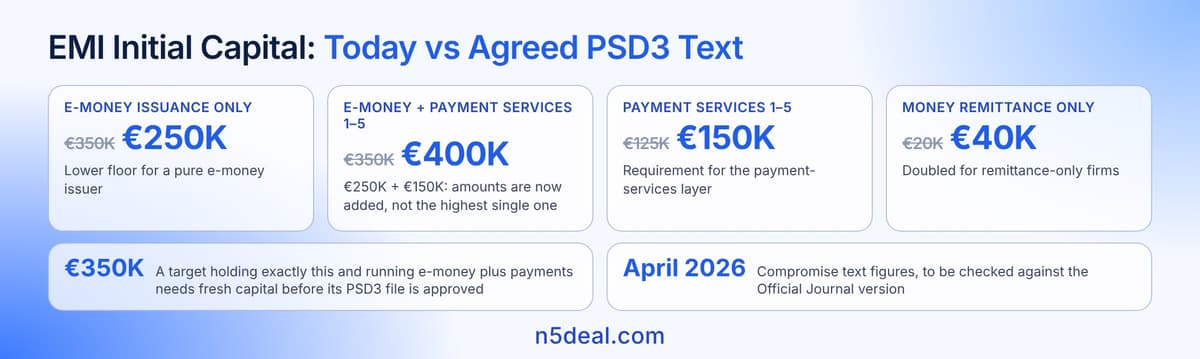
Under the agreed text, an EMI becomes a payment institution authorised to issue e-money. Initial capital for e-money issuance alone falls from €350,000 to €250,000, but the amounts for each service are now added together, so e-money plus payment services 1–5 rises to €400,000, and money remittance alone doubles from €20,000 to €40,000. Client funds must be safeguarded by the end of the business day after receipt. Banks may refuse or close a payment institution's account only on serious grounds, and must give reasons. The re-authorisation file adds a winding-up plan, DORA evidence and a three-year history of licence applications, refusals included.
Both PSD3 and the Payment Services Regulation enter into force 20 days after publication in the Official Journal. As of early October 2026 neither had been published, so the 21- and 27-month deadlines still run from a date that has not been fixed.
What happens to EMI licences under PSD3?
The licence disappears as a category, but the business it covers does not. PSD3 repeals the second E-Money Directive (2009/110/EC) and treats issuing electronic money as one of the services a payment institution can be authorised for.
The legislative track is close to the end. The Council and the Parliament reached a provisional agreement on 27 November 2025. COREPER endorsed the compromise texts on 22 April 2026 and the Council published them the next day. The Parliament's ECON committee approved PSD3 on 5 May 2026 by 55 votes to 3, with 5 abstentions. Adoption at second reading was expected in the second half of 2026, after which publication in the Official Journal fixes every deadline in this article.
From entry into force, member states have 21 months to transpose PSD3, and the Payment Services Regulation applies from the same point. The PSR's verification-of-payee provisions follow six months later.
Do existing EMIs have to reapply?
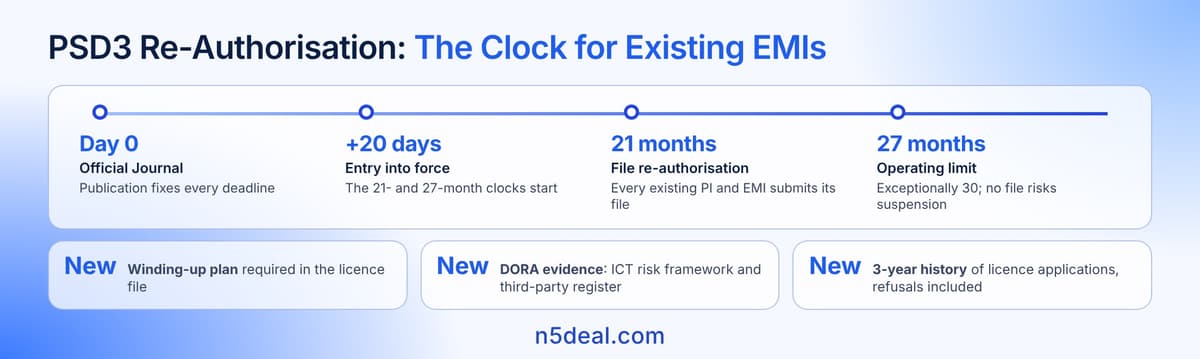
Yes, in substance. Within 21 months of PSD3 entering into force, every existing payment institution and EMI must submit the information its regulator needs to confirm it meets the new requirements.
A firm that files can keep operating until the 27-month mark, or 30 months where its authority grants an exceptional extension. A firm that does not file risks suspension. Member states may treat firms that already comply as authorised automatically, and the Dutch central bank, DNB, has said it will reassess existing institutions and can do exactly that.
The new file is heavier than a PSD2 application in three places. It needs a winding-up plan, evidence of compliance with the Digital Operational Resilience Act, and a three-year history of licence applications made by the firm, including any that were refused. That last item means a target's past refusals in other countries become part of its PSD3 file whether or not they appear in a data room.
How much capital will an EMI need under PSD3?
For e-money issuance alone, less: €250,000 instead of €350,000. For an EMI that also provides payment services, more: €400,000 instead of €350,000.
The change comes from how the amounts combine. Today, an EMI providing payment services holds the single highest requirement. Under the agreed text, the requirement for each authorised activity is added together, so e-money issuance (€250,000) and payment services 1–5 (€150,000, up from €125,000) total €400,000. An institution that also offers money remittance would need to check whether that activity adds a further amount under its home regulator's reading of the final text.
These figures come from the April compromise text and need checking against the version published in the Official Journal. They already matter for pricing: a target that holds exactly €350,000 and runs both e-money and payment services will need fresh capital before its PSD3 file is approved.
Until PSD3 applies, initial capital for an EMI is €350,000 in every EU member state. What differs between countries is the clock and the passport.
Lithuania (Bank of Lithuania): three months from a complete file for a new licence, and prior approval for qualifying holdings. A full licence passports across the EEA; the restricted licence does not. The Bank supervised 76 EMIs in 2024.
Ireland (Central Bank of Ireland): 90 working days for the assessment stage once a file is accepted. A qualifying holding is assessed within 60 working days, with a pause of 20 for an EU acquirer or 30 for a non-EU one. There is no authorisation fee.
Netherlands (DNB): 13 weeks from a complete file. A declaration of no objection takes 60 working days plus one pause of up to 30. DNB can treat compliant firms as authorised under PSD3.
Malta (MFSA): capital must be fully paid up. No statutory timeline applies; four to nine months is reported. A change of control needs prior MFSA consent.
Cyprus (Central Bank of Cyprus): since 3 August 2026, a mandatory pre-application stage comes first, with a €5,000 fee and a 30-working-day assessment, or 50 with enhanced due diligence.
United Kingdom (FCA): three months for a complete application, twelve for an incomplete one. A change of control has 60 working days and took a median of 36 days in the second quarter of 2025/26. UK EMIs have no EU passport, PSD3 does not apply to them, and new safeguarding rules have applied since 7 May 2026.
Is it still worth buying an EMI before PSD3 applies?
It can be, provided the price reflects the re-authorisation work the buyer takes on. The change-of-control route is still shorter than a new licence, and demand for licensed e-money capacity has grown in 2026.
On timing, the clearest data comes from the UK, where the FCA publishes its metrics. Change-in-control decisions in the second quarter of 2025/26 had a median of 36 calendar days across 290 cases. New payments and e-money authorisations in the first quarter of 2026 had a median of around 207 days. EU authorities publish less, but Ireland's qualifying-holding clock is 60 working days against a 90-working-day assessment stage that begins only once a licence file has been accepted.
On supply, Lithuania's figures show a market consolidating rather than growing. In 2024 the Bank of Lithuania issued 3 new EMI and PI licences, revoked 9 and approved 12 acquisitions. In 2025 it again issued 3 new licences, against 7 acquisitions and 5 cessations. It revoked PAYTEND EUROPE UAB's EMI licence with effect from 3 March 2026 for systematic AML and internal-control failures.
On demand, two 2026 events pushed crypto firms towards e-money licences. The EBA's no-action period on the interplay between PSD2 and MiCA ended on 2 March 2026, so CASPs handling e-money tokens now need a payment licence or a licensed partner. In January 2026, acquired Blue EMI, a Lithuanian EMI that issues euro stablecoins.
Two operating costs arrive regardless of PSD3. Under the Instant Payments Regulation, EMIs and payment institutions in the euro area must be able to send and receive instant euro payments by 9 April 2027. Under PSD3 itself, client funds must be safeguarded by the end of the business day after receipt, and holding them all at one bank is discouraged.
The Electronic Money Institution (EMI) licence page covers what the licence permits today. For a country view, the E-Money Institution licence in Lithuania page lists the local requirements
PSD3 readiness checklist for an EMI acquisition
N5Deal checks the owner's identity, proof of ownership, licence status, company status and public adverse media before an EMI is listed. The items below are the buyer's own due diligence and focus on what PSD3 adds.
Capital headroom. Compare current own funds with €400,000 if the target issues e-money and provides payment services, and agree in the purchase price who funds any shortfall.
Licence application history. Ask the seller for every licence application made by the entity in the last three years, in any country, with outcomes. PSD3 will require it anyway.
Winding-up plan. Check whether one exists and whether it would survive the regulator's review. If not, budget for writing it.
DORA file. Request the ICT risk framework, register of ICT third-party arrangements and incident log.
Safeguarding mechanics. Confirm how quickly incoming funds reach the safeguarding account today and how many banks hold client money. A single-bank set-up needs fixing before PSD3 applies.
Instant payments readiness. For a euro-area target, ask for the plan to send and receive SEPA Instant by 9 April 2027.
Who files for re-authorisation. If the PSD3 deadline is likely to fall after closing, the buyer files. Write the timetable and the seller's cooperation duties into the agreement.
Regulatory correspondence. Read the last three years of letters from the home regulator. A pending inspection finding will follow the licence into the PSD3 review.
Browse EMIs for sale
Authorised EMIs across the EU and the UK are listed in N5Deal's catalogue of licensed companies for sale. If you own an EMI and the PSD3 file looks like more work than you want to take on, a free valuation shows what the licence is worth to a buyer who will.
Disclaimer
This article is general commentary on the EU e-money and payment services framework as it stood in October 2026. PSD3 and the Payment Services Regulation had not been published in the Official Journal when it was written; capital amounts and deadlines are taken from the compromise texts of April 2026 and may differ in the final version. Nothing here is legal, regulatory or investment advice, and nothing guarantees an authorisation, approval or transaction outcome. Check requirements with the relevant national authority and take advice from a qualified lawyer before buying or selling a regulated entity.
Comments
Frequently Asked Questions
Clear, concise info to help you understand the process!