

Lithuania Malta Cyprus EMI licence comparison is the decision that sits at the centre of most EU payment infrastructure conversations in 2026. Lithuania is the EU's highest-volume EMI hub — over 200 licensed entities on the Bank of Lithuania register as of July 2026. Malta offers the most tax-efficient effective corporate rate available inside the EU. Cyprus is the natural pairing jurisdiction for operators who need both an EMI and a MiCA CASP authorisation under a single supervisor. No single jurisdiction wins the comparison outright. Each one wins on a specific axis, and the correct answer is determined by what the operator actually needs — timeline, tax structure, regulatory pairing, or banking access.
Key Takeaways
Lithuania Malta Cyprus EMI licence comparison resolves to three distinct profiles — Lithuania for speed and ecosystem depth, Malta for effective tax rate, Cyprus for the EMI and CASP dual-structure under one national competent authority
Lithuania's Bank of Lithuania charges a statutory application fee of €1,463 and targets a 3-month review from a complete application — the fastest and lowest-cost full EMI route in the EU, with CENTROLINK direct SEPA access and English throughout
Malta's effective corporate tax rate is approximately 5% through the shareholder refund mechanism, against a 35% nominal rate — the lowest effective rate in the EU — but the €10,000 application fee, 9 to 12 month end-to-end timeline, and banking access constraints are material trade-offs
Cyprus charges 12.5% corporate tax, processes applications in 6 to 9 months, and allows a single entity to hold both EMI authorisation under EMD2 and CASP authorisation under MiCA from CySEC — the architecture that dual-function crypto-fiat operators require
Post-authorisation supervision in Lithuania has intensified given the jurisdiction's large EMI cluster — several 2023 and 2024 authorisations were revoked for substance failures, and the Bank of Lithuania's substance requirements are enforced, not aspirational
Lithuania: Speed, Depth, and Direct SEPA Access
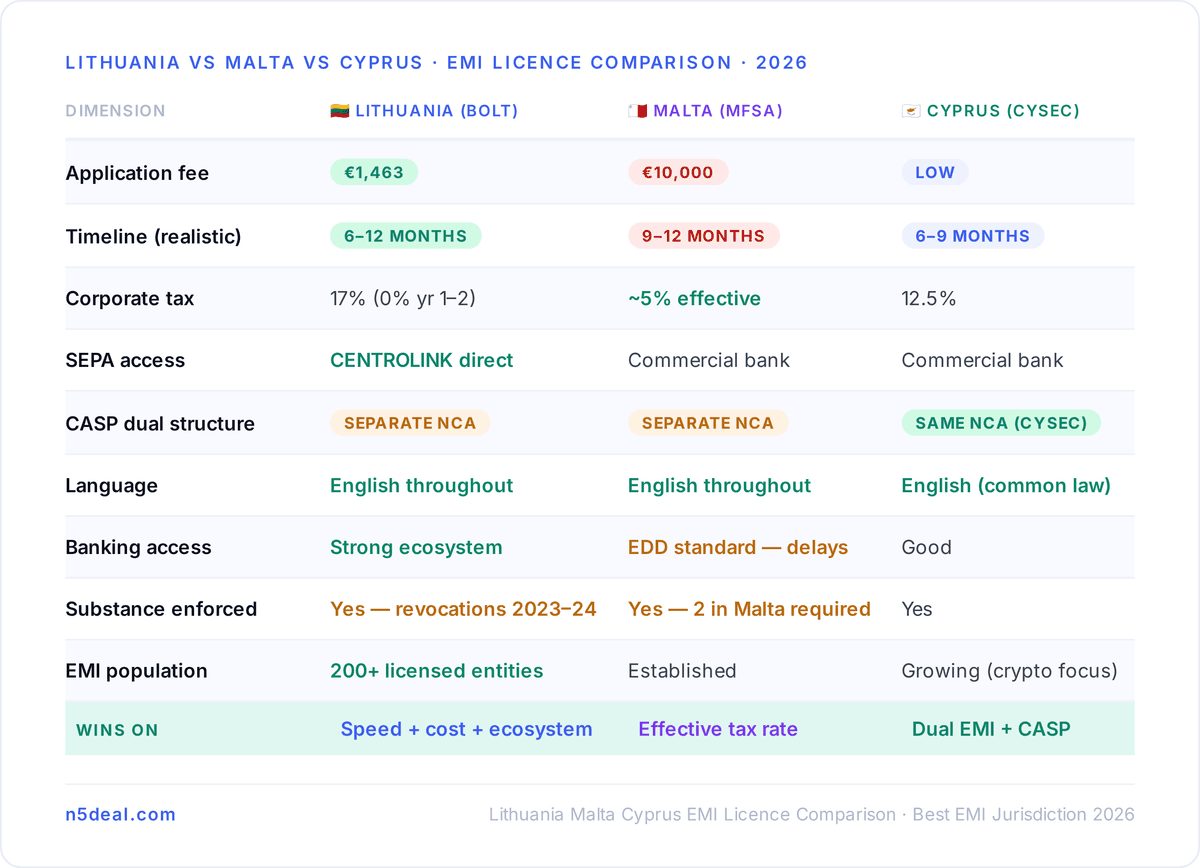
The Bank of Lithuania has licensed more than 90 EMIs since 2017, including Revolut before its upgrade to a Lithuanian specialised bank, Flywire, Banking Circle, Checkout, Contis, and Paysafe — and a long tail of neobanks and BaaS providers. The reasons are practical: every exchange with the regulator, every document, and every meeting can be in English, rare outside Ireland, the Netherlands, and Malta. Statutory review is 3 months from a complete application, with realistic timelines of 6 to 12 months — less than half the Ireland or Germany clock.
Lithuania's statutory application fee of €1,463 is the lowest among tier-1 EU EMI jurisdictions. The Bank of Lithuania runs a structured pre-application newcomer programme and a sandbox for innovative business models — giving applicants a direct dialogue with the regulator before committing to a full application. CENTROLINK provides direct SEPA access, reducing dependence on commercial correspondent banks for EUR settlement in a way that no other EU jurisdiction replicates at scale.
The substance requirements are real and enforced. Board meetings, strategic decisions, and material risk calls must happen locally. The head of risk and head of compliance report to the Lithuanian board, not to a group CEO abroad. Firms that fail substance are either refused or granted with conditions that require substance to be built within 6 months of licence, failing which the licence is revoked — several 2023 and 2024 authorisations were revoked on exactly this basis. Corporate income tax rose to 17% from January 2026, though new small companies benefit from a 0% rate for the first two years.
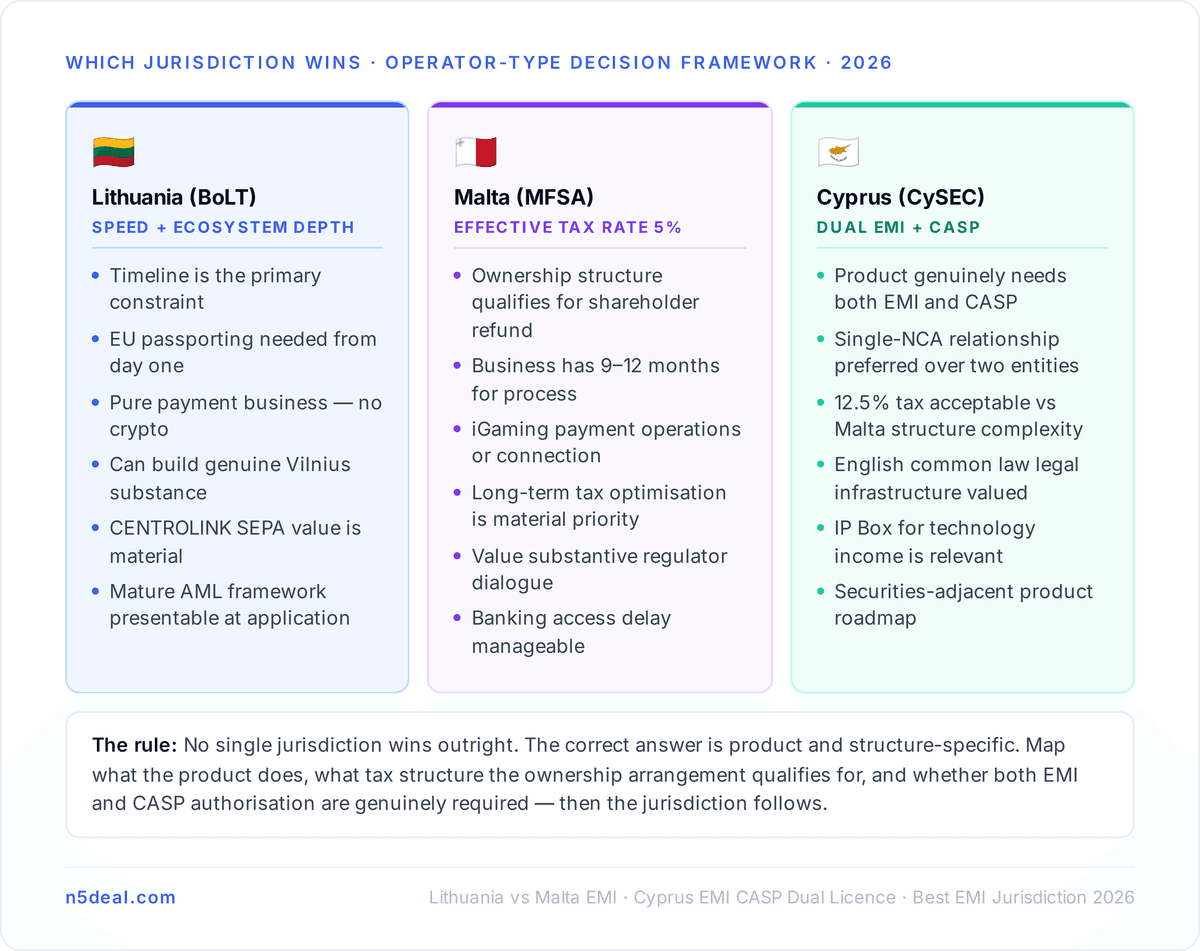
Lithuania remains attractive for fast-scaling fintechs and crypto businesses that can present a mature AML framework from day one — but firms should factor in the intensified post-authorisation supervision that accompanies the jurisdiction's large EMI and PI cluster. Lithuania is the right answer when timeline is the primary constraint, EU passporting is needed from day one, and the operator can build genuine substance in Vilnius.
Malta: The Tax Argument and Its Trade-Offs
Malta's 5% effective corporate tax rate is the number that drives most initial interest in the jurisdiction. Malta's nominal corporate tax rate is 35%, but under the full imputation system, shareholders can claim refunds of up to 6/7ths of Malta corporate tax on distributed dividends — resulting in an effective rate of approximately 5% for non-Maltese shareholders. That effective rate is the lowest achievable inside the EU for a properly structured EMI, and for operators with significant retained earnings or large dividend distributions, the long-term tax differential against Lithuania's 17% or Cyprus's 12.5% is material.
The trade-offs are specific and documented. The €10,000 MFSA application fee applies from January 2025 — the highest stated application fee among the three. A complete file triggers up to a six-month MFSA decision window, but real projects run 9 to 12 months end-to-end. Banking remains a constraint — safeguarding and operating account onboarding involves risk-based enhanced due diligence that regularly extends go-live timelines beyond the regulatory decision date. Letterbox models attract remediation or delay; the MFSA requires effective direction by two individuals in Malta, plus autonomous compliance and MLRO roles.
Malta appeals to firms that value an established, dialogue-oriented regulator and are prepared to meet the MFSA's detailed safeguarding and operational-resilience requirements — particularly relevant following the May 2026 MFSA circular on investment of client funds. It is also the natural home for iGaming payment operators, given Malta's position as the EU's dominant iGaming regulatory hub and the banking relationships that come with operating in the MGA ecosystem. A Malta EMI licence does not automatically cover MiCA CASP activities — operators who need both require separate authorisation from CySEC or another competent authority.
Malta is the right answer when the ownership structure genuinely qualifies for the shareholder refund mechanism, the business has time for a 9 to 12 month end-to-end process, and the operator's commercial model connects to Malta's iGaming and crypto intersection.
Cyprus: The Dual-Structure Advantage
Cyprus is the jurisdiction that resolves the most specific architectural problem in EU fintech licensing: the operator who needs both an EMI and a MiCA CASP authorisation from the same supervisor. A single Cyprus entity can hold EMI authorisation under EMD2 and CASP authorisation under MiCA, both issued by CySEC — the combination that the common architecture for retail crypto fintechs in 2026 requires, without the complexity of operating two licensed entities in two separate jurisdictions.
Capital is €350,000 for a full EMI. Timeline is 6 to 9 months. Corporate tax is 12.5% — matching Ireland's rate while processing faster and at lower professional fees. Cyprus uses English common law, which simplifies the legal infrastructure for international operators and post-Brexit relocations. The IP Box regime applies a 2.5% effective rate on qualifying intellectual property income, adding a further tax efficiency layer for technology-driven EMI operators.
The CySEC supervisory style differs from the Bank of Lithuania's volume-based familiarity with payment institutions. CySEC primarily licenses investment firms rather than payment institutions — Lithuania is the natural choice for operators whose primary business is payment services rather than securities dealing. For operators whose business genuinely sits at the intersection of payment services and crypto-asset services, or who intend to build toward securities-adjacent products, Cyprus provides a single supervisory relationship that covers the full commercial scope.
Cyprus is the right answer when the product genuinely requires both EMI and CASP authorisation, the 12.5% tax rate is preferable to Malta's 5% effective rate given the ownership structure's complexity, and the operator benefits from a single-NCA regulatory relationship covering the full product stack.
Conclusion
Lithuania Malta Cyprus EMI licence comparison produces three correct answers depending on what the operator is optimising for. Lithuania wins on speed, application cost, and regulatory ecosystem depth for pure payment businesses. Malta wins on effective tax rate for qualifying ownership structures prepared to invest in substance and manage banking access constraints. Cyprus wins on dual-structure efficiency for operators who need both EMI and CASP under one supervisor. For buyers evaluating existing licensed entities across all three jurisdictions, N5Deal catalogues EMI-licensed entities with documented authorisation scope and compliance history. A full overview of available assets is at n5deal.com.
Disclaimer
This page is for informational purposes only. It does not constitute legal, financial, or regulatory advice. Readers should consult qualified professionals before making any decisions.
Comments
Frequently Asked Questions
Clear, concise info to help you understand the process!