
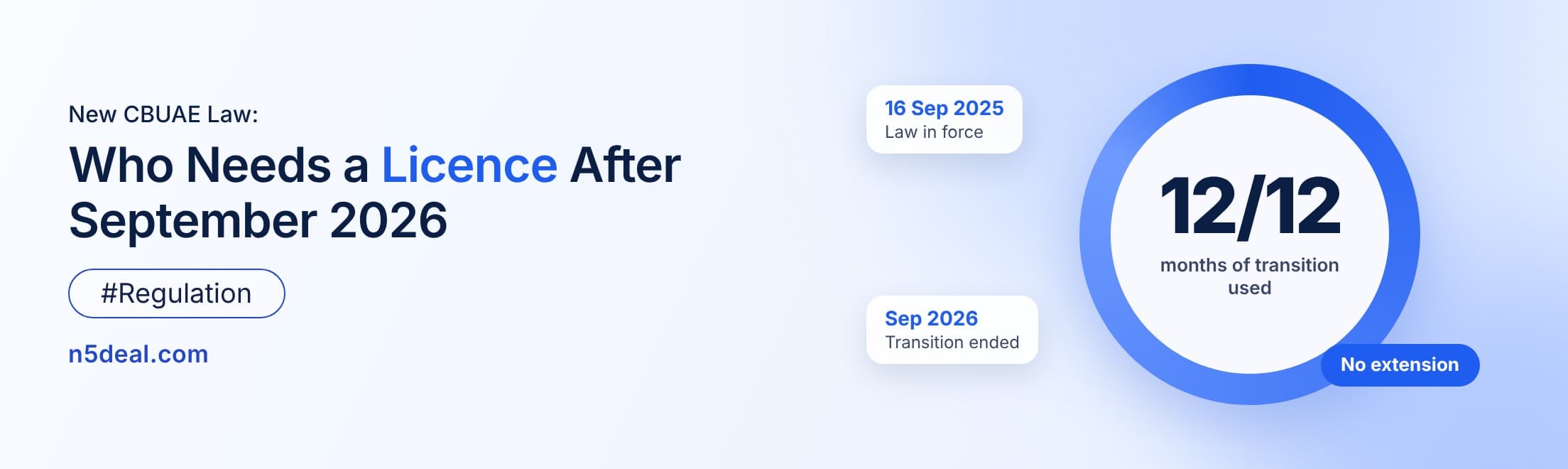
The one-year transition under the UAE's new Central Bank law ended in mid-September 2026, and no general extension was announced. Anyone carrying out, offering or facilitating a licensed financial activity onshore, through any technology including DeFi protocols and virtual-asset payment tokens, now needs a CBUAE licence or faces fines from AED 1 million.
The new CBUAE law in numbers
The law. Federal Decree-Law No. 6 of 2025, issued on 8 September 2025 and in force since 16 September 2025. It replaces the 2018 Central Bank law and folds insurance into the same framework.
Transition. One year to comply under Article 184, ending in mid-September 2026. No blanket extension was granted.
Administrative fines. Up to AED 1 billion for institutions, with a minimum of AED 1 million for unlicensed activity or its promotion. Individuals face fines of up to AED 5 million, and managers can be held personally liable.
Criminal penalties. Unlicensed activity carries a fine of AED 50,000 to AED 500 million, imprisonment, or both.
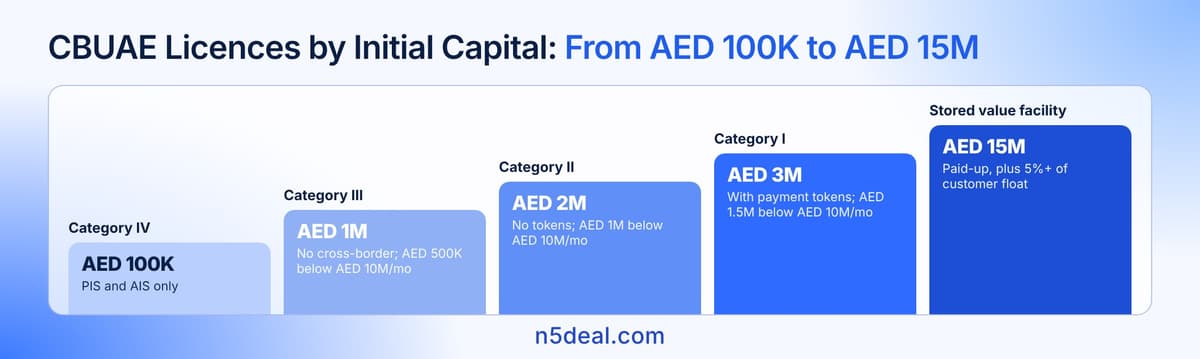
Licence capital. Retail payment services licences need AED 100,000 to AED 3 million depending on category. A stored value facility needs AED 15 million paid-up capital.
Market. As of 2025 the CBUAE counted 16 licensed stored value facilities, 13 firms holding both stored value and retail payment licences, and one payment token provider.
What changed under Federal Decree-Law No. 6 of 2025?
The licensing net became technology-neutral. Article 62 requires a licence for anyone who carries out, offers, issues or facilitates a licensed financial activity "by any medium or technology". That expressly covers virtual-asset payment tokens, decentralised finance, platforms, decentralised applications, protocols and the technology infrastructure behind them.
Article 61 lists the licensed activities: deposit-taking, credit, open finance, money transfer, payment services using virtual assets, stored value and digital money, and insurance. Promoting or marketing any of them is now a licensed activity in its own right, and licensed activities may be offered only from within the UAE.
Regulations issued under the old law, including the payment, stored value, payment token and open finance rules, stay in force until expressly replaced.
Who needs a CBUAE licence now?
Every firm serving onshore UAE customers with a listed activity, including technology providers that facilitate one. A payment gateway, a wallet holding customer balances, an API platform initiating payments or a DeFi protocol used for payments onshore falls inside the law, whatever its legal form.
Firms that are unsure whether they are in scope need either a licence or a documented view from the CBUAE that their activity falls outside it. Running on the assumption that a technology label keeps a business out is the position Article 62 was written to close.
Does the new law apply in ADGM, DIFC and to VARA licensees?
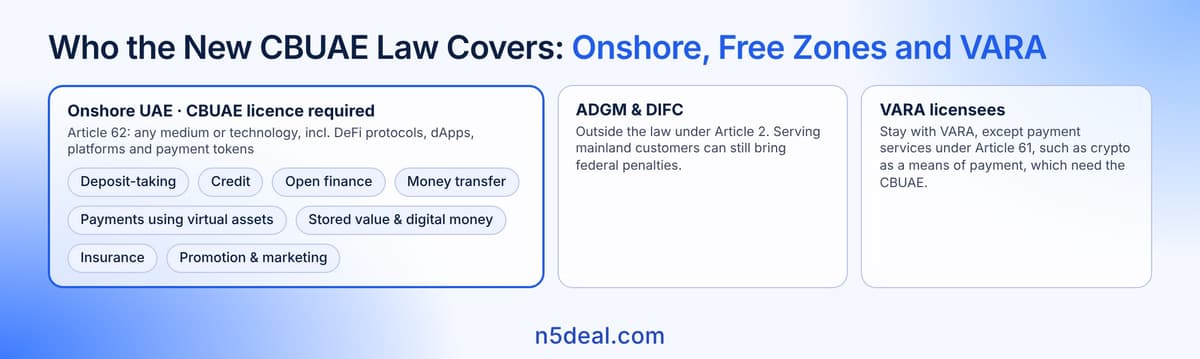
Not inside the financial free zones. Article 2 excludes ADGM, DIFC and the institutions their regulators supervise. Firms there that serve onshore customers can still be exposed to federal penalties, so the line between serving the free zone and serving the mainland matters.
VARA said in a market alert on 27 November 2025 that virtual-asset providers remain under VARA or the federal securities regulator, except where an activity is a payment service under Article 61, such as using crypto as a means of payment or holding stored value for retail payments. Those activities need the CBUAE. How the free zones and VARA compare for crypto firms is set out in Crypto Adoption in the Gulf: ADGM, DIFC, and VARA Compared.
Which CBUAE licence does a payment business need?
It depends on what the business does with funds and tokens.
Retail payment services, Category I. All payment services plus payment token services. Initial capital AED 3 million, or AED 1.5 million below AED 10 million in monthly volume.
Category II. The same services without payment tokens. AED 2 million, or AED 1 million.
Category III. As Category II, without cross-border transfers. AED 1 million, or AED 500,000.
Category IV. Payment initiation and account information only. AED 100,000.
Stored value facility. For wallets and stored balances. AED 15 million paid-up capital plus capital of at least 5% of customer float.
Payment token services. Issuing dirham-backed tokens, custody and transfer, or conversion. Dirham tokens can be issued only by UAE-resident firms and may not pay interest, and foreign stablecoins need CBUAE registration.
Open finance provider. Data sharing or payment initiation through the CBUAE's API hub.
Recent entrants show which licences large players chose: Revolut received stored value and Category II licences in June 2026, and Ant International received Category II and stored value licences in October 2026. The Payment Service Provider License in United Arab Emirates page lists the requirements, and token issuers start from the Payment Token Services License in United Arab Emirates.
Is buying a licensed UAE firm faster than applying?
Usually, because the licence already exists and the buyer needs only prior approval as a new controller. For retail payment firms that approval is required before anyone reaches 20% of shares or votes. Stored value facilities need approval for any new controlling shareholder, and banks for any stake of 5% or more, with 1% stakes notified.
The CBUAE still assesses the buyer closely. Its 2026 enforcement, including a AED 20 million fine on a foreign bank branch for anti-money-laundering failures with a personal fine on its compliance head, shows the weight it puts on controls after closing.
Checklist: firms caught by the new CBUAE law
Map activities to Article 61. List every service you provide onshore and mark which are licensed activities, including marketing.
Check the technology test. If your platform, API or protocol facilitates payments, stored value or credit, Article 62 applies.
Confirm your location. ADGM or DIFC firms serving only the free zone are outside the law; serving mainland customers changes that.
Choose the licence. Retail payment category, stored value facility, payment token services or open finance, with the matching capital.
Stop unlicensed promotion. Marketing a licensed activity is itself licensed, so pause campaigns aimed at onshore customers until you are covered.
Get it in writing. If you believe you are out of scope, seek a documented CBUAE view rather than relying on your own reading.
Compare buy and apply. An acquisition needs controller approval at 20% for payment firms; a new application starts from nothing.
Prepare the controller file. Source of funds, group structure and the compliance team the CBUAE will expect to stay after closing.
Disclaimer
This article is general commentary on Federal Decree-Law No. 6 of 2025 and related CBUAE regulations as they stood in October 2026. It is not legal, regulatory or investment advice, and nothing here guarantees a licence, an approval or a transaction outcome. Implementing regulations may change the position; check current requirements with the Central Bank of the UAE and take advice from a UAE-qualified lawyer before acting.
Comments
Frequently Asked Questions
Clear, concise info to help you understand the process!