
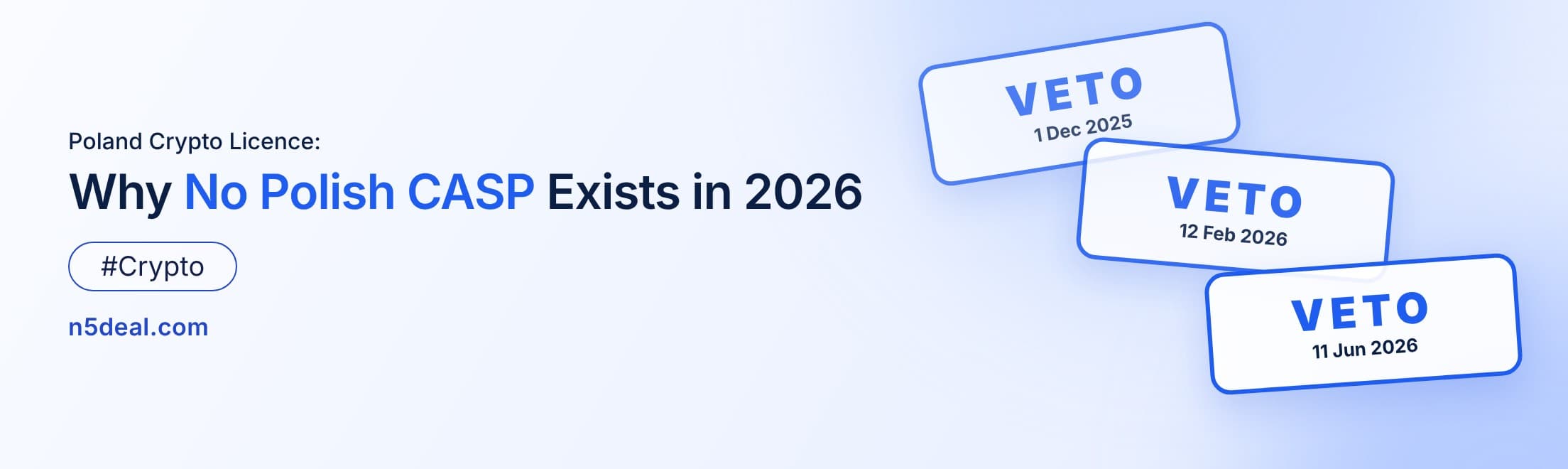
No Polish company can obtain a MiCA licence at home in 2026. President Nawrocki vetoed the crypto-assets act three times, the last on 11 June 2026, so Poland has no authority designated to authorise crypto-asset service providers. Since 1 July 2026, Polish clients are served only by CASPs licensed elsewhere in the EU.
Poland's crypto vacuum in numbers
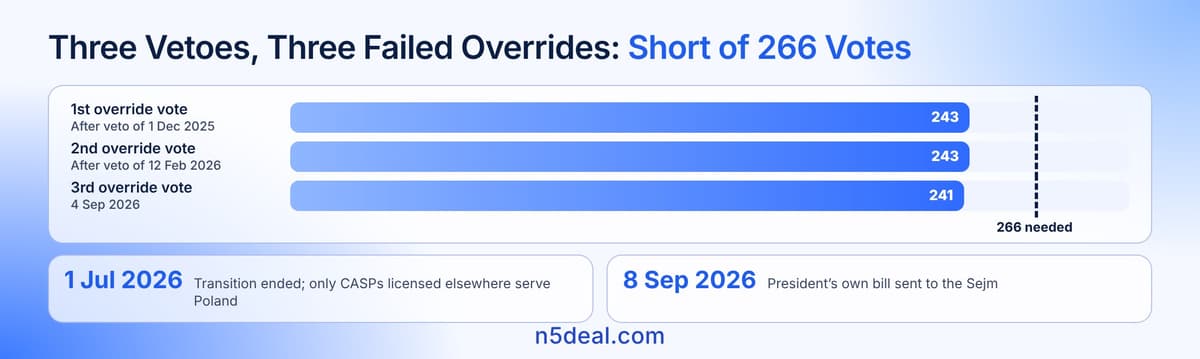
Vetoes. 1 December 2025, 12 February 2026 and 11 June 2026. Each override vote failed: 243–192, 243–191 and, on 4 September 2026, 241–198, when 266 votes were needed.
Transition. Poland never shortened MiCA's transitional period, so it ended on 1 July 2026.
Old register. The VASP register kept by the tax chamber in Katowice had about 1,841 entries, 1,189 of them active, in May 2026. Registration cost a PLN 616 stamp fee. Since 2 July 2026, an entry gives no right to operate.
Users. A National Bank of Poland survey in May 2026 found 6.4% of adults hold crypto-assets.
Loss. Zondacrypto's operator was declared bankrupt in Estonia on 27 August 2026, with debts of at least EUR 431.9 million.
Pending bill. The President's office submitted its own crypto bill to the Sejm on 8 September 2026.
Can you get a CASP licence in Poland in 2026?
No. MiCA requires each member state to designate a competent authority, and Poland's designation was in the vetoed act. The financial supervisor's office (UKNF) says it cannot accept CASP applications, and that neither a Polish statute nor a KNF decision could extend the transitional period after 1 July 2026. The KNF is competent only for issuers of e-money tokens.
A Polish founder who wants a MiCA licence must apply in another member state and passport back into Poland. The routes are listed under Poland Crypto Licenses.
Why did the Polish president veto the crypto bill?
He called it overregulation. Vetoing the third version on 11 June 2026, President Nawrocki said it was nearly identical to the two bills he had already rejected and that only one of the 16 changes his office proposed had been adopted: an annual market report by the KNF and the finance ministry. He said he would sign a revised version.
The vetoed text gave the KNF power to freeze accounts and transactions for 96 hours, extendable to six months, and to keep a register of blocked illegal websites. It set penalties of up to PLN 5 million and five years in prison for providing crypto services without a licence. The President's own bill of 8 September 2026 keeps that structure but adds court approval to extend freezes, mandatory investor warnings and state compensation for wrongful freezes.
What happened to firms on the Polish VASP register?
They lost the right to operate. Under MiCA and ESMA's statements of April and June 2026, every provider without a CASP licence had to carry out a wind-down plan by 1 July 2026: tell clients, let them withdraw or move assets to an authorised CASP or self-custody, and keep custody only as long as the exit needed. The tax chamber told clients from 2 July that registered firms were not authorised and that their assets had no deposit guarantee.
The register showed why regulators cared. About 95% of entries were made after February 2022, and 38 firms had beneficial owners in Belarus or Russia. What happened to unlicensed providers across the EU is covered in VASPs That Missed the MiCA Deadline: What Happened Next.
Can a MiCA licence from another EU country be used in Poland?
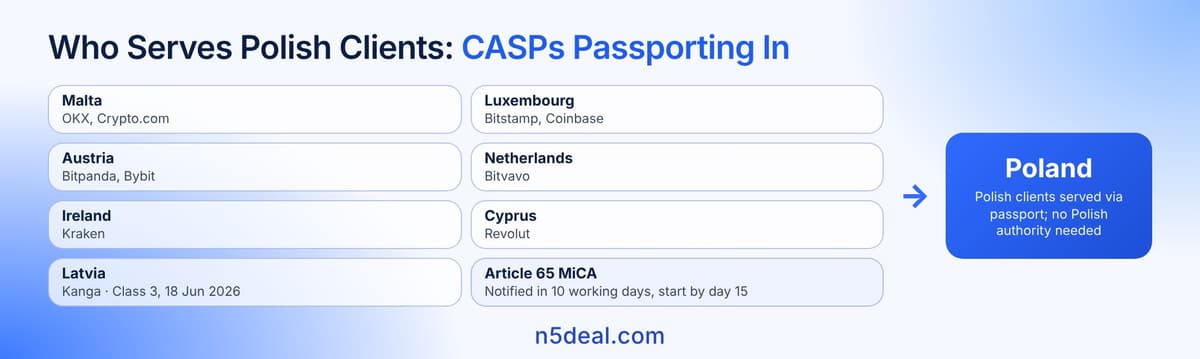
Yes. Passporting under Article 65 of MiCA runs through the home regulator, which forwards the notification within 10 working days, and services can start no later than day 15. No Polish authority is needed, and the UKNF confirms cross-border services into Poland continue.
Most large platforms already serve Polish clients that way: OKX and Crypto.com from Malta, Bitstamp and Coinbase from Luxembourg, Bitpanda and Bybit from Austria, Bitvavo from the Netherlands, Kraken from Ireland and Revolut from Cyprus. Polish exchange Kanga took the same route: Latvia's central bank authorised its EU entity as a Class 3 CASP on 18 June 2026.
How did Zondacrypto change the debate?
It turned a regulatory gap into a loss for Polish clients. Zondacrypto operated through BB Trade Estonia OÜ, which was on the Polish register from August 2023 but licensed in Estonia. Estonia's Financial Intelligence Unit suspended part of its licence on 18 May 2026 and revoked it on 29 June 2026. A Tallinn court declared the company bankrupt on 27 August 2026, with debts of at least EUR 431.9 million and around 1,500 injured parties in the Polish criminal case.
Prosecutors in Katowice opened their investigation on 17 April 2026, the day the second override vote failed. Supporters of the act cite the case as proof that Poland needs its own supervisor; the President's camp argues that the act's freezing powers go too far.
Checklist: serving Polish crypto clients in 2026
Choose a home state. Apply for MiCA authorisation in a member state with a working regulator; Polish founders have used Latvia.
Plan substance there. Registered office, effective management and at least one resident director in the home state.
File the passport. List Poland in the Article 65 notification and confirm the date services may start.
Close the Polish VASP entity properly. Document the wind-down, client notices and asset transfers, which any future regulator or buyer will ask for.
Write Polish-language disclosures. Marketing to Polish clients still follows MiCA's rules from the home state.
Watch the Sejm. If a Polish act passes, the KNF becomes the authority and domestic applications open.
Consider buying. Acquiring an authorised CASP in another member state needs approval of the buyer, not a new licence.
Find an authorised CASP
MiCA-authorised companies in Latvia, Lithuania, Malta, Cyprus and other member states are listed in N5Deal's catalogue of licensed companies for sale. If you own one that already passports into Poland, a free valuation shows what that access is worth while Poland has no regulator.
Disclaimer
This article is general commentary on crypto-asset regulation in Poland as it stood on 28 October 2026. The legislative position may change quickly. It is not legal, regulatory or investment advice, and nothing here guarantees an authorisation, approval or transaction outcome. Take advice from a qualified Polish or EU regulatory lawyer before acting.
Comments
Frequently Asked Questions
Clear, concise info to help you understand the process!