
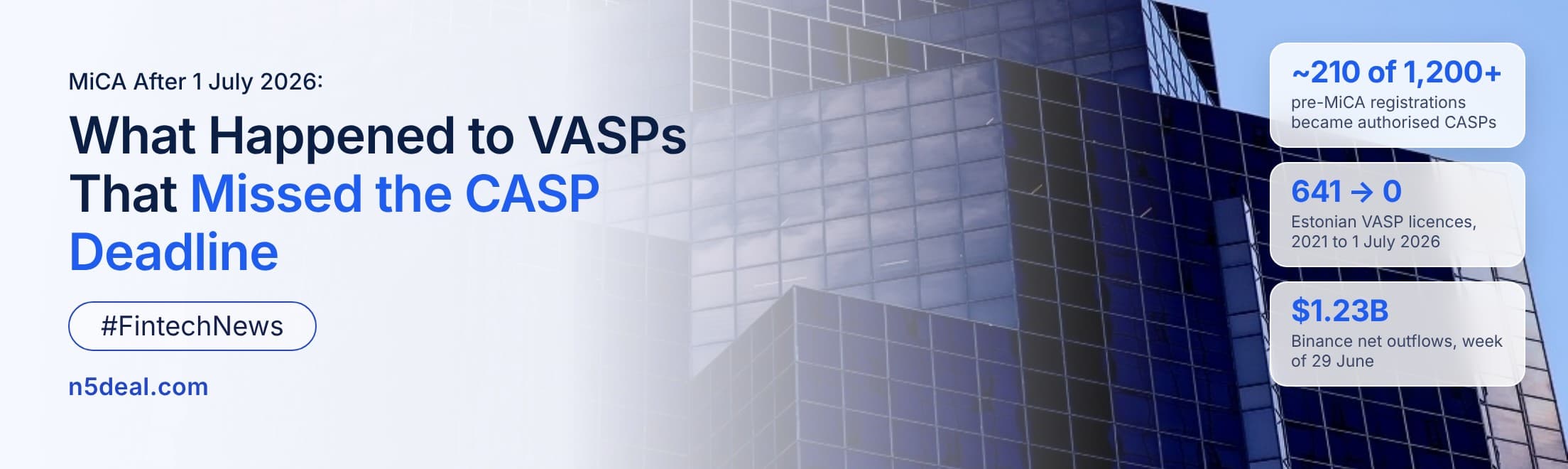
VASPs without a MiCA licence on 1 July 2026 had to stop onboarding and marketing, keep withdrawals open and wind down. Estonia cancelled every remaining crypto licence that day, France and Italy blacklisted and blocked sites, and BaFin refused operator in October. Getting back to EU clients now takes a new authorisation or an authorised CASP.
Where the unlicensed VASPs went, country by country
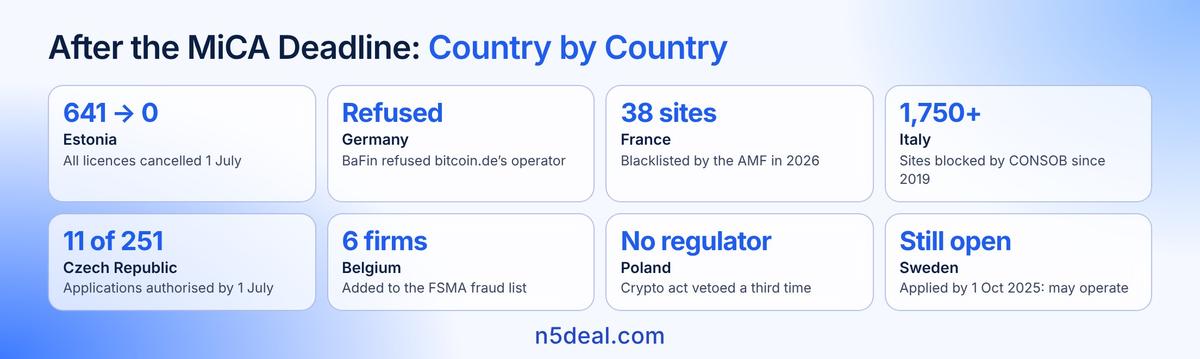
Estonia. The Financial Intelligence Unit cancelled all remaining virtual-currency licences on 1 July 2026. The country had 641 such licences in 2021 and 36 at the start of 2026. Firms with an application still pending at the Finantsinspektsioon must limit their activity until it is decided. The routes still open are listed under Estonia Crypto Licenses.
Germany. On 6 October 2026, BaFin refused the MiCA application of futurum bank AG, the operator of bitcoin.de, which had applied on 27 June 2025. Trading had been largely suspended since 12 June 2026. Client assets stay in custody until they move to another regulated custodian, and the group plans to restart through licensed German partners.
France. On 8 July 2026 the AMF added 16 crypto websites to its blacklist, bringing its 2026 additions to 38. The AMF's chair had said in May that unlicensed platforms would be blacklisted and could face court proceedings.
Italy. CONSOB keeps blocking access to unauthorised sites. Its running total passed 1,750 websites blocked since 2019, with crypto sites added throughout July and August 2026.
Belgium. Around 10 July 2026 the FSMA added six firms to its list of fraudulent crypto-asset service providers, identified through consumer complaints and market monitoring.
Czech Republic. By 1 July 2026 the Czech National Bank had assessed 251 applications and authorised 11 firms. The rest must stop onboarding and inform clients of the wind-down.
Poland. The President vetoed the crypto-assets act for the third time on 11 June 2026. With no authority designated by law, no Polish firm can apply for MiCA authorisation at home. The choice is to passport in from another member state or wind down.
Sweden. Sweden is the exception. Firms that applied by 1 October 2025 may keep operating until the regulator, and any appeal, decides. Of seven applications, one was authorised and one refused and appealed.
What must an unlicensed VASP do after 1 July 2026?
It must stop taking new clients and stop marketing, and limit itself to letting existing clients sell, transfer or close positions. ESMA's statement of 23 June 2026 allows custody only for as long as an orderly exit needs, and custody cannot be handed to an entity that is not itself an authorised CASP.
Binance shows what that looks like at scale. It withdrew its MiCA application in Greece on 24 June 2026. From 1 July, EU users lost spot trading, deposits, new sign-ups and staking products, while withdrawals stayed open. By mid-August no withdrawal deadline had been set. Binance's co-CEO said on 9 July that 70% of the funds EU users withdrew went to self-custody and 30% to licensed platforms. In the week of 29 June, Binance recorded net outflows of $1.23 billion.
Smaller exchanges used referrals. MEXC scheduled its full exit from the Netherlands for 23 October 2026, pointed Dutch users to Bybit EU, which is authorised by Austria's FMA, and agreed a referral partnership with Kraken in August.
Can a firm still apply for MiCA authorisation after the deadline?
Yes, but a pending application does not allow the firm to keep serving EU clients. Estonia and Cyprus say this explicitly. CySEC also set 27 February 2026 as its last date for applications from firms relying on the transition.
The futurum bank case shows how long the wait can be: the application was filed in June 2025 and refused in October 2026, more than fifteen months later. A late applicant should plan for at least that long without revenue from EU clients.
Some countries closed even earlier than 1 July 2026. The Netherlands, Latvia, Hungary, Poland, Slovenia and Finland chose six-month transitions, so the Dutch period ended on 30 June 2025. Lithuania ended its transition on 31 December 2025. Hungary went further, making trading through exchanges without a validation certificate a criminal offence from July 2025, a rule the new government said in June 2026 it would reverse.
How many VASPs became authorised CASPs?
Fewer than one in five. Kaiko counted about 210 authorised CASPs out of more than 1,200 pre-MiCA registrations as of 24 June 2026, and ten EU countries had not issued a single CASP licence by then.
ESMA's interim register grew after the deadline as national decisions caught up. Its third post-deadline update, in late July 2026, added 15 CASPs for a total of 309. Most of the growth came from firms that had applied in time, not from late applicants.
Is an old VASP registration worth anything now?
Not as a licence. A national VASP registration no longer permits crypto-asset services anywhere in the EU, so a buyer pays for what the company still holds: a team, a client base, technology, and sometimes a pending application.
Each of those has a cost attached. Clients can only be served again under someone's MiCA authorisation. A pending application may be refused, as futurum bank's was. And the company carries its history: regulators' blacklists, unresolved complaints and, in the worst cases, insolvency. The Crypto-Asset Service Provider (CASP) licence page sets out what an authorised firm can do that a lapsed one cannot.
How do firms that missed the deadline get back to EU clients?
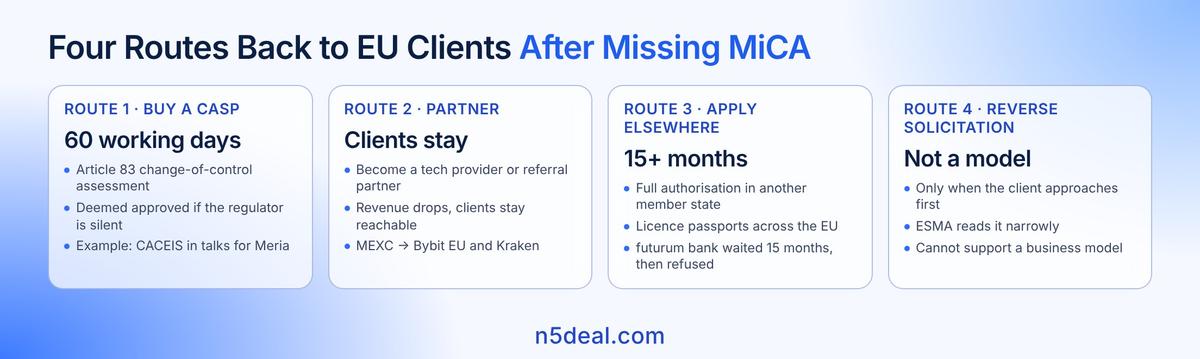
There are four routes, and the speed differs by months.
Buying an authorised CASP. The acquirer needs approval under Article 83 of MiCA, which has a 60-working-day assessment and is deemed approved if the regulator stays silent. In July 2026 CACEIS, part of Crédit Agricole, entered exclusive talks to buy Meria, a French MiCA-licensed platform with about 150,000 clients and €350 million of client assets.
Partnering with an authorised CASP. The firm becomes a technology provider or referral partner, as futurum bank plans in Germany and MEXC arranged with Bybit EU and Kraken. Revenue drops, but clients stay reachable.
Applying in another member state. Binance's co-CEO said regulators had invited it to apply elsewhere. This takes the full authorisation time, but the licence passports across the EU once granted.
Reverse solicitation. A non-EU firm may serve an EU client only when the client approaches it on its own initiative. ESMA reads this narrowly, and it cannot support a business model.
Re-entry checklist for a VASP that missed the deadline
Close the wind-down cleanly. Confirm every EU client can withdraw, record where client assets went and keep the evidence. Any authority assessing your next application or acquisition will ask for it.
Check every blacklist. Search ESMA's non-compliant entities list and the AMF, CONSOB, FSMA and home-country warning lists for your entity, brands and domains.
Choose the route by time to revenue. An acquisition of an authorised CASP is assessed in 60 working days; a new authorisation can take more than a year.
Match the target's services to your business. A CASP authorised only for reception and transmission of orders cannot run custody or an exchange without extending its licence.
Prepare the acquirer file before signing. Reputation and source of funds for every controller, including any refusal or blacklisting history, which the regulator will find anyway.
Plan the client migration. Clients move to the acquired CASP's terms, onboarding and custody. Budget for re-KYC.
Keep the UK separate. A MiCA licence does not cover UK clients; the FCA's application window for cryptoasset firms closes on 28 February 2027.
Find an authorised CASP
MiCA-authorised companies are listed in N5Deal's catalogue of licensed companies for sale. If you hold an authorised CASP and buyers that missed the deadline are already calling, start with a free valuation.
Disclaimer
This article is general commentary on the end of the MiCA transitional period and regulators' public actions up to early October 2026. It is not legal, regulatory or investment advice about any company, platform or transaction. Positions of named firms may have changed after publication. Nothing here guarantees an authorisation, an approval or a transaction outcome. Check current requirements with the relevant national competent authority and take advice from a qualified lawyer before acting.
Comments
Frequently Asked Questions
Clear, concise info to help you understand the process!