
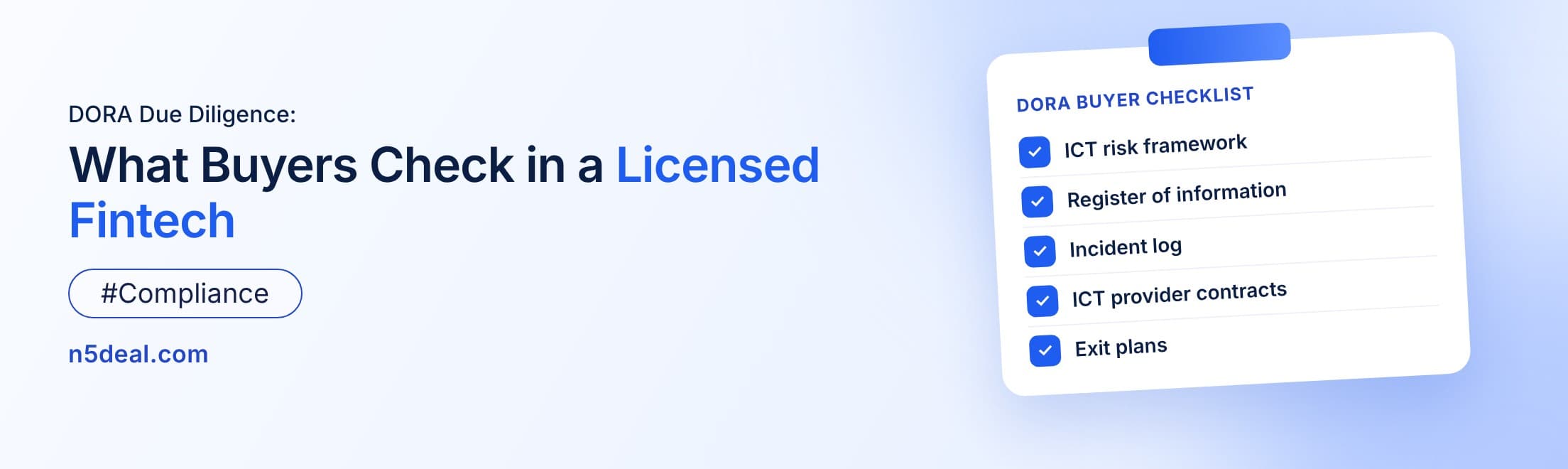
The EU's Digital Operational Resilience Act has applied since 17 January 2025 to banks, payment institutions, e-money institutions and MiCA-authorised crypto firms. A buyer of a licensed fintech now checks five DORA items: the ICT risk framework, the register of ICT providers, the incident log, the provider contracts and the exit plans.
DORA in numbers
Scope. Regulation (EU) 2022/2554 covers 20 types of financial entity, including payment institutions, e-money institutions, account information service providers, investment firms and MiCA crypto-asset service providers.
Simplified regime. Payment and e-money institutions exempted under PSD2 or the E-Money Directive follow a lighter framework under Article 16. Fully authorised PIs and EMIs do not.
Register of information. National authorities sent the first registers to the European supervisors by 30 April 2025. In the 2024 dry run, only 6.5% of roughly 1,000 registers passed all 116 data-quality checks.
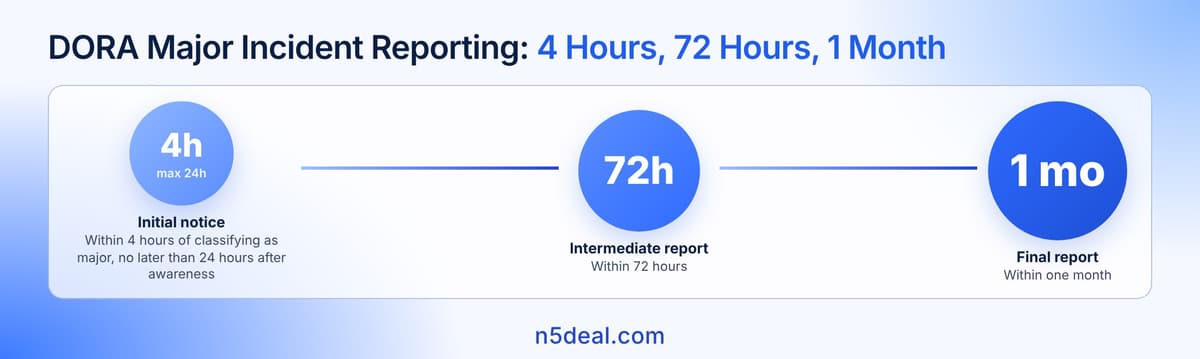
Incident reporting. Initial notice within 4 hours of classifying an incident as major and no later than 24 hours after becoming aware of it; intermediate report within 72 hours; final report within one month.
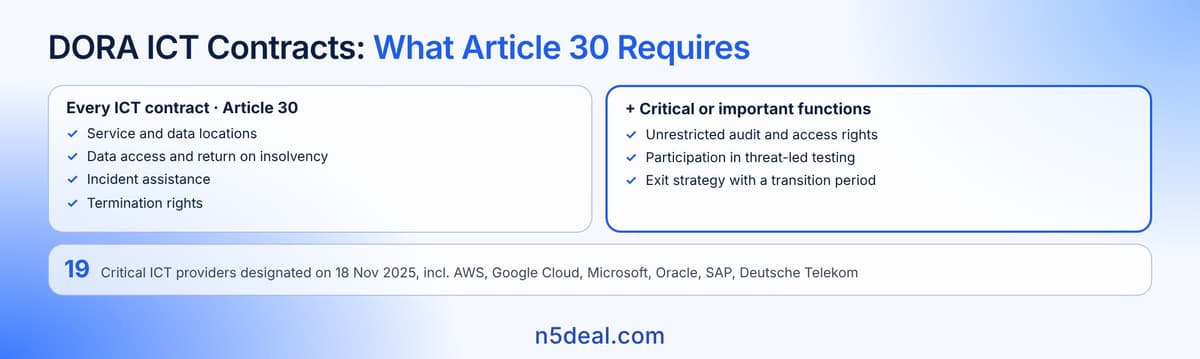
Critical providers. On 18 November 2025 the European supervisors designated 19 critical ICT third-party providers, including AWS, Google Cloud, Microsoft, Oracle, SAP and Deutsche Telekom.
Testing. Entities selected by their supervisor run threat-led penetration tests at least every three years.
Does DORA apply to payment institutions and EMIs?
Yes. Payment institutions and e-money institutions are named financial entities under Article 2, and so are crypto-asset service providers authorised under MiCA. Small institutions exempted under PSD2 or the E-Money Directive are also in scope but follow the simplified ICT risk framework in Article 16 instead of the full rules in Articles 5 to 15.
For a buyer, the category matters. A fully authorised EMI must run the full framework: governance, ICT risk management, incident classification, testing and third-party risk. A target that describes itself as "light-touch" under DORA should be able to show which exemption puts it there.
What is the DORA register of information?
It is a structured list of every contractual arrangement the firm has with ICT third-party providers, the services they support and whether those services underpin critical or important functions. Firms update it continuously and submit it to their national authority each year; the 2026 submission used a reference date of 31 December 2025.
Data quality is the weak point. In the European supervisors' 2024 dry run, only 6.5% of registers passed every check, though half of the rest failed fewer than five. The Dutch markets regulator reported a strong improvement in accepted registers in August 2026. A buyer reads the register both as a compliance document and as a map of the target's real dependencies: cloud, core banking, card processing and KYC vendors.
What do supervisors find when they review DORA compliance?
Gaps in policies, prevention and incident reporting. The Dutch AFM's August 2026 report on its 2025 supervision found entities missing required DORA policies, weak access management and patching, and fewer incident reports than expected, which it read as under-classification. It also stressed that group subsidiaries remain fully responsible for their own compliance.
The EBA's February 2026 follow-up on ICT risk in bank supervision found that supervisors had improved but had not reached full maturity. No public DORA fine had been reported by October 2026, so a buyer's exposure today comes from supervisory findings and remediation plans rather than penalties.
Which ICT contracts matter most in an acquisition?
Those supporting critical or important functions. Article 30 requires every ICT contract to set out service and data locations, access to and return of data on insolvency, incident assistance and termination rights. Contracts for critical or important functions must add unrestricted audit and access rights, participation in threat-led testing and an exit strategy with a transition period.
A target whose card processor, core ledger or cloud provider contract lacks these terms needs renegotiation, and providers on the critical list now face direct EU oversight. A change of owner can also trigger change-of-control or assignment clauses in those contracts, so check them before signing.
How does DORA connect to licensing and re-authorisation?
It is now part of the evidence regulators expect. MiCA applications must include technical documentation of the applicant's ICT systems and security arrangements, and CASPs are directly in DORA's scope. Under the PSD3 text agreed in April 2026, governance and outsourcing rules for payment institutions are aligned with DORA, and every existing PI and EMI must show compliance within the re-authorisation window. The timeline is covered in EMI Licence Under PSD3.
UK targets follow a separate regime. The FCA's operational resilience transition ended on 31 March 2025, and on 10 July 2026 HM Treasury designated AWS, Google Cloud, Microsoft and Oracle as the first UK critical third parties. The Crypto-Asset Service Provider (CASP) licence page sets out what a MiCA file must contain.
DORA due diligence checklist
Scope. Confirm whether the target runs the full framework or the Article 16 simplified one, and why.
ICT risk framework. Board-approved policies, the risk assessment behind them and the date of the last review.
Register of information. The latest submission, any rejection or data-quality feedback, and the list of providers supporting critical functions.
Incident log. Every major incident reported since January 2025, with timelines against the 4-hour, 72-hour and one-month deadlines, plus minor incidents that may have been under-classified.
Critical contracts. Article 30 terms in cloud, processing, core ledger and KYC contracts, and any change-of-control clauses.
Exit plans. A tested exit strategy for each critical provider, with a transition period.
Testing. Results of resilience testing and, if the supervisor selected the target, the last threat-led penetration test.
Supervisory correspondence. DORA findings, remediation plans and deadlines from the national authority.
People. Who owns ICT risk and incident reporting, and whether they stay after closing.
Find a licensed fintech
EMIs, payment institutions and CASPs across the EU are listed in N5Deal's catalogue of licensed companies for sale. If you own one with a clean DORA record, a free valuation shows what that record is worth to a buyer.
Disclaimer
This article is general commentary on the EU Digital Operational Resilience Act and related rules as they stood in October 2026. It is not legal, regulatory or investment advice, and nothing here guarantees an authorisation, approval or transaction outcome. Supervisory expectations differ by country and change; take advice from a qualified adviser before buying or selling a regulated entity.
Comments
Frequently Asked Questions
Clear, concise info to help you understand the process!