
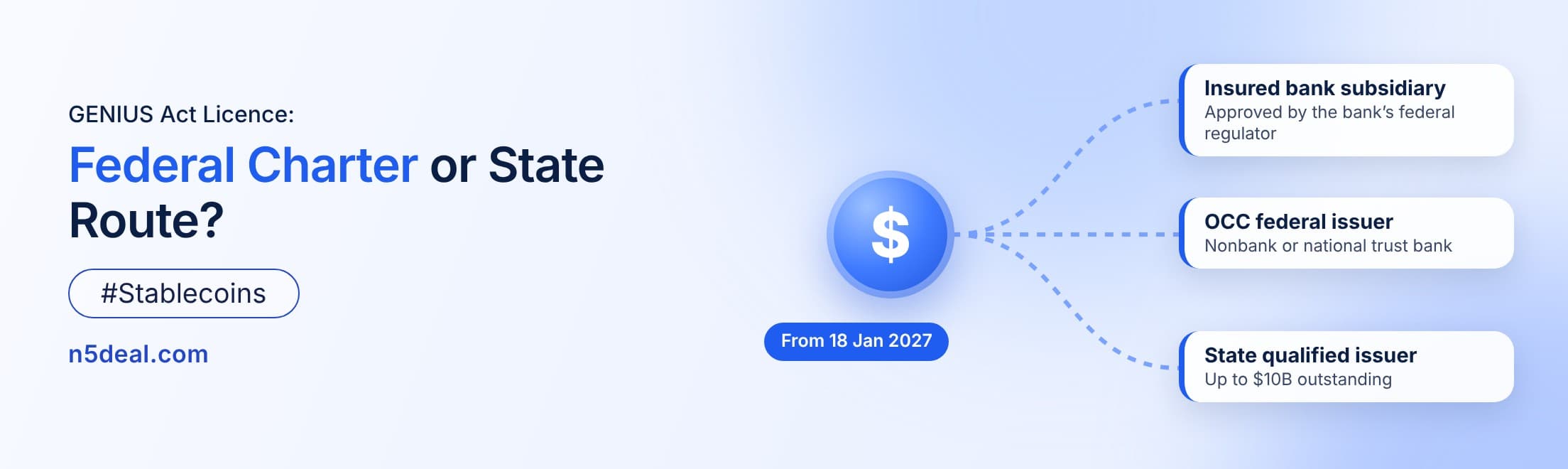
From 18 January 2027, only a permitted payment stablecoin issuer may issue a payment stablecoin in the US. There are three routes: a subsidiary of an insured bank, a federal issuer approved by the OCC, or a state-qualified issuer with $10 billion or less outstanding. Regulators must decide complete applications within 120 days.
The GENIUS Act in numbers
Enactment. Public Law 119-27, signed on 18 July 2025.
Effective date. The earlier of 18 January 2027 or 120 days after final regulations. No federal rule was final by mid-October 2026, so 18 January 2027 is the working date.
State ceiling. The state route is limited to issuers with $10 billion or less in outstanding stablecoins. Above that, an issuer has 360 days to move under federal supervision or stop new issuance, unless the regulator grants a waiver.
Decision clock. 120 days from a substantially complete application, and an application not decided in time is treated as approved.
Reserves. At least one dollar of eligible reserves for every dollar of stablecoin, published monthly and examined by a registered public accounting firm.
Penalties. Knowingly taking part in issuance by an unpermitted issuer carries fines of up to $1 million per violation and up to five years in prison. Civil penalties for unlawful issuance reach $100,000 a day.
Charters. The OCC has granted conditional approval for national trust bank charters to Ripple, Circle, BitGo, Fidelity Digital Assets, Paxos, Stripe's Bridge and Crypto.com, among others. Circle received final approval on 10 July 2026.
Who can issue a stablecoin under the GENIUS Act?
Only a permitted payment stablecoin issuer, of which the Act defines three types. The first is a subsidiary of an insured depository institution, approved by that bank's federal regulator. The second is a federal qualified issuer approved by the OCC: a nonbank company, an uninsured national bank such as a national trust bank, or a federal branch of a foreign bank. The third is a state qualified issuer, formed under state law and approved by a state stablecoin regulator.
Foreign issuers may offer stablecoins to US persons only after the Treasury finds their home regime comparable to the US one, and the Treasury had not proposed how it will make that finding by October 2026. From 18 July 2028, US digital asset service providers may not offer stablecoins issued by anyone outside these categories.
Do you need an OCC charter to issue a stablecoin?
No, but it is the route the largest issuers have taken. A national trust bank charter allows a company to hold customer assets in custody without taking deposits or making loans, and it removes the $10 billion ceiling that applies under the state route.
The OCC's December 2025 approvals covered two new charters, Circle's First National Digital Currency Bank and Ripple National Trust Bank, and three conversions of state trust companies: BitGo, Fidelity Digital Assets and Paxos. Bridge followed in February 2026, and three more firms received preliminary conditional approval on 18 September 2026.
The OCC's proposed rule, published on 2 March 2026, sets a capital floor of the greater of $5 million or the amount in the approval order, a liquidity buffer covering 12 months of operating costs, and redemption within two business days. The final rule was expected in November 2026.
What is the $10 billion limit for state issuers?
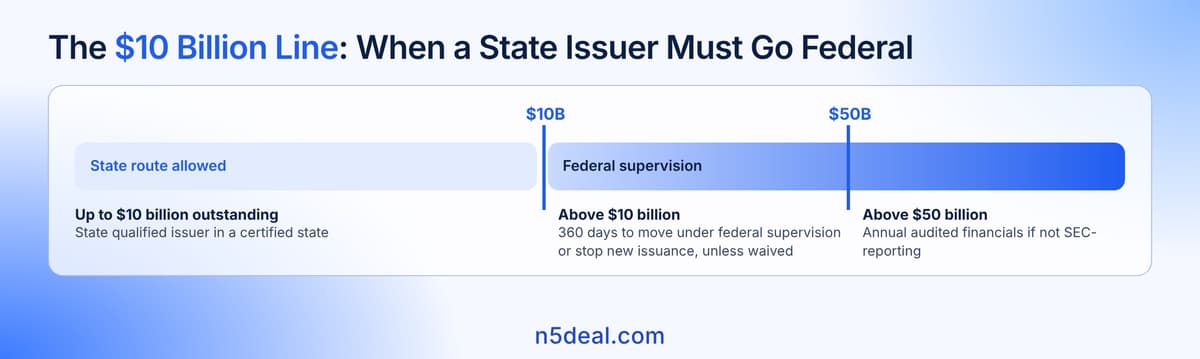
It caps how large a stablecoin can grow under state supervision alone. A state qualified issuer with more than $10 billion outstanding must transition to the federal framework within 360 days, or stop issuing new stablecoins.
The state regime itself must be certified as "substantially similar" to the federal one by a committee of the Treasury Secretary, the Federal Reserve Chair and the FDIC Chair, and recertified each year. The Treasury issued an interim final rule on the certification process on 30 September 2026. No state had been certified by October 2026. New York proposed a new Part 202 of its rules on 9 June 2026 to align its regime and seek certification.
Can a money transmitter issue a stablecoin under the GENIUS Act?
Not on a money transmitter licence alone. A state qualified issuer needs approval from a state payment stablecoin regulator to issue payment stablecoins, which is a separate permission from money transmission. New York's draft rules open eligibility to limited purpose trust companies and applicants for that charter.
State money transmitter licences still matter for everything around the stablecoin: on-ramps, off-ramps and transfers for customers. The Money Transmitter License (MTL) page covers what the licence permits and how it differs by state.
What rules does an issuer follow once approved?
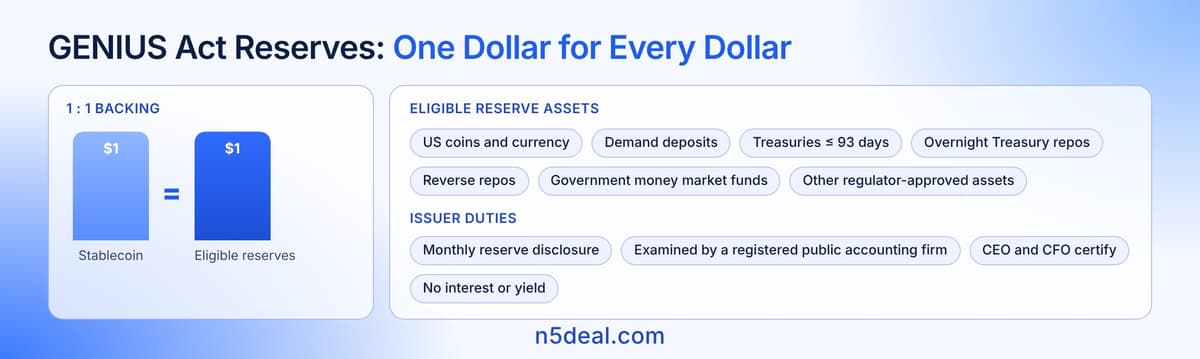
Reserves, disclosure and a ban on yield. Eligible reserves are limited to US coins and currency, demand deposits, Treasury bills, notes and bonds maturing within 93 days, overnight repurchase and reverse repurchase agreements backed by Treasuries, government money market funds, and similar assets the regulator approves.
The composition of reserves is published monthly and examined by a registered public accounting firm, and the chief executive and chief financial officer certify it; a knowingly false certification is a crime. Issuers with more than $50 billion outstanding that do not already report to the SEC must also publish annual audited financial statements. No issuer may pay interest or yield simply for holding the stablecoin.
The EU's equivalent route, through an e-money institution or a bank, is compared in E-Money Token Licence: Who Can Issue a Euro Stablecoin?
Route checklist for a US stablecoin issuer
Size the token. Projected outstanding supply above $10 billion within a few years points to the federal route from the start.
Choose the entity. A bank subsidiary if you already own an insured bank; a national trust bank or nonbank federal issuer through the OCC; or a state trust company in a state that seeks certification.
Check state certification. If you choose the state route, confirm the state has applied for, or received, certification before relying on it.
Prepare a complete file. The 120-day clock and deemed approval start only once the regulator treats the application as substantially complete.
Build the reserve and reporting stack. Custodians for eligible reserve assets, monthly disclosure, an auditor willing to examine it and officers prepared to certify it.
Plan capital and liquidity. Under the OCC proposal, at least $5 million in capital plus a 12-month operating-cost buffer.
Map the services around the token. Money transmission, custody and exchange may still need state licences or a trust charter.
Consider buying instead of building. A state trust company can convert to a national trust charter, as Paxos, Fidelity Digital Assets and BitGo did, which shortens the path to a federal issuer.
Find a US licensed company
US money transmitters and trust-chartered companies are listed in N5Deal's catalogue of licensed companies for sale. If you own a state-licensed company that could serve a stablecoin issuer, a free valuation shows how buyers price that position before January 2027.
Disclaimer
This article is general commentary on the GENIUS Act and related rulemaking as they stood in October 2026. Several implementing rules were still proposals and may change before they are final. It is not legal, regulatory or investment advice, and nothing here guarantees an approval, a charter or a transaction outcome. Take advice from a qualified US lawyer before issuing a stablecoin or buying a regulated entity.
Comments
Frequently Asked Questions
Clear, concise info to help you understand the process!