

Only a credit institution or an electronic money institution may issue an e-money token in the EU under Article 48 of MiCA; a CASP licence is not enough. The issuer notifies its regulator 40 working days before the offer, sends a white paper 20 working days before publication and must redeem at par at any time.
The e-money token rulebook in numbers
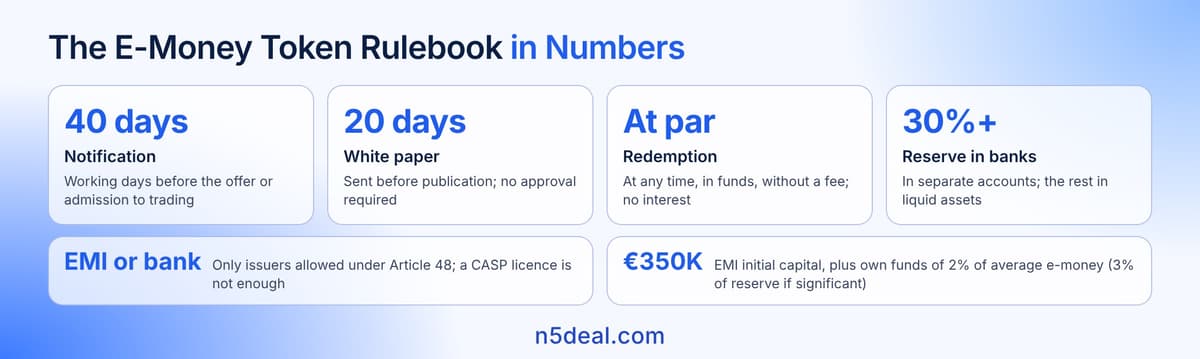
Who may issue. Credit institutions and EMIs only. MiCA treats e-money tokens as electronic money, so the EMI regime applies on top of MiCA's own rules.
Notification. The issuer notifies its national authority at least 40 working days before offering the token or seeking admission to trading. The white paper goes to the same authority at least 20 working days before publication. It needs no approval, and authorities may not demand one.
Redemption and interest. Tokens are issued at par on receipt of funds and redeemable at par at any time, in funds, without a fee. Neither the issuer nor a CASP may pay interest or any benefit linked to how long a holder keeps the token.
Reserve. At least 30% of the funds received must sit in separate accounts at credit institutions. The rest goes into secure, low-risk, highly liquid assets in the token's currency.
Capital. An EMI needs initial capital of €350,000 and, under the standard method, own funds of at least 2% of average outstanding e-money. For a significant token, own funds rise to 3% of the average reserve.
Market size. ESMA's interim register listed 49 e-money token white papers from 24 issuers in 14 countries by late September 2026. Five issuers were credit institutions; almost all the rest were EMIs.
Which licence do you need to issue a euro stablecoin?
An EMI licence or a banking licence. A fiat-backed stablecoin that references one official currency is an e-money token under MiCA, and Article 48 limits its issuance to those two types of institution.
A CASP authorisation covers services around crypto-assets, such as custody, exchange and transfer, but not issuance of an e-money token. Many groups therefore hold both: an EMI that issues the token and a CASP that lists and safeguards it. Under the Electronic Money Institution (EMI) licence, the token is e-money in law, with the same safeguarding and redemption duties as balances in an e-wallet.
Who issues e-money tokens in the EU today?
A mix of crypto-native EMIs and banks, spread across 14 countries. Named issuers on ESMA's register include:
Circle Internet Financial Europe (France, ACPR): EURC and USDC.
Société Générale-Forge (France, ACPR): EURCV and USDCV.
Paxos Issuance Europe, formerly Membrane Finance (Finland, FIN-FSA): EUROe and USDG.
Monerium (Iceland, Central Bank of Iceland): EURe.
Quantoz Payments (Netherlands, DNB): EURQ and USDQ.
AllUnity (Germany, BaFin): EURAU.
Banks: Oddo BHF in France, Bison Bank in Portugal, and Banking Circle and CACEIS Bank, each issuing under a banking licence.
The Dutch route, used by Quantoz, is set out on the Electronic Money Institution (EMI) License in Netherlands page.
When does an e-money token become significant?
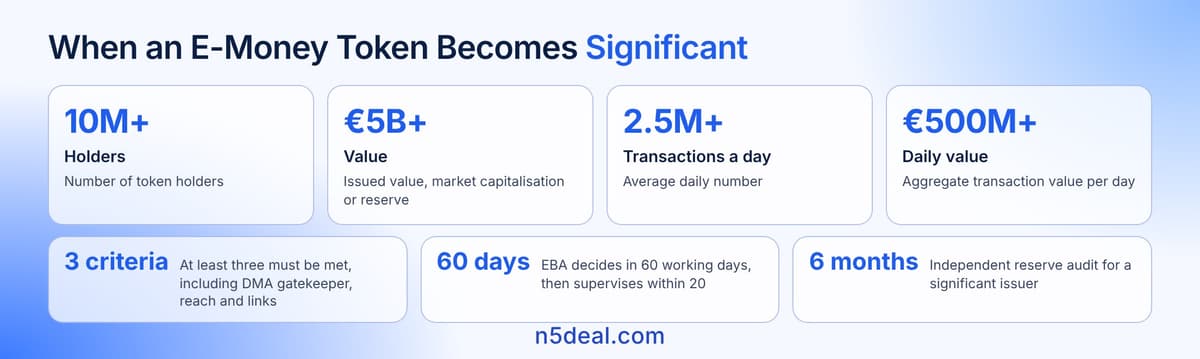
When the EBA finds that it meets at least three of MiCA's criteria. Four of them are numerical: more than 10 million holders, more than €5 billion in issued value, market capitalisation or reserve, more than 2.5 million transactions a day on average, or more than €500 million a day in aggregate transaction value. The others cover gatekeeper status under the Digital Markets Act, international reach, links to the financial system, and the issuer's other tokens or crypto services.
The EBA gives the issuer and its regulator 20 working days to comment, decides within 60 working days and takes over supervision within 20 working days of a positive decision. It reviews the classification every year. A significant issuer follows stricter reserve, custody, liquidity and own-funds rules, with an independent reserve audit every six months, and its national authority can apply some of those rules to a non-significant issuer too. No EMI-issued token had been classified as significant by early October 2026.
Should you buy an EMI or apply for one to issue a stablecoin?
Both routes were used in 2026, and the choice comes down to time against control.
Buying gives a licence in months. Checkout.com acquired Blue EMI, a Bank of Lithuania-authorised EMI already licensed to issue euro stablecoins, in January 2026. Paxos took the same route earlier, completing its purchase of Finland's Membrane Finance in February 2025. Outside stablecoins, the Bank of Lithuania approved Lloyds Banking Group's purchase of Curve Europe, a Lithuanian EMI, in May 2026.
Applying gives a licence built to the issuer's design, but takes longer. Ripple received preliminary EMI approval from Luxembourg's CSSF in January 2026. zerohash received its EMI licence from DNB in May 2026, and Stripe's Bridge was reported in July 2026 to hold both an EMI licence and a CASP authorisation from the CSSF.
Demand also comes from CASPs that only transfer stablecoins. The EBA's transition on the interplay between PSD2 and MiCA ended on 2 March 2026. Since then, a CASP that transfers e-money tokens for clients needs its own payment licence, an application filed by 1 March 2026, or a partnership with a licensed payment firm. Firms that chose none of these had to stop serving EU clients.
Checklist: buying an EMI to issue e-money tokens
Before an EMI is listed on N5Deal, the platform checks the owner's identity, proof of ownership, licence status, company status and public adverse media. The list below is the buyer's own due diligence for a stablecoin plan.
Authorised activities. Confirm the licence covers issuance of e-money, not only payment services, and whether it is a full or restricted licence with a passport.
Existing tokens. Check ESMA's register for any white paper the target has already notified, and read it: the buyer inherits liability for what it says.
Own-funds headroom. Model own funds at 2% of the outstanding token supply you expect in year one, and 3% of the reserve if the token could become significant.
Reserve banking. Identify the credit institutions that will hold at least 30% of reserve funds, and confirm they accept crypto-related deposits.
Redemption operations. Test how the target pays out at par on request, at what cut-off times and through which rails.
Change of control. Prepare the qualifying-holding notification for the target's home regulator before signing, and make closing conditional on approval.
CASP coverage. Decide which entity will provide custody or exchange of the token. The EMI does not need a CASP licence to issue, but does to offer crypto-asset services.
PSD3 re-authorisation. Under the PSD3 text agreed in April 2026, existing EMIs must re-qualify as payment institutions within 21 months of entry into force. Ask how the target will file.
Find an EMI that fits a stablecoin plan
EMIs authorised in Lithuania, the Netherlands, France and other member states are listed in N5Deal's catalogue of licensed companies for sale. If you own an EMI with an e-money permission, a free valuation shows how stablecoin buyers price it.
Disclaimer
This article is general commentary on MiCA's rules for e-money tokens and the EU e-money regime as they stood in October 2026. It is not legal, regulatory or investment advice about any token, issuer or transaction. The ESMA register and the position of named firms change often. Nothing here guarantees an authorisation, a notification outcome or a transaction result. Check requirements with the relevant national competent authority and the EBA, and take advice from a qualified lawyer before issuing a token or buying a regulated entity.
Comments
Frequently Asked Questions
Clear, concise info to help you understand the process!