
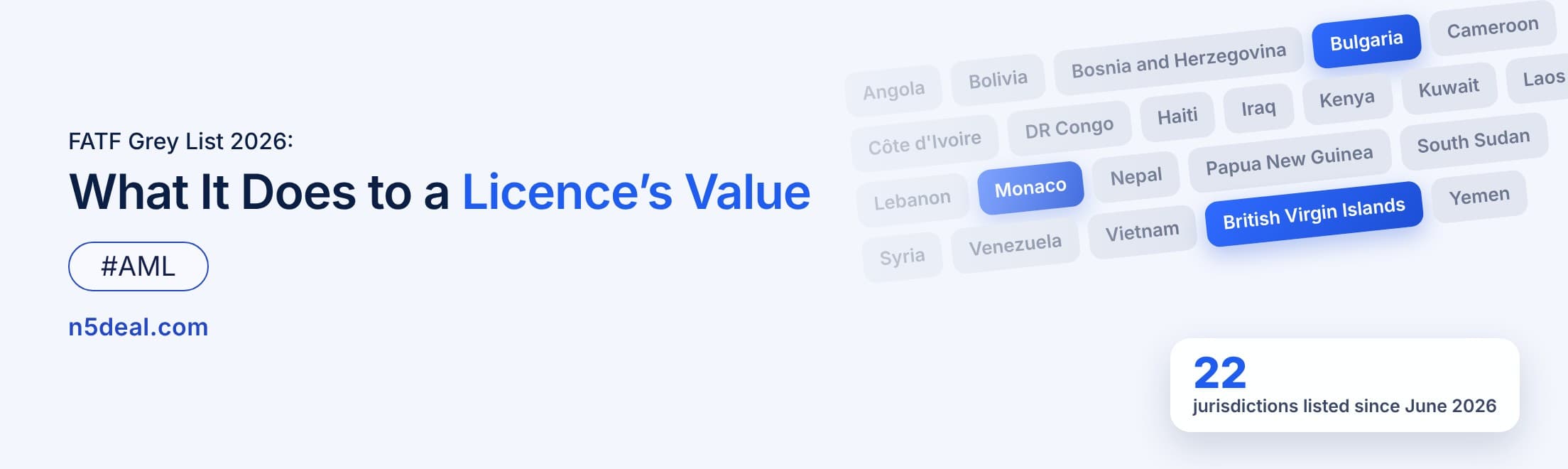
Twenty-two jurisdictions are on the FATF grey list since June 2026, including EU member Bulgaria, Monaco and the British Virgin Islands. Listing does not cancel a licence or its EU passport, but banks apply enhanced due diligence to licensed firms there, which raises costs and lowers the price buyers will pay.
The grey list in numbers
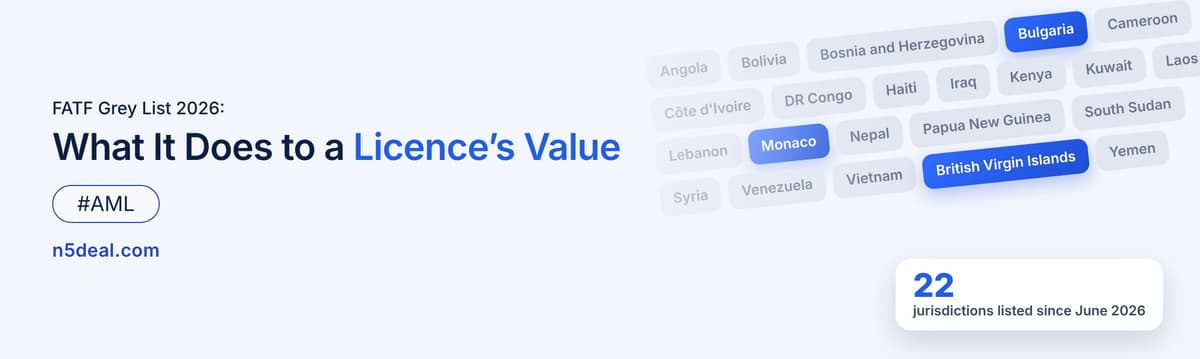
Current list. Angola, Bolivia, Bosnia and Herzegovina, Bulgaria, Cameroon, Côte d'Ivoire, Democratic Republic of the Congo, Haiti, Iraq, Kenya, Kuwait, Laos, Lebanon, Monaco, Nepal, Papua New Guinea, South Sudan, Syria, Venezuela, Vietnam, British Virgin Islands and Yemen.
2026 changes. Kuwait and Papua New Guinea were added in February. Bosnia and Herzegovina and Iraq were added in June, and Algeria and Namibia removed.
Call for action. Iran and North Korea face countermeasures; Myanmar faces enhanced due diligence.
Next decision. The October 2026 plenary in Paris ends on 30 October. Bulgaria, Monaco and Côte d'Ivoire were reported in September as expected to leave the list.
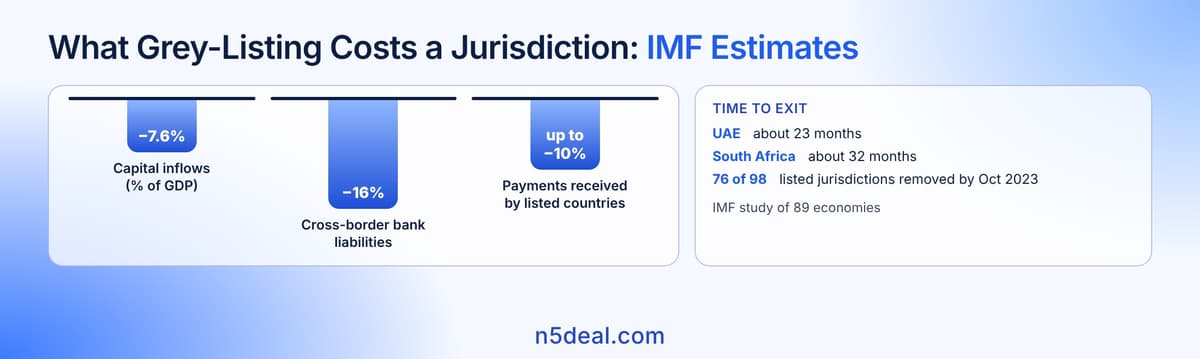
Economic cost. An IMF study of 89 economies found grey-listing cuts capital inflows by about 7.6% of GDP. Cross-border bank liabilities fall by about 16%, and payments received by listed countries fall by up to 10%.
Exit times. The UAE left after about 23 months, South Africa after about 32. Of 98 jurisdictions listed by October 2023, 76 had been removed.
What happens when a country is on the FATF grey list?
It commits to an action plan to fix weaknesses in its anti-money-laundering regime, and the FATF monitors progress at each plenary. The list itself imposes no sanctions; the cost comes through how banks and regulators elsewhere treat the country.
Correspondent banks are the main channel. Banks abroad apply enhanced due diligence to customers and counterparties connected with a listed country, which means more questions, slower payments and, for some, an exit. When Bulgaria was listed in October 2023, S&P Global expected greater scrutiny from foreign counterparts and higher compliance costs for its banks.
Is the FATF grey list the same as the EU high-risk list?
No. The EU keeps its own list of high-risk third countries, which covers only non-EU states and triggers mandatory enhanced due diligence for every EU bank, EMI, payment institution and crypto firm. Its latest update took effect on 29 January 2026, adding Bolivia, the British Virgin Islands and Russia and removing six African countries, for 26 countries in total, Monaco among them.
The EU list lags the FATF. Its 2026 version still includes Algeria and Namibia, removed by the FATF in June, and does not yet include Kuwait, Papua New Guinea, Bosnia and Herzegovina or Iraq. Bulgaria, as an EU member, cannot appear on it, so its listing affects counterparties outside the EU more than inside.
Do UK firms still apply enhanced due diligence to grey-list countries?
Not automatically since 30 June 2026. UK money-laundering rules now require enhanced due diligence only for FATF call-for-action countries: Iran, North Korea and Myanmar. A grey-list connection is a factor each firm weighs under its own risk assessment.
In practice, large banking groups are expected to keep enhanced checks for many grey-listed jurisdictions. A licensed fintech in Bulgaria or the British Virgin Islands should not expect UK banks to relax because the rule changed.
Can a Bulgarian EMI still passport across the EU?
Yes. Passporting works by notification between EU regulators, and the FATF listing does not affect it. A Bulgarian EMI or payment institution can still serve clients across the EEA under its home licence.
The cost shows up in banking. Safeguarding banks, correspondent banks and card schemes outside Bulgaria may apply enhanced due diligence to a Bulgarian licensee, which slows onboarding and can narrow the choice of partners. The Electronic Money Institution License in Bulgaria page sets out the licence itself.
How does grey-listing change a licence's price?
There is no published data on discounts, so the pricing comes from how buyers assess the risk. On N5Deal's deal desk, three factors move the number.
Delisting risk. A licence in a jurisdiction close to exit, with its action plan substantially completed and an on-site visit granted, sells closer to an unlisted peer. Bulgaria and Côte d'Ivoire reached that stage in June 2026.
Banking that transfers. Safeguarding accounts, correspondent relationships and card-scheme memberships that stay with the company after closing carry most of the value. A licence whose banks have already exited is worth little more than a fresh application.
Enhanced due diligence cost. Buyers price in slower onboarding of their own clients and the extra compliance staff a listed jurisdiction needs.
How regulated status is priced more generally is covered in Licence Valuation Premiums 2026.
Checklist: buying or selling a licence in a grey-listed jurisdiction
Check both lists. FATF grey list and EU high-risk list, and the date each was last updated.
Read the action plan status. Has the FATF found the plan substantially complete, and is an on-site visit scheduled?
Map banking relationships. Safeguarding, correspondent and card-scheme partners, where they are based and whether any has asked for extra information since the listing.
Test onboarding. Ask the target how long new client onboarding takes now compared with before the listing.
Check passporting. For an EU licence, confirm passport notifications are in place for every market served.
Model two scenarios. Value the licence if the jurisdiction exits at the next plenary and if it stays listed for another year.
Time the deal. Sellers in jurisdictions expected to exit may gain by waiting for the plenary decision; buyers may gain by signing before it.
Find a licence outside the grey list, or price yours inside it
Licensed companies across more than 100 jurisdictions are listed in N5Deal's catalogue of licensed companies for sale. If you own a licence in a jurisdiction close to leaving the list, a free valuation shows how the exit would change its price.
Disclaimer
This article is general commentary on the FATF grey list and related EU and UK rules as they stood on 27 October 2026, before the October 2026 FATF plenary decision. It is not legal, regulatory or investment advice, and nothing here guarantees a licence's value or a transaction outcome. Check the current FATF and EU lists before acting.
Comments
Frequently Asked Questions
Clear, concise info to help you understand the process!