

Payment institutions and EMIs that offer euro credit transfers must be able to receive instant euro transfers by 9 April 2027, and send them by the same date in the euro area or by 9 July 2027 outside it. Since October 2025 they can also apply to join TARGET directly instead of relying on a bank.
The Instant Payments Regulation in numbers
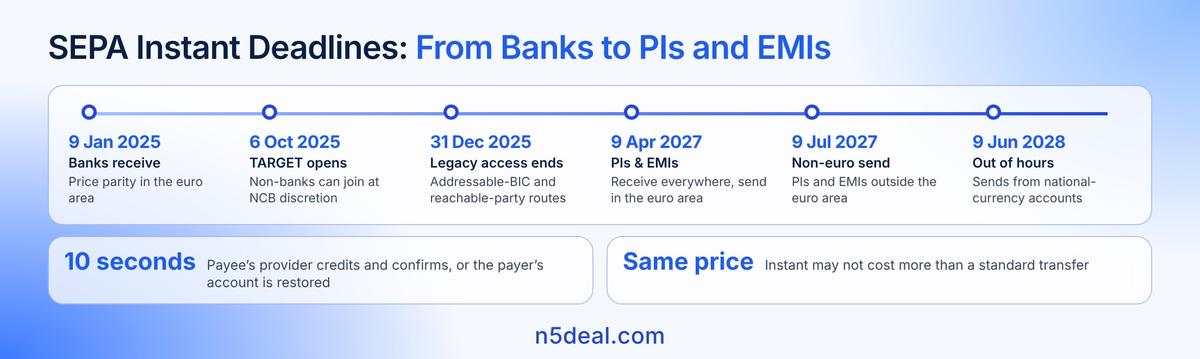
Receiving. PIs and EMIs must receive instant euro credit transfers by 9 April 2027, in euro and non-euro member states alike. Banks have had to do so since 9 January 2025.
Sending. By 9 April 2027 in the euro area and 9 July 2027 elsewhere. Banks in the euro area have sent instant transfers since 9 October 2025.
Speed. The payee's provider must credit the funds and confirm within 10 seconds. If no confirmation arrives, the payer's account is restored.
Price. An instant transfer may not cost more than a comparable standard transfer. This has applied in the euro area since 9 January 2025 and applies in non-euro states from 9 January 2027.
Sanctions screening. Instead of screening each transfer, providers check their own users against EU sanctions lists at least once a day and immediately when new listings take effect.
Scope. The obligation attaches to providers that already offer standard credit transfers. A firm with no credit-transfer product does not have to add instant ones.
Adoption. In the second half of 2025, instant transfers made up 25% of the number and 8% of the value of credit transfers processed by euro-area retail payment systems, according to ECB statistics published in July 2026.
When do payment institutions have to offer SEPA Instant?
By 9 April 2027 for receiving everywhere in the EU, and for sending in the euro area. PIs and EMIs in member states outside the euro area have until 9 July 2027 to send, and until 9 June 2028 to send outside business hours from accounts in their national currency.
Member states had to set penalties for breaches by 9 April 2025. Providers also report to their regulator each year on charges and on transfers rejected for sanctions reasons.
How the rails compare with the US and India is covered in FedNow vs SEPA Instant vs UPI: real-time rails compared.
Can an EMI or payment institution join TARGET directly?
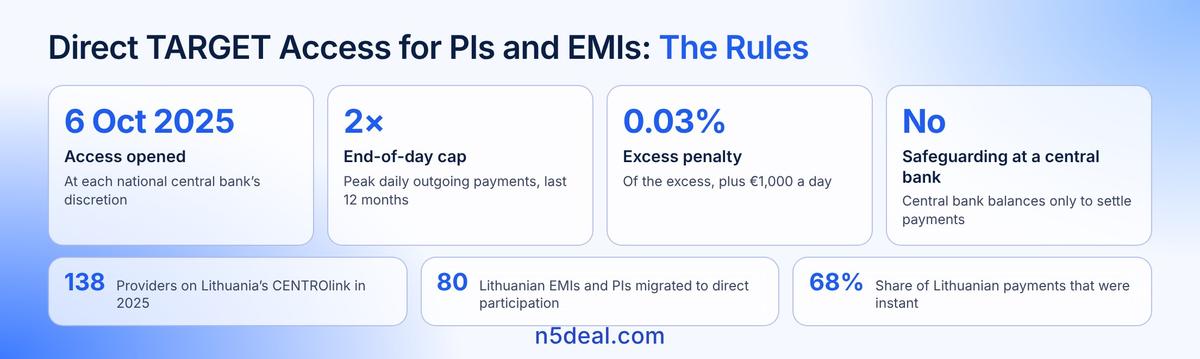
Yes, since 6 October 2025, at the discretion of each national central bank. The Instant Payments Regulation amended the Settlement Finality Directive and PSD2 so that PIs and EMIs can join designated payment systems. Member states had to transpose the change by 9 April 2025, and the ECB postponed non-bank access to TARGET from April to October 2025 because some countries were late.
An applicant must document how it safeguards user funds, its governance and internal controls, and a winding-up plan, and file a compliance statement every year. The ECB caps a non-bank's end-of-day balance, generally at twice its peak daily outgoing payments over the previous 12 months. Exceeding the cap costs 0.03% of the excess plus €1,000 a day.
Lithuanian EMI Paysera says it became the first EMI in Europe to process euro payments directly in TARGET's T2 system, in April 2026.
Can a payment institution keep safeguarded funds at a central bank?
No. The ECB decided in July 2024 that the Eurosystem will not give non-bank payment providers accounts for safeguarding user funds, and its January 2025 decision put that into rules. A non-bank may hold central bank balances only to settle payments, within the cap.
The same decision ended older indirect arrangements. Non-banks that reached TARGET as an addressable BIC or reachable party through a central bank's own account had to stop by 31 December 2025. A target that relied on such access has either moved to direct participation or to a bank, and a buyer should know which.
Which countries admit PIs and EMIs to payment systems?
All euro-area central banks can now admit them to TARGET, but national systems and procedures differ.
Lithuania. Lietuvos bankas has admitted EMIs and PIs to TARGET since 6 October 2025. Its retail system, CENTROlink, served 138 providers from 20 countries in 2025. Eighty EMIs and PIs had migrated to direct participation, with migration continuing to the end of 2026. Instant transfers made up 68% of Lithuanian payments that year.
France. A law of 30 April 2025 added PIs and EMIs to the institutions allowed to join payment systems. Applicants need a statutory auditor's attestation and confirmation from the ACPR that no administrative measure is pending against them. The Banque de France opened its TARGET component to non-banks on 6 October 2025.
Netherlands. A non-bank applies to the system operator and then sends its safeguarding, governance and winding-up documentation to DNB, with a statement from its management board and an annual compliance statement.
Ireland. Ireland added PIs and EMIs to its settlement finality rules in May 2025, a month after the EU deadline.
The Payment Institution License in Lithuania page covers the licence that sits underneath CENTROlink access.
Instant-payments checklist for buying an EU PI or EMI
Before a payment institution or EMI is listed on N5Deal, the platform checks the owner's identity, proof of ownership, licence status, company status and public adverse media. The list below is the buyer's own due diligence on instant payments.
Scope. Does the target offer euro credit transfers today? If yes, the 2027 deadlines apply.
Receiving and sending plan. Ask for the project plan, the scheme adherence status and the test results for receiving and sending instant transfers within 10 seconds.
Access model. Direct participant in TARGET or a national system, or indirect through a sponsor bank? Get the sponsor agreement and its notice period.
Legacy access. If the target used addressable-BIC or reachable-party access before 2026, confirm what replaced it.
Verification of payee. Confirm the target's verification-of-payee status and the date its regulator expects it.
Sanctions screening. Check that users are screened daily and on each new listing, and read the annual report on rejected transfers.
Price parity. Compare the fee schedule for instant and standard transfers.
Balance cap. For a direct TARGET participant, check its cap and whether it has ever paid the excess-balance penalty.
Browse payment institutions and EMIs
EU payment institutions and EMIs, including firms with direct access to payment systems, are listed in N5Deal's catalogue of licensed companies for sale. If your institution already sends and receives instant transfers, a free valuation shows what that readiness is worth to a buyer.
Disclaimer
This article is general commentary on Regulation (EU) 2024/886 and related ECB rules as they stood in October 2026. It is not legal, regulatory or investment advice about any institution or transaction. National transposition and central bank practice differ and change. Nothing here guarantees access to any payment system, an authorisation or a transaction outcome. Check requirements with the relevant national competent authority and central bank, and take advice from a qualified lawyer before acting.
Comments
Frequently Asked Questions
Clear, concise info to help you understand the process!