

Since 7 May 2026, UK authorised payment institutions and EMIs must reconcile safeguarded funds daily, file a monthly safeguarding return within 15 business days of month-end, keep a resolution pack and, above £100,000 safeguarded, commission an annual safeguarding audit. For a buyer, those records are now the fastest evidence of how the target handles client money.
The rules sit mainly in CASS 10A and CASS 15 of the FCA Handbook and were set out in policy statement PS25/12, published on 7 August 2025. Firms that only provide payment initiation or account information services are outside them, because they never hold client funds.
What do the FCA safeguarding rules require since 7 May 2026?
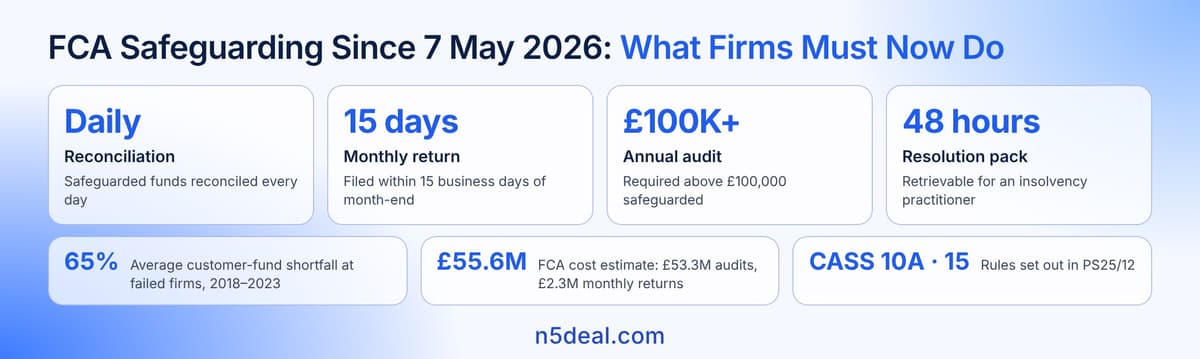
They turn safeguarding from an annual compliance item into a monthly reporting duty. The FCA introduced them because payment and e-money firms that became insolvent between 2018 and 2023 had an average shortfall of 65% in the customer funds they should have protected.
The monthly return reports how much the firm safeguarded and how, and the first returns covered June 2026 activity. The annual audit tests whether the firm met the rules across the year, not only on the reporting date. The resolution pack is the set of documents an insolvency practitioner would need to return funds quickly, and it must be retrievable within 48 hours.
The FCA estimated the total cost of the regime at £55.6 million, of which £53.3 million is the cost of audits and £2.3 million the cost of monthly returns. For a small authorised payment institution, the audit is the expense that changes its margin.
Do the rules apply to small payment institutions?
Mostly not. The supplementary regime applies to authorised payment institutions, EMIs and small EMIs. Small payment institutions are outside the audit requirement and are not among the firms the supplementary regime names.
The line between the two categories is set by volume. A small payment institution may not exceed a monthly average of €3 million in payment transactions over the previous 12 months, and a firm that crosses that ceiling must apply for full authorisation. For a buyer planning to grow a target beyond €3 million a month, buying a small payment institution means buying a future authorisation application along with it.
The capital difference is smaller than the compliance difference. An authorised payment institution needs initial capital of €20,000 for money remittance only, €50,000 for payment initiation and €125,000 for the full range of payment services. The Payment Institution License in United Kingdom page sets out the full authorisation requirements.
Is it faster to buy an FCA-authorised payment institution than to apply?
Yes, on the FCA's own numbers. In 2025/26 the median change-in-control decision took 39 days, and 99.9% were decided within the 60-working-day statutory limit. The median new-firm authorisation across all sectors took 125 days, up from 112 the year before.
The statutory frame explains the gap. A new application must be decided within 3 months of being complete and 12 months if it is not. A change in control has 60 working days, with the clock pausing while the FCA waits for information. Buying control without approval is a criminal offence under section 191F of the Financial Services and Markets Act 2000, so signing and closing are always separated by the FCA's decision.
The change-in-control assessment looks at the buyer, not the business, but the business arrives with its record. Since May 2026 that record includes every safeguarding return the target has filed. A target with clean monthly returns, an unqualified audit and a tested resolution pack is cheaper to approve and cheaper to run. A target with reconciliation breaks or late returns brings that history into the FCA's file on the buyer.
Why is the FCA cancelling more payment licences?
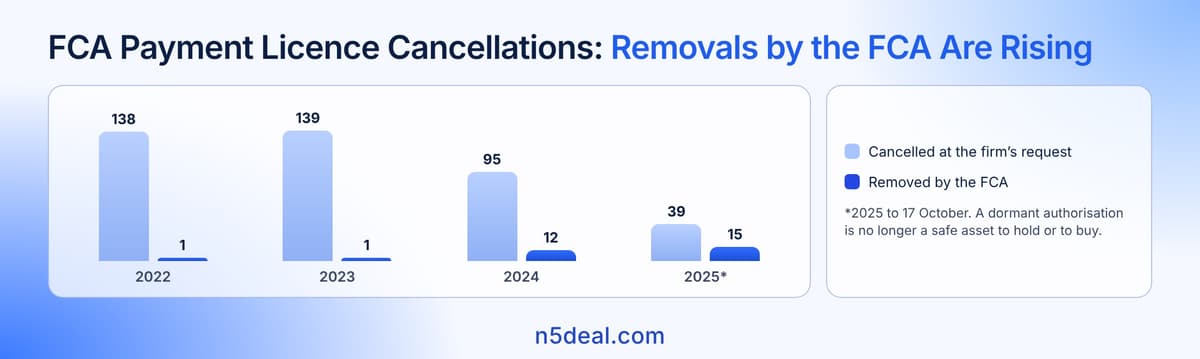
Because the FCA has started removing permissions itself. Freedom of information data on EMI and payment institution cancellations shows firm-requested cancellations falling while FCA-initiated removals rose:
2022: 138 cancelled at the firm's request, 1 removed by the FCA.
2023: 139 at the firm's request, 1 removed by the FCA.
2024: 95 at the firm's request, 12 removed by the FCA.
2025, to 17 October: 39 at the firm's request, 15 removed by the FCA.
The rise in FCA-initiated removals means a dormant authorisation is no longer a safe asset to hold or to buy. A target with no activity and no safeguarding history gives the FCA nothing to assess except its silence, and it will ask the buyer why it wants the permission.
Does PSD3 change anything for UK payment institutions?
No. PSD3 is EU legislation agreed after Brexit and does not apply to firms authorised by the FCA. The UK is moving on its own track.
HM Treasury consulted from 14 July to 6 October 2026 on modernising payment services regulation. The proposals would move the detailed requirements of the Payment Services Regulations and the Electronic Money Regulations into FCA rules and asked whether senior managers at payment and e-money firms should face enhanced accountability. The consultation set no new capital amounts or thresholds.
For a buyer comparing a UK target with an EU one, the difference is concrete. An EU payment institution faces re-authorisation under PSD3 within 27 months of its entry into force, at higher capital under the agreed text: €40,000 for money remittance and €150,000 for the full range of services. A UK authorised payment institution keeps its permission and its capital requirement, and carries the safeguarding regime instead. The Payment Service Provider (PSP) licence page compares PSP regimes across jurisdictions.
Safeguarding request list for a UK payment institution acquisition
Before a payment institution is listed on N5Deal, the platform checks the owner's identity, proof of ownership, authorisation status on the FCA register, company status and public adverse media. The list below is the buyer's own due diligence on safeguarding.
Register entry. Confirm the firm reference number, permission type (authorised or small payment institution), the payment services permitted and any agents or distributors.
Every monthly safeguarding return since June 2026. Compare the amounts with bank statements for the same dates.
Daily reconciliation records for at least the last three months, including how each break was resolved and how long it took.
Safeguarding method. Segregated account, insurance or guarantee, and the letters from each safeguarding bank or insurer acknowledging the arrangement.
The annual safeguarding audit, or evidence that the firm stayed under £100,000 safeguarded for 53 weeks and is exempt.
The resolution pack. Ask the seller to produce it within 48 hours. If it takes longer during due diligence, it would take longer in an insolvency too.
Breach notifications. Every safeguarding breach reported to the FCA, with the remediation that followed.
Banking concentration. How many banks hold client funds and what notice period each can give to close the account.
Regulatory correspondence. FCA letters, skilled person reports and any requirements imposed on the permission in the last three years.
Change-in-control file. Prepare the buyer's notification before signing, with source of funds for each controller, so the 60-working-day clock starts on signing.
Browse payment institutions for sale
Authorised payment institutions in the UK and across the EU are listed in N5Deal's catalogue of licensed companies for sale. Sellers with a clean run of safeguarding returns can use a free valuation to see how buyers price that record.
Disclaimer
This article is general commentary on the UK safeguarding regime for payment and e-money firms as it stood in October 2026. It is not legal, regulatory or investment advice about any firm or transaction, and nothing in it guarantees an authorisation, a change-in-control approval or a transaction outcome. FCA rules, metrics and consultation outcomes change; check the current FCA Handbook and take advice from a qualified lawyer before buying or selling a regulated entity.
Comments
Frequently Asked Questions
Clear, concise info to help you understand the process!