
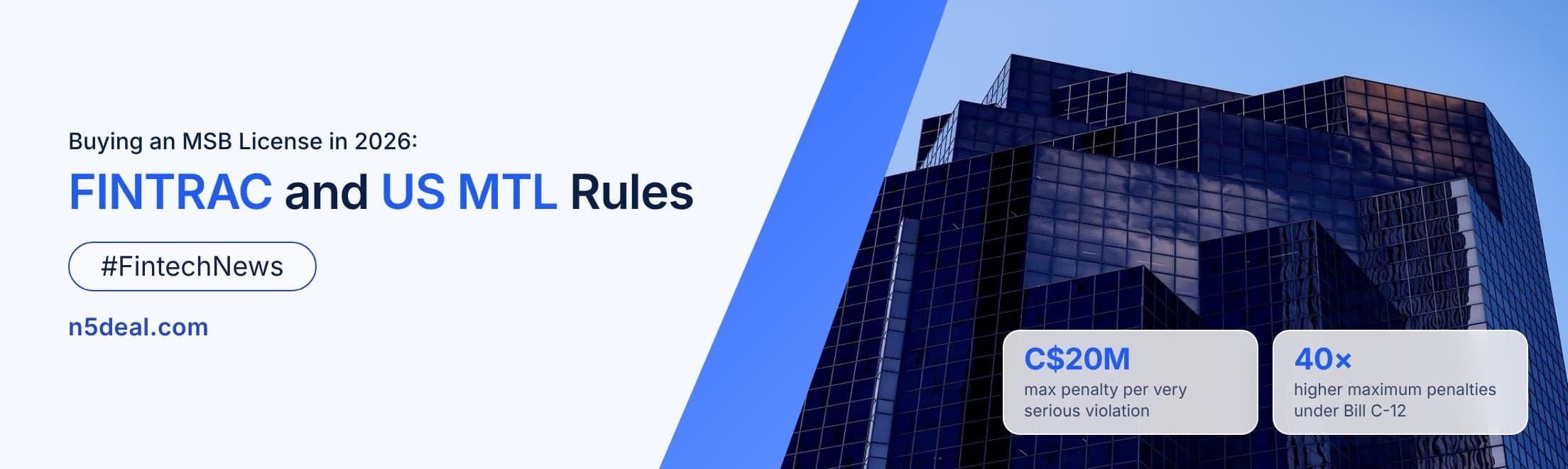
Canada's MSB "license" is a FINTRAC registration, and since March 2026 its history matters as much as its existence: FINTRAC revoked 151 registrations by late May, against 23 in all of 2025, and Bill C-12 raised maximum penalties up to 40 times. In the US, every money transmitter license changes hands only with prior state approval.
MSB and MTL regimes at a glance
Four regimes can apply to the same money services business, and only one of them is a licence.
Canada MSB (FINTRAC): an anti-money-laundering registration, valid for two years, with no capital requirement. It stays with the legal entity when the owners change. FINTRAC revoked 151 registrations by 21 May 2026, and penalties now reach C$20 million per violation.
Canada PSP (Bank of Canada): registration under the Retail Payment Activities Act for retail payment service providers. Client funds must be held in trust or segregated, and an annual report is due by 31 March. An unregistered party acquiring control is a ground for revocation. 257 applications from the November 2024 window were still pending in August 2026.
US federal MSB (FinCEN): registration on Form 107, renewed every two years, with no federal capital requirement. A transfer of more than 10% of voting or equity interest triggers re-registration within 180 days.
US state MTL: a licence in each state where the firm operates, usually renewed every year, with a net-worth floor and surety bond set by each state. Every licensing state requires prior approval of a change of control, and 31 states had adopted the Money Transmission Modernization Act by September 2026.
Is an MSB license in Canada a license, and can it be transferred?
No on both counts, strictly speaking. A Canadian MSB holds a registration with FINTRAC, and the registration belongs to the legal entity, not to its owners.
That makes the structure of the deal decisive. In a share purchase the entity keeps its registration and its history, and the buyer updates FINTRAC on the changes to ownership, directors and compliance officer. In an asset purchase nothing transfers: the buyer's own entity has to register from scratch. Registration is valid for two years and must be renewed, and foreign MSBs serving people in Canada need the same registration as domestic ones.
The first deal closed on N5Deal, in December 2023, was a Canadian MSB. The structure has not changed since then. What changed in 2026 is the value of a clean record.
How many MSB registrations has FINTRAC revoked in 2026?
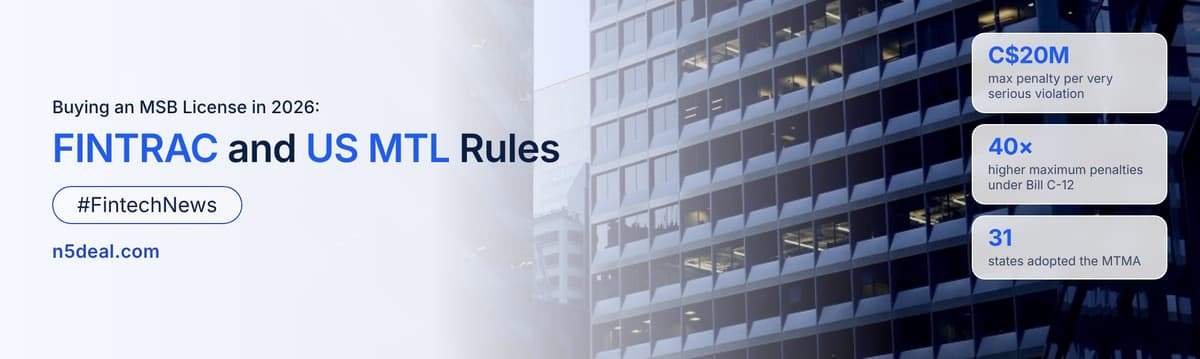
151 by the registry update of 21 May 2026, according to a count of the public FINTRAC registry. FINTRAC revoked 23 registrations in all of 2025 and 16 in 2024.
The wave started in March. On 17 March 2026, Canada's Minister of Finance said FINTRAC had revoked 23 MSB registrations that day alone. Most of the 2026 revocations sit in British Columbia (72 in the count above) and Ontario (68), and a later third-party tally of the registry put the share of revoked firms listing virtual currency activity at about three quarters.
Fines continued alongside revocations. FINTRAC imposed C$693,742.50 on Necosmart, an Edmonton MSB, on 27 March 2026 and announced it in May.
For a buyer, the registry is now the first document to read, not the last. A target that has never been examined since registering carries a different risk from one that passed an examination in 2025 or later.
What did Bill C-12 change for MSB owners and buyers?
Bill C-12 received Royal Assent on 26 March 2026 and raised the maximum administrative penalty for each violation by up to 40 times. The new framework applies to violations that occur from that date.
The tiers moved as follows:
Minor violation: from C$1,000 to C$40,000.
Serious violation: from C$100,000 to C$4 million.
Very serious violation: from C$500,000 to C$20 million.
For entities, total penalties are capped at the greater of C$20 million or 3% of the group's gross global revenue for the previous year. A compliance program now has to be reasonably designed, risk-based and effective, and failing that standard counts as a very serious violation. FINTRAC can also issue compliance orders, and breaching one can cost an entity up to C$30 million or 3% of revenue.
The date line matters in a transaction. Conduct before 26 March 2026 is assessed under the old penalty amounts. Conduct after it is assessed under the new ones, and measured against the revenue of the group that owns the MSB at the time, which after closing is the buyer's group.
Do Canadian MSBs also need Bank of Canada PSP registration?
Many do. The Retail Payment Activities Act requires payment service providers that hold funds, initiate transfers or provide related services to Canadian end users to register with the Bank of Canada, and an MSB that moves funds for retail clients often falls inside that definition.
The two regimes are linked. Serious or very serious FINTRAC violations within the previous five years are grounds for the Bank of Canada to refuse a PSP application. If someone acquires control of a registered PSP without being registered themselves, the Bank can revoke the registration.
The Bank began publishing notices of violation on 12 June 2026. The first decisions concerned firms operating without registration, a very serious violation with a maximum of C$10 million, although every penalty published so far has been set at zero. By August 2026 the registry showed 1,562 PSPs registered, 459 in review, 44 refused and 15 revoked, and 257 of the 1,204 applications from the November 2024 window were still pending.
The Bank of Canada must be part of the closing timetable for any MSB that is also a PSP. The Money Services Business (MSB) license page sets out the base FINTRAC requirements.
How long does a US money transmitter license change of control take?
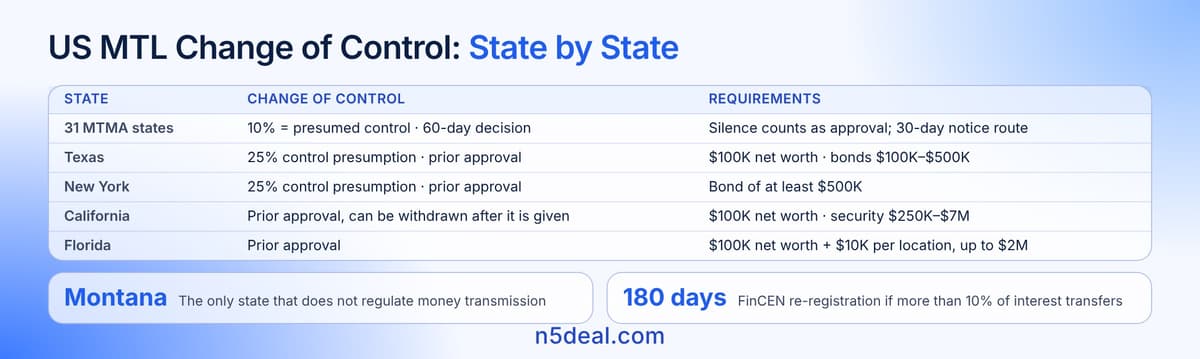
Between 60 days and several months per state, and no state allows closing before it approves. Forty-nine states and the District of Columbia require a money transmitter license; Montana does not regulate money transmission.
Thirty-one states had adopted the Money Transmission Modernization Act in full or in part by September 2026, according to the Conference of State Bank Supervisors. Louisiana's version took effect on 1 July 2026, as did Virginia's. Under the model act, holding 10% or more of a licensee is presumed to be control, the regulator has 60 days to decide, and silence counts as approval. An acquirer already approved for the same deal in other MTMA states can use a shorter 30-day notice route.
States outside the model differ. Texas and New York both use 25% as their control presumption and require prior approval. California's regulator showed in 2026 that approval can be withdrawn after it is given: in the Western Union acquisition of Intermex, New York approved the change of control on 13 August 2026, and the same day California suspended the extension it had granted on 31 July, after more than 50 other states and territories had already cleared the deal.
Capital and bond requirements vary as widely. Texas sets a $100,000 net-worth floor with bonds of $100,000 to $500,000. New York requires a bond of at least $500,000. California sets a $100,000 net-worth floor and security of $250,000 to $7 million. Florida requires $100,000 net worth plus $10,000 per location, up to $2 million. The Money Transmitter License (MTL) page covers the licensing basics state by state.
At federal level, FinCEN registration must be renewed within 180 days if more than 10% of voting or equity interest transfers.
Checklist: what to verify before buying an MSB or MTL holder
Before an MSB or MTL holder is listed on N5Deal, the platform checks the owner's identity, proof of ownership, registration status, company status and public adverse media. The list below is the buyer's own due diligence.
Canada
Registry status and history. Check the FINTRAC MSB registry for the current status, renewal date and every activity listed, including virtual currency and foreign exchange.
Examinations and penalties. Ask for every FINTRAC examination letter, finding and penalty notice, and search FINTRAC's public penalty list for the entity and its trade names.
Conduct since 26 March 2026. Identify any open findings from that date onward, because they fall under the new penalty tiers and the buyer's group revenue.
Compliance program. Request the policies, risk assessment, training records and the latest two-year effectiveness review. A program that exists on paper but has never been reviewed is a very serious violation risk.
RPAA status. Confirm whether the entity is a registered PSP, in review, or outside scope, and plan the Bank of Canada notification before closing.
Deal structure. Use a share purchase if the goal is to keep the registration. An asset purchase means registering again.
United States
License map. List every state license, the renewal dates and any states where the company operates under an exemption.
Change-of-control filings. Identify the threshold and review period in each state, and file in parallel through NMLS.
FinCEN re-registration. Calendar the 180-day deadline if more than 10% of interest changes hands.
Closing conditions. Make closing conditional on approval in every state that requires it, and set a long-stop date that allows for the slowest one.
See MSB and MTL companies for sale
Registered MSBs in Canada and US money transmitters are listed in N5Deal's catalogue of licensed companies for sale. If you own an MSB with a clean FINTRAC record, that record is now part of its price: a free valuation shows by how much.
Disclaimer
This article is general commentary on Canadian and US money services and money transmission rules as they stood in October 2026. Registry counts are taken from public registry data and third-party tallies and change with each update. State requirements differ and change often. Nothing here is legal, regulatory or investment advice, and nothing guarantees a registration, a license, a change-of-control approval or a transaction outcome. Check current requirements with FINTRAC, the Bank of Canada, FinCEN and each state regulator, and take advice from a qualified lawyer before buying or selling a regulated entity.
Comments
Frequently Asked Questions
Clear, concise info to help you understand the process!