
Financial services recorded $134.5bn in disclosed M&A across 1,137 transactions in the first half of 2026, and the ten largest deals carried 58% of that value — $78.7bn. Fintech deal count fell to a six-quarter low of 199 transactions in Q1, down from 269 a year earlier (full H1 2026 figures in our report). KPMG’s fintech-specific count puts payments at $44.2bn for the half — more than the whole of 2025 — and digital assets at $11.1bn across 467 deals, while EMEA fell to a decade low of $11.3bn.
Ranking those deals by price tells you who had the balance sheet. Ranking them by what the buyer was actually paying for tells you something more useful: in six of the ten below, the asset being bought was regulatory permission, and in three of those the buyer would not disclose what permission costs.
1. Ramp acquires Billhop — the licence was the whole deal
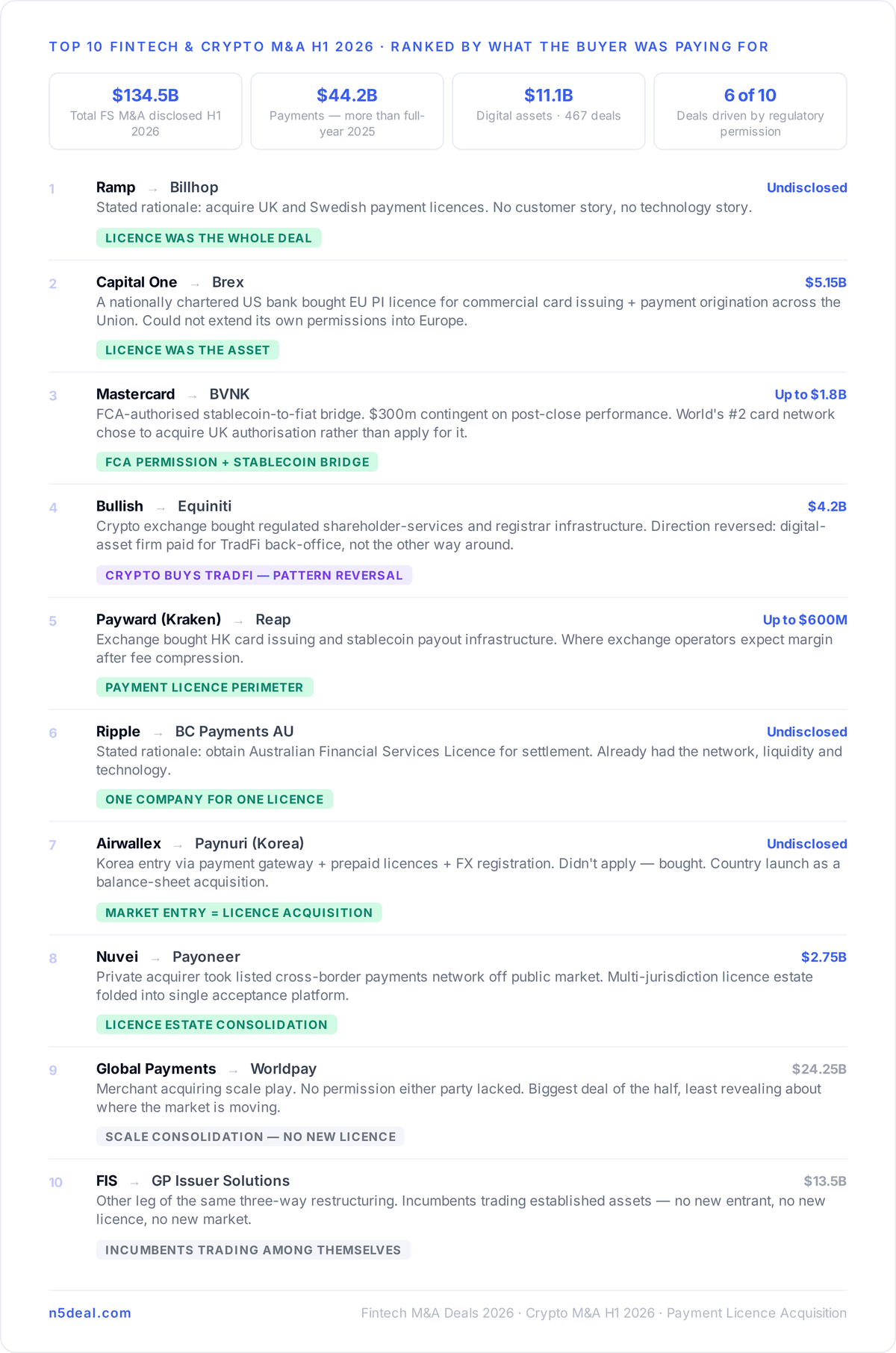
Announced March 2026, value undisclosed. Ramp, a US corporate card and spend management company, bought Swedish B2B payments firm Billhop and stated the rationale plainly: acquire UK and Swedish payment licences, and open offices in London and Stockholm. No customer-base story, no technology story. This is the cleanest signal of the half — a $16bn-valued American fintech concluded that buying European authorisation beat applying for it, and the absence of a disclosed price is consistent with an asset that has no revenue multiple to anchor against.
2. Capital One acquires Brex for $5.15bn — a chartered US bank still had to buy Europe
Announced 23 January 2026 in stock and cash, expected to close mid-2026, and described as the largest bank-fintech deal on record. Brex last raised at $12.3bn in January 2022, so Capital One paid roughly 42% of the 2022 mark. Among the assets: the EU Payment Institution licence Brex had recently obtained, which permits commercial card issuing and payment origination across the Union. A nationally chartered US bank could not extend its own permissions into Europe and bought a company that already had them — the build-versus-buy calculation resolving the same way at the top of the market as it does at the bottom.
3. Mastercard acquires BVNK for up to $1.8bn — a network buys an FCA counterparty
Announced 17 March 2026 and closed 3 August 2026, with $300m of the consideration contingent on performance. BVNK is FCA-authorised and connects stablecoin flows to fiat rails; Mastercard framed the purchase as a chain-agnostic approach that avoids ecosystem lock-in. The scheme with the widest acceptance footprint in the world chose to acquire a UK-authorised entity rather than seek the permission itself, which is the same arithmetic behind applying to the FCA versus buying an authorised firm. The contingent tranche is worth noting: a fifth of the price was held back against a regulated asset’s ability to perform post-close.
4. Bullish acquires Equiniti for $4.2bn — the direction of travel reversed
Announced May 2026, expected to close January 2027. A crypto exchange operator bought a shareholder-services and registrar business, retaining existing leadership. For a decade the pattern was traditional finance buying crypto capability; here a digital-asset firm paid $4.2bn for regulated back-office infrastructure serving listed companies. The eight-month gap between announcement and expected close is the honest price of change-of-control approval on a business of that type — a timeline no buyer can compress with capital.
5. Payward (Kraken) acquires Reap for up to $600m — exchanges become payment companies
Announced 7 May 2026. Kraken’s parent bought Hong Kong-based Reap for its card issuing and stablecoin payment infrastructure across Asia, completing the deal on 1 July. An exchange with a trading revenue model bought a payments licence perimeter, which tells you where exchange operators expect margin to sit after fee compression — and why Hong Kong keeps competing with Singapore for this category of transaction.
6. Ripple acquires BC Payments Australia — bought for one licence
Announced March 2026, value undisclosed. Ripple stated the purpose directly: obtain an Australian Financial Services Licence to oversee settlement and optimise transaction routing. That is the second undisclosed licence-only acquisition announced in the same month as Ramp’s, by a buyer with no shortage of capital. When two unrelated firms buy authorisation in the same four weeks and neither discloses a price, the pattern is not coincidence — it is a market in which permission trades privately.
7. Airwallex acquires Paynuri — market entry priced as an acquisition
Announced January 2026, value undisclosed. Airwallex entered South Korea by buying payment gateway and prepaid electronic payment licences together with an FX business registration. Korea does not grant those permissions quickly to foreign applicants, and Airwallex did not try. The deal reframes what a country launch costs: not a budget line for a local team, but an acquisition on the balance sheet.
8. Nuvei acquires Payoneer for $2.75bn — private capital consolidating licensed networks
Announced June 2026. Nuvei, itself taken private, bought a Nasdaq-listed cross-border payments business to fold its banking network and licence estate into a single acceptance platform. The strategic point is ownership structure: a privately held acquirer took a listed, multi-licensed payments network off the public market, which is how the buyer base for large regulated assets narrows without any regulator changing a rule.
9. Global Payments closes Worldpay at $24.25bn — the biggest deal revealed the least
Completed January 2026, the largest financial-technology transaction of the half by a wide margin. It was a scale play in merchant acquiring: more volume, more merchants, cost synergies. Nothing about it turned on regulatory permission either party lacked. It ranks ninth here precisely because $24.25bn bought consolidation of an existing position rather than access to a new one — the classic incumbent logic that the rest of this list is moving away from.
10. FIS closes the $13.5bn purchase of Global Payments’ Issuer Solutions — incumbents trading among themselves
Completed January 2026, the other leg of the same three-way restructuring, with FIS also selling its remaining Worldpay stake. Two established processors exchanged $37.75bn of assets in a single month without a new entrant, a new licence or a new market involved. Read alongside EMEA’s decade-low $11.3bn, it shows how concentrated the half was: a small number of very large transactions among parties who already held the permissions they needed.
What the ranking adds up to
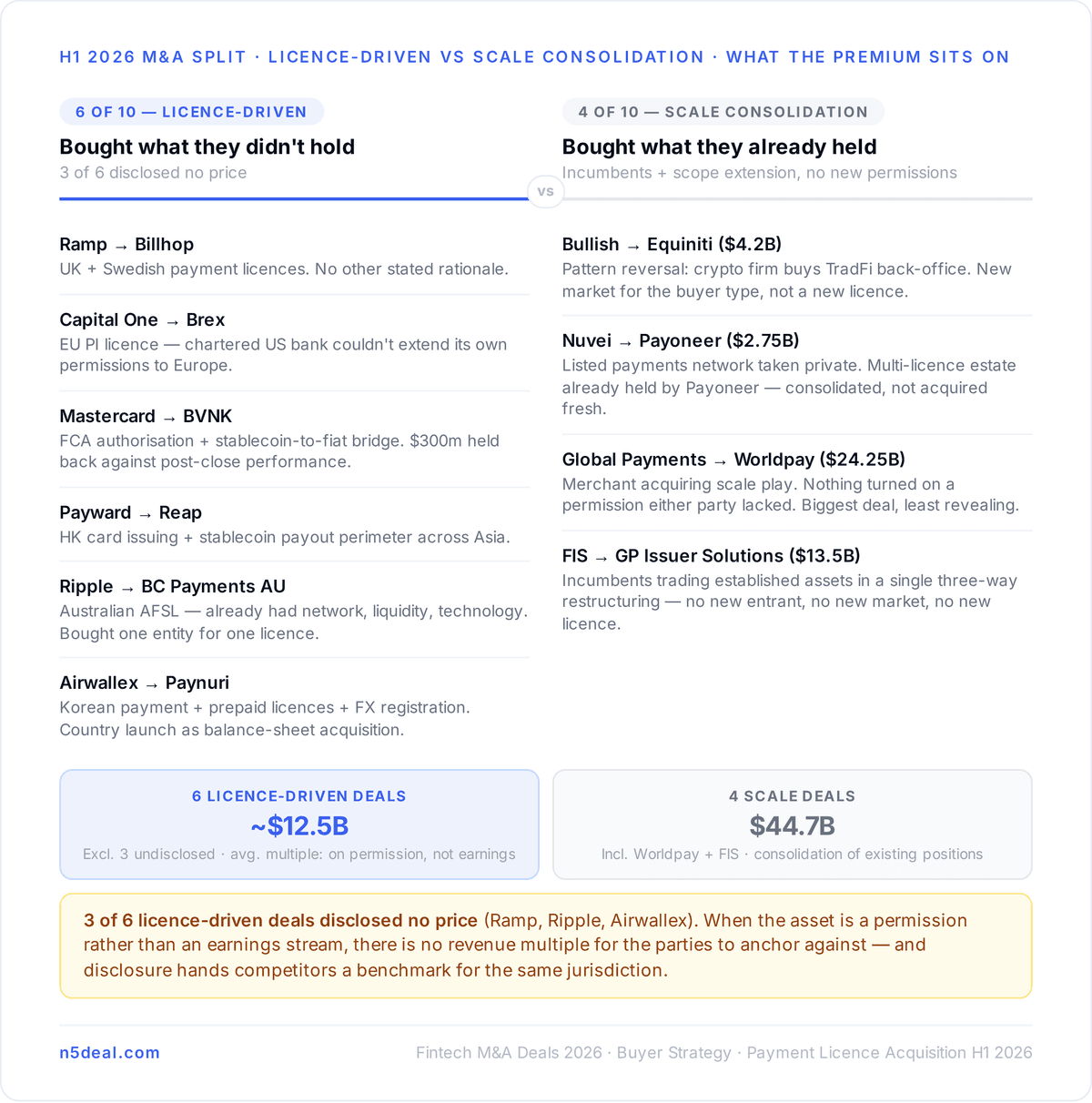
Six of these ten deals were driven wholly or partly by authorisation the buyer did not hold — Ramp, Capital One, Mastercard, Ripple, Airwallex and Payward. Three of the six disclosed no price. The two largest deals of the half, at a combined $37.75bn, involved no licence acquisition at all. The market did not get smaller in H1 2026; it got more selective about what it will pay a premium for, and the premium sits on regulated permission. If you are pricing an entity on either side of that trade, our current listings of licensed entities show what comparable permissions are actually asking today.
Disclaimer
This page is for informational purposes only. It does not constitute legal, financial, or regulatory advice. Readers should consult qualified professionals before making any decisions. N5Deal is an M&A marketplace operated by M&A Tech Group LTD. It is not a regulated financial institution and does not provide investment, legal or tax advice. Nothing on this page is an offer, solicitation or recommendation to buy or sell any business, licence or financial instrument.
Comments
Frequently Asked Questions
Clear, concise info to help you understand the process!