
Crypto licence vs payment licence is the wrong frame for the decision most fintech founders are actually trying to make. The correct frame is product architecture: what the product does determines the licence required, and the two categories of licence cover different regulatory ground that overlaps in specific ways but is not interchangeable. A crypto exchange that holds fiat balances needs both. A stablecoin issuer needs an EMI, not just a CASP. A payment provider processing stablecoin settlement flows needs both a Payment Institution licence and a CASP authorisation. The two licences cover different regulatory ground: the MiCA licence covers crypto-asset services, and the PI licence covers payment services — operating recurring billing or settlement flows without both is a material compliance gap. The product is the starting point. The licence follows from it.
Key Takeaways
Crypto licence vs payment licence is a product-architecture question, not a category question — what the product does at the transaction level determines the regulatory perimeter, not what the founder calls the product
A single legal entity can hold both an EMI licence under EMD2 and a CASP authorisation under MiCA from the same national competent authority — this is the common architecture for retail crypto fintechs in 2026
The dividing line between an EMI and a PI is whether the product stores customer value as e-money — a PI moves money, an EMI stores it; issuance of a stored balance triggers EMI requirements, not PI
Issuing a fiat-backed stablecoin (e-money token) requires an EMI licence under MiCA, not just CASP authorisation — MiCA explicitly uses the EMI licence for EMT issuance
The EBA's February 2026 Opinion clarified but did not eliminate dual authorisation requirements for certain EMT-related payment activities — the expectation that a single CASP covers fiat payment services is one of the most consistent licensing errors in 2026
The Regulatory Ground Each Licence Covers
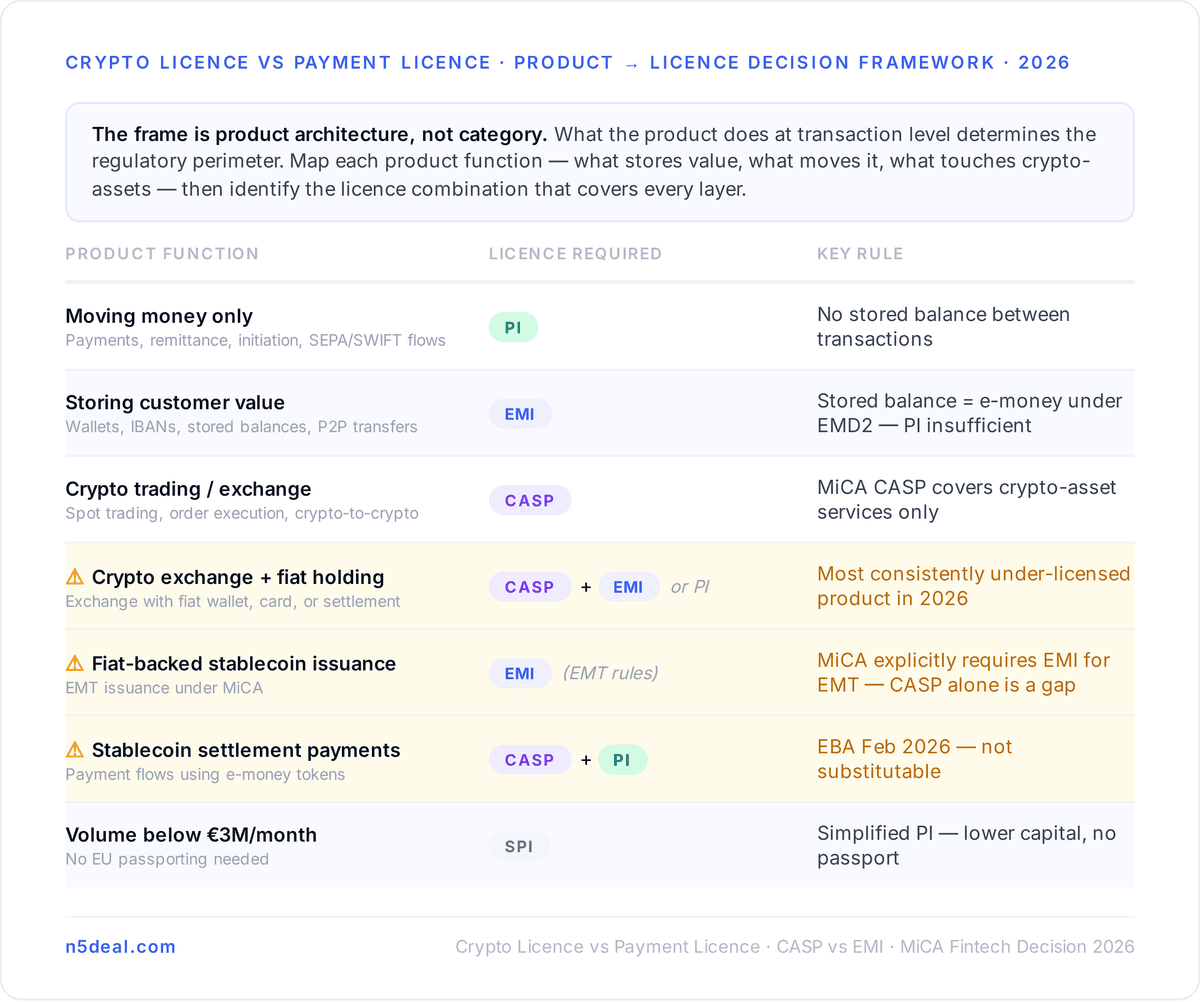
A Payment Institution is authorised to provide payment services — transfers, direct debits, acquiring, money remittance, payment initiation, account information, and payment accounts used for executing payment transactions — under PSD2. A PI moves money on behalf of clients. It does not store value between transactions.
An EMI can do everything a PI can, plus issue e-money: electronically stored monetary value, issued on receipt of funds, representing a claim on the issuer. The practical test is not simply whether the customer can see a balance. A PI may hold customer funds on payment accounts for the purpose of executing payment transactions, including future transactions, but the key distinction is whether value is being stored as e-money or is in transit for the purpose of a payment.
A CASP under MiCA is authorised for specific crypto-asset services: operating a trading platform, exchanging crypto-assets, executing orders, receiving and transmitting orders, providing advice, managing a crypto-asset portfolio, providing transfer services, and custody and administration. A CASP authorisation does not provide the right to hold client fiat balances, issue cards, process fiat payment flows, or issue e-money.
The Five Product Archetypes and What Each Needs
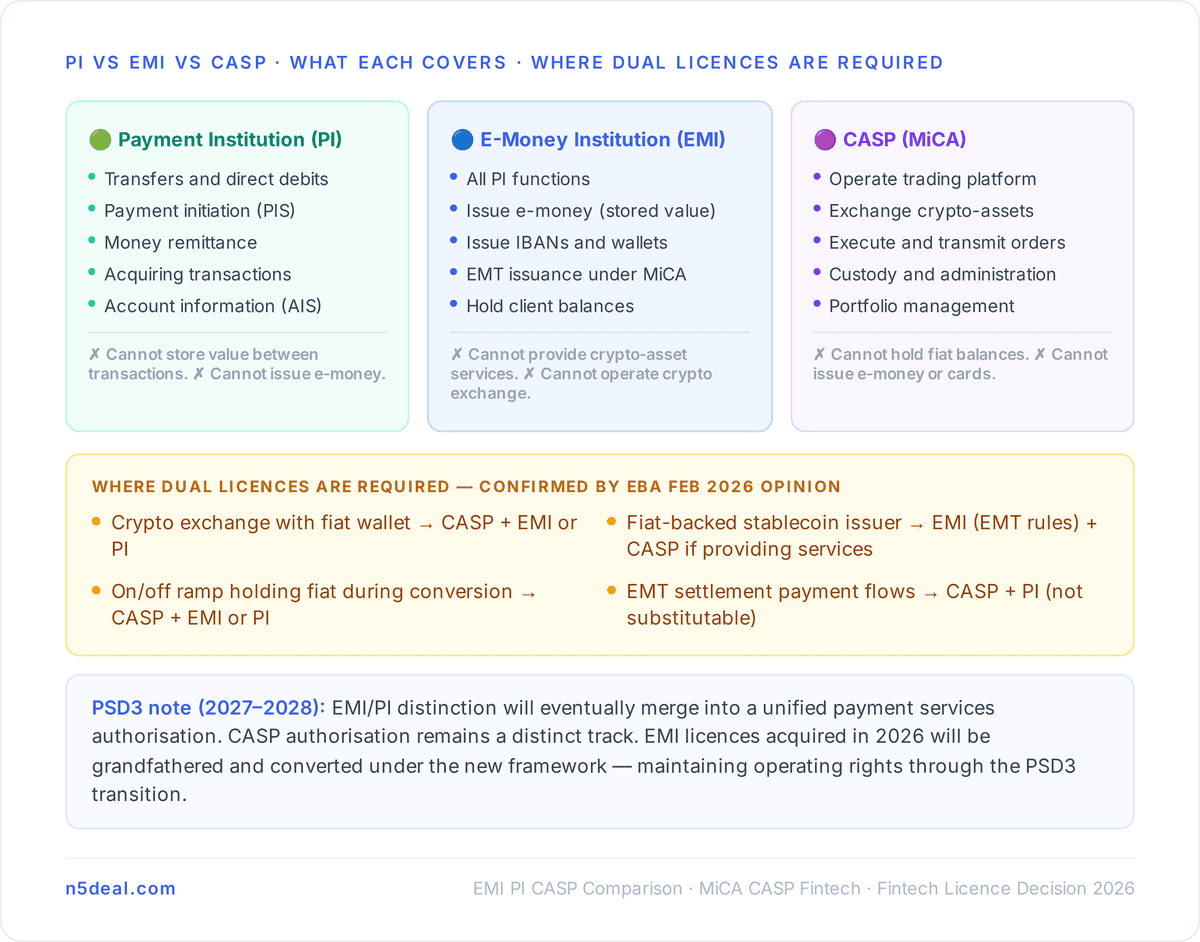
Pure payment rails — B2B payments, cross-border remittance, payment initiation, SEPA/SWIFT flows — where no customer balance is held between transactions: a PI is sufficient. Where monthly transaction volume stays below €3 million, a Small Payment Institution registration may apply, with no passporting rights but significantly lower capital and governance requirements.
Digital wallet with stored balance — a product that issues IBANs, holds client funds as a stored balance, or enables peer-to-peer value transfer within the product's own ledger — requires an EMI. The stored balance is e-money under EMD2; the PI does not cover its issuance.
Crypto exchange — spot trading, order execution, exchange between crypto-assets — requires a CASP authorisation under MiCA for the crypto-asset services component. If the exchange also holds fiat balances, issues a card linked to crypto holdings, or processes fiat payment flows, it requires an EMI or PI alongside the CASP.
Crypto on/off ramp with fiat holding — the product that moves between fiat and crypto, holds fiat during the conversion window, and settles in either direction — is the most consistently under-licensed product in 2026. The CASP covers the crypto-asset service component. The fiat holding and settlement require an EMI or PI. High-profile crypto firms are increasingly pursuing EMI, PI, or CASP authorisation to combine fiat payment rails with crypto services under a single, passportable structure — operating without clear regulatory footing creates both legal risk and competitive disadvantage.
Stablecoin issuer — a product that issues fiat-backed tokens (e-money tokens under MiCA): requires an EMI licence. MiCA explicitly uses the EMI licence framework for EMT issuance. Issuing a fiat-backed stablecoin under a CASP authorisation without an EMI is a structural compliance gap, not a grey area.
The February 2026 EBA Opinion and Its Practical Implication
The EBA's February 2026 Opinion addressed the boundary between MiCA CASP services and payment services under PSD2. It clarified — but did not eliminate — dual authorisation requirements for certain EMT-related payment activities. The practical implication is specific: a fintech that processes payment settlement flows using e-money tokens, and also provides the payment initiation or execution function, needs both CASP authorisation and PI authorisation. The CASP covers the crypto-asset service; the PI covers the payment service. The Opinion confirmed that these are not substitutable — one does not permit the other.
This distinction matters for product decisions being made in 2026 because the EU's AML Regulation, applying from 10 July 2027, will overlay a single rulebook on every CASP, EMI, and PI — replacing the current patchwork of 27 national AML laws. Direct AMLA supervision will cover approximately 40 highest-risk obliged entities; the rest will remain under their home NCA applying the AMLR substantive rules. Building the correct dual-licence architecture now, before the AMLR transition, avoids the compliance rebuild that a single-licence product will face.
PSD3 and the Coming Framework Change
The EU's PSD3 and Payment Services Regulation are expected to merge EMD2 into a unified payment services framework, replacing the EMI/PI split, with adoption expected in 2025-2026 and application from 2027-2028. Existing EMI and PI authorisations will be grandfathered and converted under the new framework. The practical implication for 2026 licensing decisions is directional: the regulatory separation between EMI and PI will eventually collapse into a single authorisation, but CASP authorisation will remain a distinct track covering crypto-asset services.
Founders choosing between applying fresh and acquiring an existing licensed entity should factor the PSD3 transition into the analysis. An existing EMI acquired in 2026 will be grandfathered under PSD3, maintaining operating rights through the transition period. A fresh PI application in 2026 provides a narrower authorisation that will need to be assessed for upgrade under the new framework.
Conclusion
Crypto licence vs payment licence resolves to a product-layer audit, not a category choice. Map each function of the product against the regulatory perimeter of each licence type — what stores value, what moves it, what touches crypto-assets — and the licence combination that covers every layer becomes apparent. For founders evaluating which licensed entities are available for acquisition across EMI, PI, and CASP categories in EU jurisdictions, N5Deal catalogues licensed entities with documented authorisation scope. A full overview of available assets is at n5deal.com.
Disclaimer
This page is for informational purposes only. It does not constitute legal, financial, or regulatory advice. Readers should consult qualified professionals before making any decisions.
Comments
Frequently Asked Questions
Clear, concise info to help you understand the process!