

Fastest fintech licence jurisdictions 2026 is a ranking that only matters if the speed serves the commercial goal. The fastest licence in a jurisdiction whose clients your banking partner won't serve, whose regulator your institutional counterparties don't recognise, and whose authorisation doesn't cover your product's actual activities is not fast — it is a delay that costs twice: once for the application, and once for the rebuild when the gap is discovered. The seven jurisdictions below are ranked on honest go-live timelines verified against 2026 regulatory data. Each one includes what the speed actually buys, and when it is the right answer rather than the fastest one.
Key Takeaways
Fastest fintech licence jurisdictions 2026 span a range from 2 to 4 weeks for a Canada FINTRAC MSB registration to 6 to 9 months for Cyprus MiCA CASP — the fastest tier-1 EU authorisation available
Speed and market coverage are inversely correlated in fintech licensing — the jurisdictions that process applications in weeks typically cover one market; the ones that take 6 to 12 months cover 30
Canada's FINTRAC MSB registration has no minimum capital, no government fee, and no mandatory resident director — making it the fastest FATF-compliant entry point available anywhere for payment and crypto services
A Mauritius Payment Intermediary Services licence was secured in 11 weeks in a documented 2026 case — one of the fastest documented go-live timelines for a regulated payment service licence
Banking is consistently the real bottleneck, not the application — a licence without an operating bank account is a paperweight, and the banking onboarding timeline often exceeds the licensing timeline for fast-entry jurisdictions
1. Canada — FINTRAC MSB (2 to 3 Months)
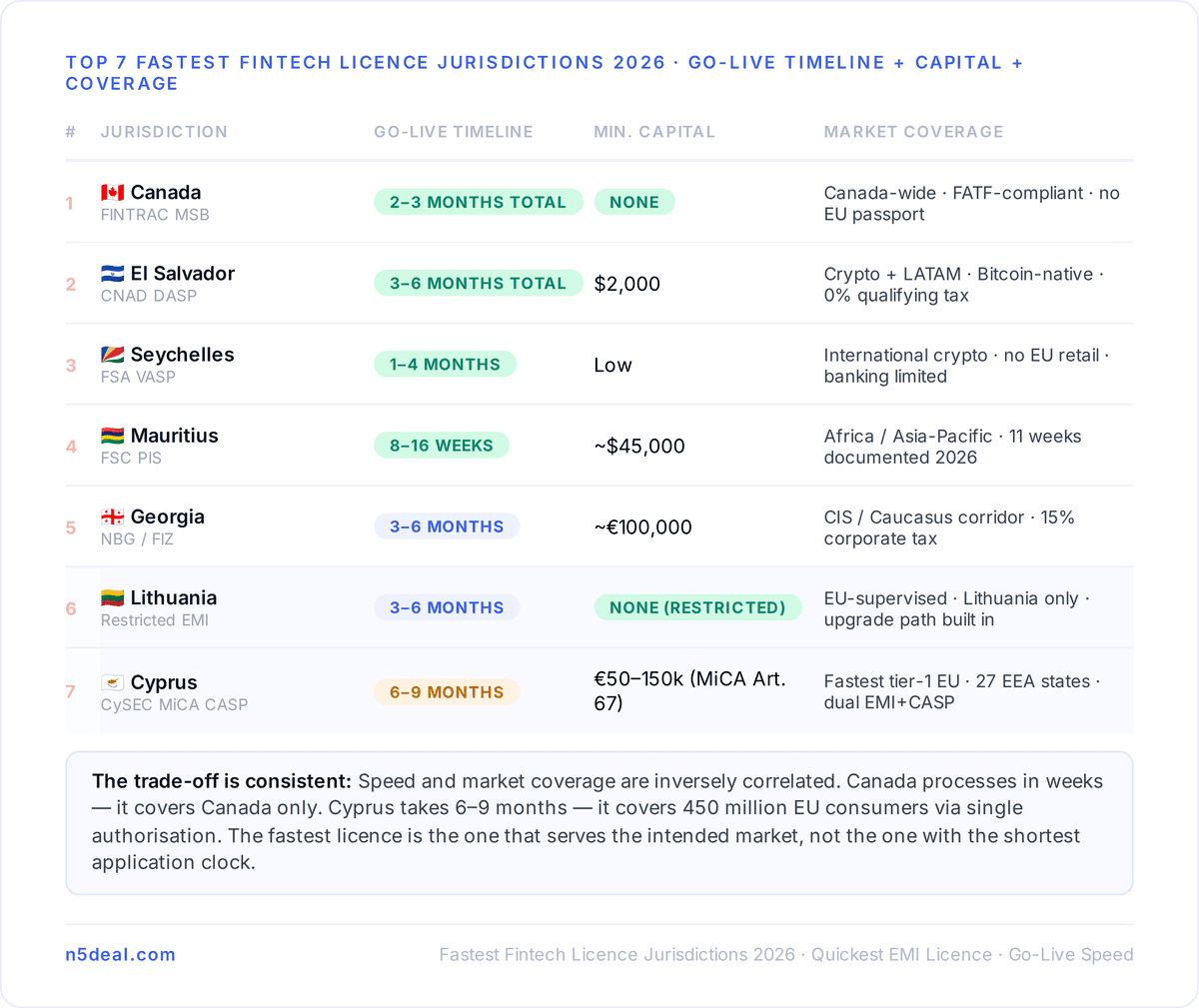
Canada's Money Services Business registration with FINTRAC is the fastest FATF-compliant entry point available globally for payment and crypto services. It has no minimum capital requirement, no government application fee, and no mandatory resident director. FINTRAC registration covers foreign exchange, money transfer, virtual currency exchange and transfer — all under a single registration that works Canada-wide without additional provincial licences outside Quebec.
The registration process itself can complete in 2 to 4 weeks for a well-prepared file. The total go-live timeline including AML programme setup, bank account opening, and operational readiness runs 2 to 3 months for a clean application. Canada is the cheapest, fastest way for a European EMI or PI to establish a North American beachhead, validate demand, and build a regulatory track record before attempting a US state money transmitter licence rollout. The limitation is coverage: Canada only, with no EU passporting and no path to US clients without separate state-level authorisation.
2. El Salvador — DASP/CNAD (4 to 8 Weeks Active + 3 to 6 Months Total)
El Salvador's Digital Asset Service Provider regime, administered by the CNAD, is the lowest-cost formally licensed crypto entry point globally. Minimum capital is $2,000. The registration process takes weeks once the documentation file is complete — with a total end-to-end timeline of 3 to 6 months including preparation, incorporation, and banking setup. Licensed DASP and BSP holders benefit from 0% tax on qualifying digital asset activities.
El Salvador's attractiveness is specific: for Bitcoin-native operations, remittance businesses serving Latin American corridors, and operators who need a legitimate regulatory home without EU capital requirements, it is the fastest credible option available. Banking access is limited — the jurisdiction's banking infrastructure is developing, and many licensed DASP operators pair El Salvador with a second jurisdiction for their correspondent banking and fiat settlement needs.
3. Seychelles — FSA VASP (1 to 4 Months)
The Seychelles Financial Services Authority VASP licence is the fastest entry point that carries a formal regulatory framework for crypto-asset services without EU capital requirements. Setup costs run $30,000 to $100,000. Timelines run 1 to 4 months for a well-prepared application. The Seychelles FSA operates a genuine regulatory oversight framework — not a simple registration — with AML obligations, KYC requirements, and annual supervision.
The practical limitation is banking. Traditional correspondent banking for Seychelles-incorporated entities is limited — most operators use EMI banking partners, crypto-friendly banks, or offshore correspondent structures for their operating accounts. For operators who don't need to serve EU retail clients and whose institutional counterparties don't require a tier-1 EU supervisory credential, Seychelles offers the fastest genuinely regulated entry point for international crypto operations.
4. Mauritius — FSC Payment Intermediary Services (8 to 16 Weeks)
The Mauritius Financial Services Commission issued a Payment Intermediary Services licence in 11 weeks in a documented 2026 case — one of the fastest go-live timelines for a regulated payment service authorisation on record. Typical timelines run 3 to 6 months for a complete, well-prepared application. Capital requirement for a PIS licence is approximately $45,000 — substantially below EU EMI floors.
Mauritius is FATF-aligned, operates a genuine supervisory framework, and provides better banking access than Seychelles for Africa-facing and Asia-Pacific-focused operations. It is a natural licensing home for operators serving sub-Saharan Africa, the Indian Ocean region, and ASEAN corridors who need a credible regulated structure without EU licensing costs. The common multi-jurisdictional architecture pairs a Cyprus MiCA CASP for EU clients with a Mauritius FSC VASP for international markets.
5. Georgia — NBG / FIZ (3 to 6 Months)
Georgia's National Bank registers virtual asset service providers under a national regime, and the Tbilisi Free Industrial Zone provides an accelerated setup path for technology and financial services companies. Total timeline including incorporation, licensing, and operational setup runs 3 to 6 months. Capital requirement for payment services is approximately GEL 300,000 — around €100,000 — substantially below the EU EMI floor of €350,000. Corporate tax is 15%.
Georgia's strategic value is the Caucasus and CIS corridor: remittance flows into Russia, Armenia, Azerbaijan, and Kazakhstan that don't route through EU banking infrastructure. It is a tactical play for speed and cost for operators whose commercial geography centres on that corridor — and a useful regulatory track record builder for operators who plan to upgrade to an EU authorisation after demonstrating operational compliance history.
6. Lithuania — Bank of Lithuania Restricted EMI (3 to 6 Months)
Lithuania's Bank of Lithuania offers a restricted EMI regime with no capital requirement — the only major EU regulator that provides a capital-free entry path to regulated payment services. The restricted EMI caps average outstanding e-money at €900,000 per month and provides Lithuania-only operating rights without EU passporting. Statutory review is 3 months from a complete application, with realistic timelines of 3 to 6 months including file preparation and banking setup.
For operators who need EU regulatory standing but cannot commit €350,000 initial capital before product-market fit is established, the restricted EMI is the fastest EU-supervised entry point available. The upgrade path to an unrestricted EMI — full €350,000 capital and EU passporting — is built into the Bank of Lithuania's framework, allowing operators to migrate when volume projections justify the capital commitment.
7. Cyprus — CySEC MiCA CASP (6 to 9 Months)
Cyprus is the fastest tier-1 EU jurisdiction for a full MiCA CASP authorisation. CySEC processes complete applications in 6 to 9 months — faster than Lithuania's Bank of Lithuania for equivalent CASP applications, faster than Malta's MFSA, and significantly faster than Germany's BaFin or France's ACPR. Capital tiers under MiCA Article 67 run from €50,000 for Class 1 services to €150,000 for Class 3. Corporate tax is 12.5%.
For operators who need EU-wide passporting for crypto-asset services and cannot accept the 9 to 14 month timelines that other major EU CASP jurisdictions produce, Cyprus is the fastest credible path. Its position as the preferred jurisdiction for dual EMI and CASP structure under a single NCA — a single entity, both authorisations, one supervisory relationship — adds a structural advantage for crypto-fiat operators that speed alone doesn't capture.
Conclusion
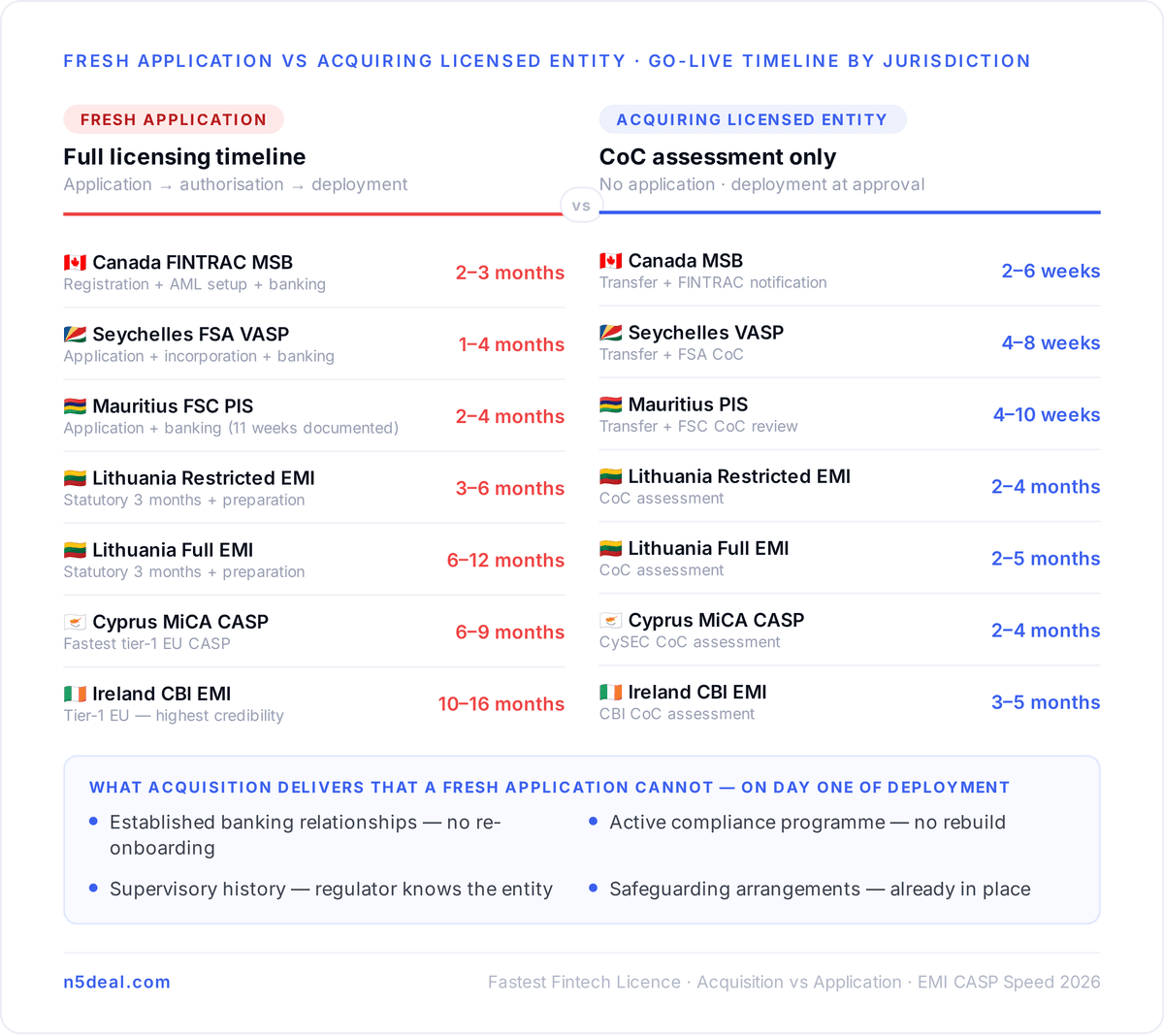
Fastest fintech licence jurisdictions 2026 delivers a range from weeks to months depending on which market the business actually intends to serve. For operators who need speed without EU passporting, Canada, El Salvador, Seychelles, and Mauritius offer the fastest legitimate options at the lowest capital cost. For operators who need EU market access, Lithuania's restricted EMI and Cyprus's CASP authorisation are the fastest credible paths. For buyers who need to compress any of these timelines further, acquiring an existing licensed entity in the target jurisdiction eliminates the application period entirely — converting a 3 to 9 month licensing process into a 2 to 5 month change-of-control assessment from a well-prepared position. For available licensed entities across all these jurisdictions, N5Deal catalogues regulated assets with documented authorisation scope. A full overview is at n5deal.com.
Disclaimer
This page is for informational purposes only. It does not constitute legal, financial, or regulatory advice. Readers should consult qualified professionals before making any decisions.
Comments
Frequently Asked Questions
Clear, concise info to help you understand the process!