

Ready-made company bank account vs licensed entity is a distinction that the market has successfully blurred, and that distinction costs buyers real money when they discover the difference after a purchase. A ready-made company with a bank account is a corporate vehicle — an incorporated legal entity with an existing banking relationship that transfers when ownership changes. A licensed entity is a regulatory authorisation — a specific permission to provide regulated financial services, issued by a supervisory authority, that carries compliance obligations, a supervisory relationship, and a change-of-control assessment before any transfer completes. The two products are marketed in adjacent language, sold through adjacent channels, and priced in overlapping ranges. They are not the same asset, do not provide the same capabilities, and do not satisfy the same regulatory requirements. Understanding which one you are actually purchasing is the first question that must be answered before any other due diligence begins.
Key Takeaways
Ready-made company bank account vs licensed entity is the distinction between a corporate vehicle and a regulatory authorisation — one provides a legal entity with a banking relationship, the other provides permission to provide regulated financial services
A company with a bank account sale transfers the company's legal ownership of the bank account, but the bank still runs its own KYC on the new beneficial owner — banks vary on whether they accept the change of control without re-onboarding, some close the account on transfer regardless of paperwork
In regulated financial services, a company without a licence cannot provide payment services, issue e-money, or process client funds regardless of its incorporation date, its bank account status, or the age of its trading history
A dormant licensed entity — one that holds a regulatory authorisation but has let its compliance programme lapse, its MLRO resign, and its banking relationships dissolve — is a different asset from an operational licensed entity, and pricing that fails to reflect the rebuild cost produces the most common acquisition surprise in this market
If the company has previously received refusals from European regulators, it is unsuitable for launching a regulated financial business — a regulator lookback can investigate past activities after a change of ownership
What a Ready-Made Company with Bank Account Actually Provides
A shelf company or ready-made company is a legal entity that was incorporated and left dormant with no trading history, no assets, and no liabilities. An older incorporation date rather than a fresh registration provides a specific practical advantage in contexts that require a minimum trading history — supplier approval processes, Amazon Seller Central verification, or investment round structures that require an entity with a specified history. For these use cases, the ready-made company genuinely provides what it claims: a faster entry point than incorporating from scratch, with an established entity date.
The bank account component is more conditional. A company with a bank account sale transfers the company's legal ownership of the bank account — but the bank still runs its own KYC on the new beneficial owner. Banks vary on whether they accept the change of control without re-onboarding: some maintain the account fully, some require fresh KYC documentation, some close the account on transfer regardless of paperwork. A reputable provider informs the buyer of the realistic outcome in advance for their specific case and banking relationship. A provider who represents the bank account as a guaranteed asset upon transfer is providing an incomplete picture of what the purchase delivers.
For fintech operations specifically, the bank account provides corporate treasury capability — the ability to hold the company's own operating funds and conduct ordinary commercial transactions. It does not provide the regulatory permission to hold client funds, process payments on behalf of third parties, issue electronic money, or provide any other regulated payment or financial service. Providing those services without a licence is a regulatory violation regardless of how old the company is or whether it has a bank account.
What a Licensed Entity Actually Provides
A licensed entity holds a specific regulatory authorisation issued by a supervisory authority — an EMI authorisation from the Bank of Lithuania, a Payment Institution licence from the FCA, a CASP authorisation from CySEC, a banking charter from the ECB. That authorisation is the specific permission to provide the regulated services listed in the authorisation document, within the scope defined by the regulator, subject to ongoing compliance obligations that include safeguarding, AML/CFT, DORA, governance, and supervisory reporting.
What a licensed entity provides that a ready-made company cannot is a regulatory relationship. The regulator knows the entity. There is a supervisory correspondence file, an inspection history, and a compliance programme that has been assessed by an authority with enforcement power. That relationship — the documented history of how the entity has operated under regulatory oversight — is what changes the buyer's position when approaching banking partners, card schemes, institutional counterparties, and the corporate clients who will send client funds through the entity.
A licensed entity is subject to change-of-control assessment before any transfer completes. Completing a transaction without prior regulatory approval is a criminal offence in most regulated jurisdictions. The assessment reviews the incoming buyer as thoroughly as the original licence applicant — governance, beneficial ownership, regulatory history, financial standing. This is not a formality; it is a substantive review that can take 60 to 90 working days for a clean application from a well-prepared buyer.
The Three Product Types and What Each Costs
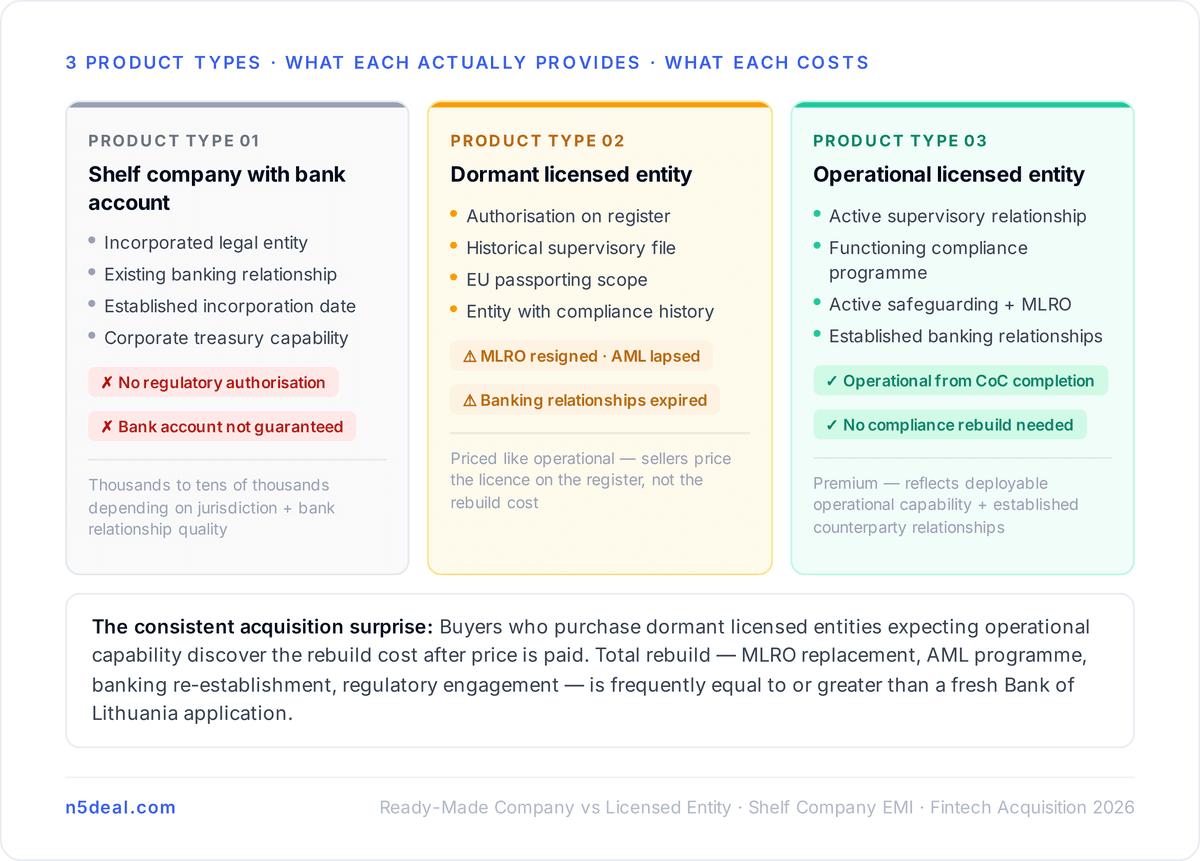
The market produces three product types that are commonly confused with each other, priced in overlapping ranges, and marketed with similar language.
The first is the shelf company with bank account — a corporate vehicle with an existing banking relationship. Useful for corporate structuring, tender credibility, or investment round holding structures. Not useful for providing regulated financial services. Price range: thousands to tens of thousands of euros depending on jurisdiction and bank relationship quality. The bank account is not guaranteed to survive the buyer's KYC review.
The second is the dormant licensed entity — a company that holds a regulatory authorisation that appears active on the register but whose compliance infrastructure has dissolved. The MLRO has resigned. The AML programme has not been updated since the last regulatory examination. The safeguarding account was closed when the banking relationship ended. The authorisation exists on paper; the operational capability to use it does not. Price range: similar to an operational entity, because sellers price for the licence on the register rather than for the rebuild cost. Discovery of the gap after purchase produces the most consistent and most expensive acquisition surprise in this segment.
The third is the operational licensed entity — an entity with an active supervisory relationship, a functioning compliance programme, documented internal procedures, established safeguarding arrangements, active banking relationships, and a compliance history that has been tested by the regulator. This is the asset that provides what the marketing for all three product types claims: immediate operational capability, established counterparty relationships, and a regulatory foundation that doesn't need to be rebuilt from scratch.
What to Verify Before Purchasing Either
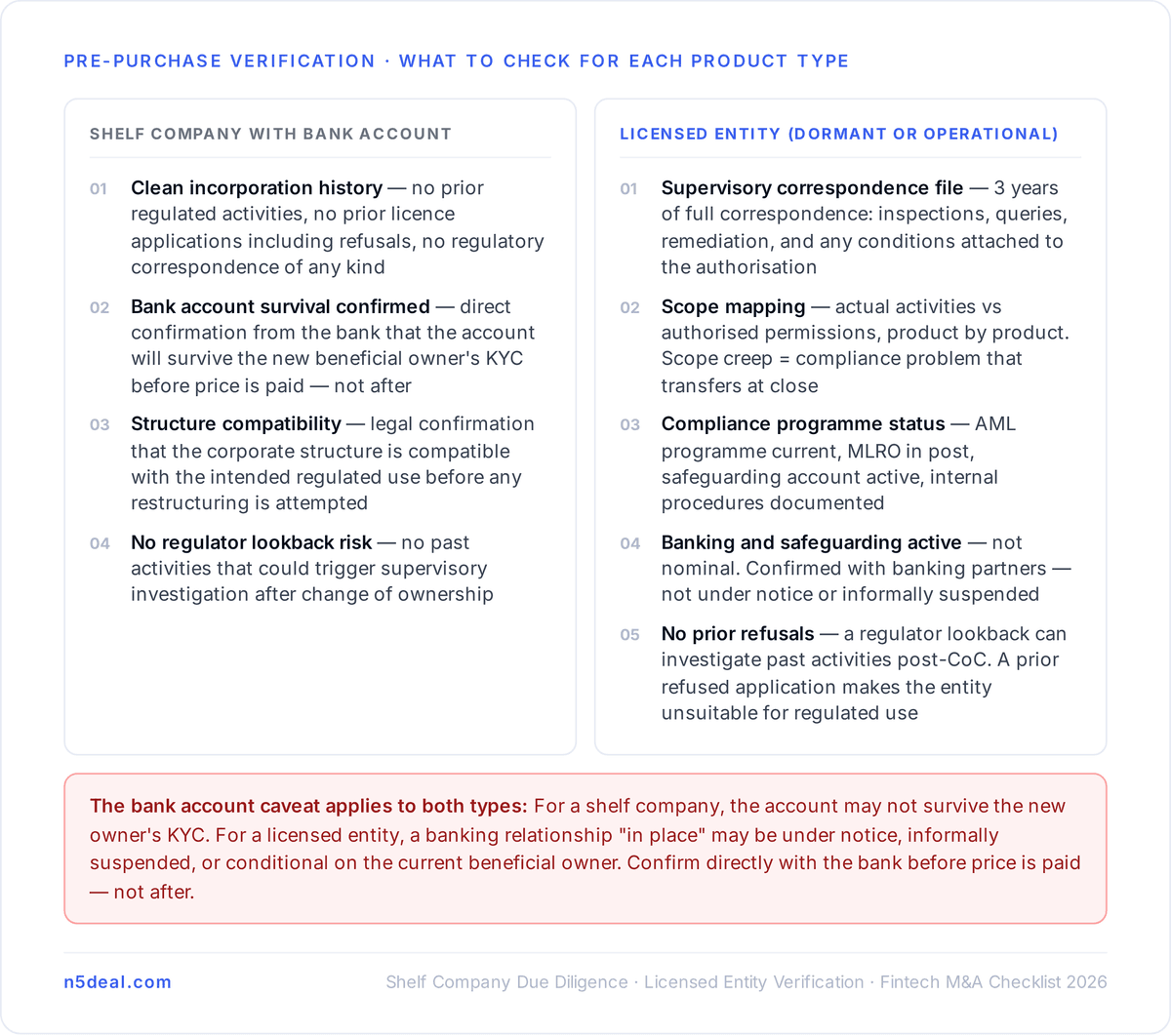
A ready-made company with bank account requires three verifications: confirmation that the incorporation history is genuinely clean with no prior regulated activities, no prior licence applications (including refusals), and no prior regulatory correspondence; direct confirmation from the banking provider that the account will survive the new beneficial owner's KYC review before the purchase price is paid; and legal confirmation that the corporate structure is compatible with the intended regulated use before any restructuring is attempted.
A licensed entity requires the same due diligence applied to any acquisition in this segment — supervisory correspondence file for the preceding three years, scope mapping of actual activities against the authorised permissions, compliance programme documentation review, and confirmation that the banking and safeguarding arrangements are operational rather than nominal. A regulator lookback can investigate the company's past activities after a change of ownership — a prior refused licence application makes the entity unsuitable for a new regulated business regardless of how clean the current register status appears.
Conclusion
Ready-made company bank account vs licensed entity is the distinction between a corporate vehicle and a regulatory permission. The former provides legal entity infrastructure and a conditional banking relationship. The latter provides the right to operate a regulated financial business — subject to change-of-control assessment, ongoing compliance obligations, and a supervisory relationship that transfers with the entity. For buyers who want to understand which licensed entities are available with documented authorisation scope, operational compliance infrastructure, and active banking arrangements, N5Deal presents regulated entities with the information that allows that distinction to be assessed before formal processes begin. A full catalogue is at n5deal.com.
Disclaimer
This page is for informational purposes only. It does not constitute legal, financial, or regulatory advice. Readers should consult qualified professionals before making any decisions.
Comments
Frequently Asked Questions
Clear, concise info to help you understand the process!