

EMI licence cost 2026 is almost always quoted as the initial capital figure — €350,000 under EMD2, held in a segregated account and verified by the regulator. That number is the starting point, not the total cost. The real first-year cost of a fresh EMI application includes regulatory filing fees, professional fees for legal and compliance preparation, key personnel salaries for the MLRO and local directors, office and substance costs, safeguarding account setup, and ongoing own-funds maintenance calculated at 2% of average e-money outstanding on top of the capital floor. In practice, working capital needed to open the doors is well above the statutory minimum — and that gap is the number founders consistently underestimate when deciding between applying fresh and acquiring an existing licensed entity.
Key Takeaways
EMI licence cost 2026 starts at €350,000 initial capital across all EU jurisdictions — the headline figure that varies by jurisdiction is not the capital but the professional fees, filing fees, timeline cost, and post-authorisation infrastructure
Lithuania's Bank of Lithuania charges a statutory application fee of €1,463 — the lowest in the EU — with a statutory 3-month review period from a complete file and a realistic 3 to 6 month total timeline
Luxembourg's CSSF charges a €30,000 filing fee on top of the €350,000 capital requirement — the highest entry cost among the major EU EMI hubs — but CSSF-supervised entities are accepted by institutional counterparties who will not engage with smaller-jurisdiction licensees
The Central Bank of Ireland charges no application fee, takes 10 to 16 months, and costs €120,000 to €250,000 in professional fees — justified by institutional credibility that compresses banking and counterparty onboarding timelines post-authorisation
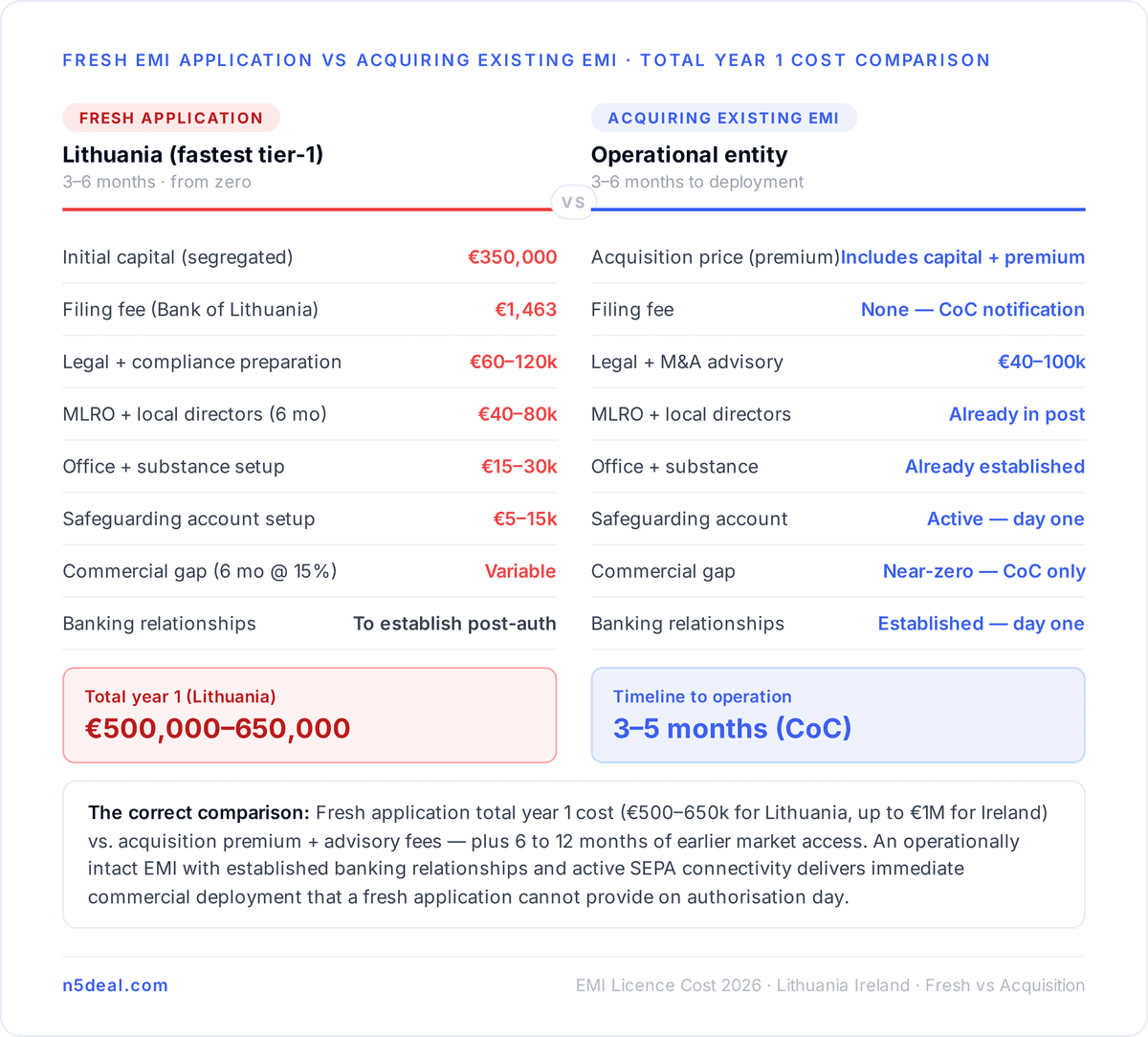
A well-documented fresh EMI application in the right jurisdiction typically costs €500,000 to €1.2 million in the first year including capital — acquiring an existing operational EMI compresses that timeline by 6 to 12 months while delivering established banking relationships from day one
Lithuania — Bank of Lithuania
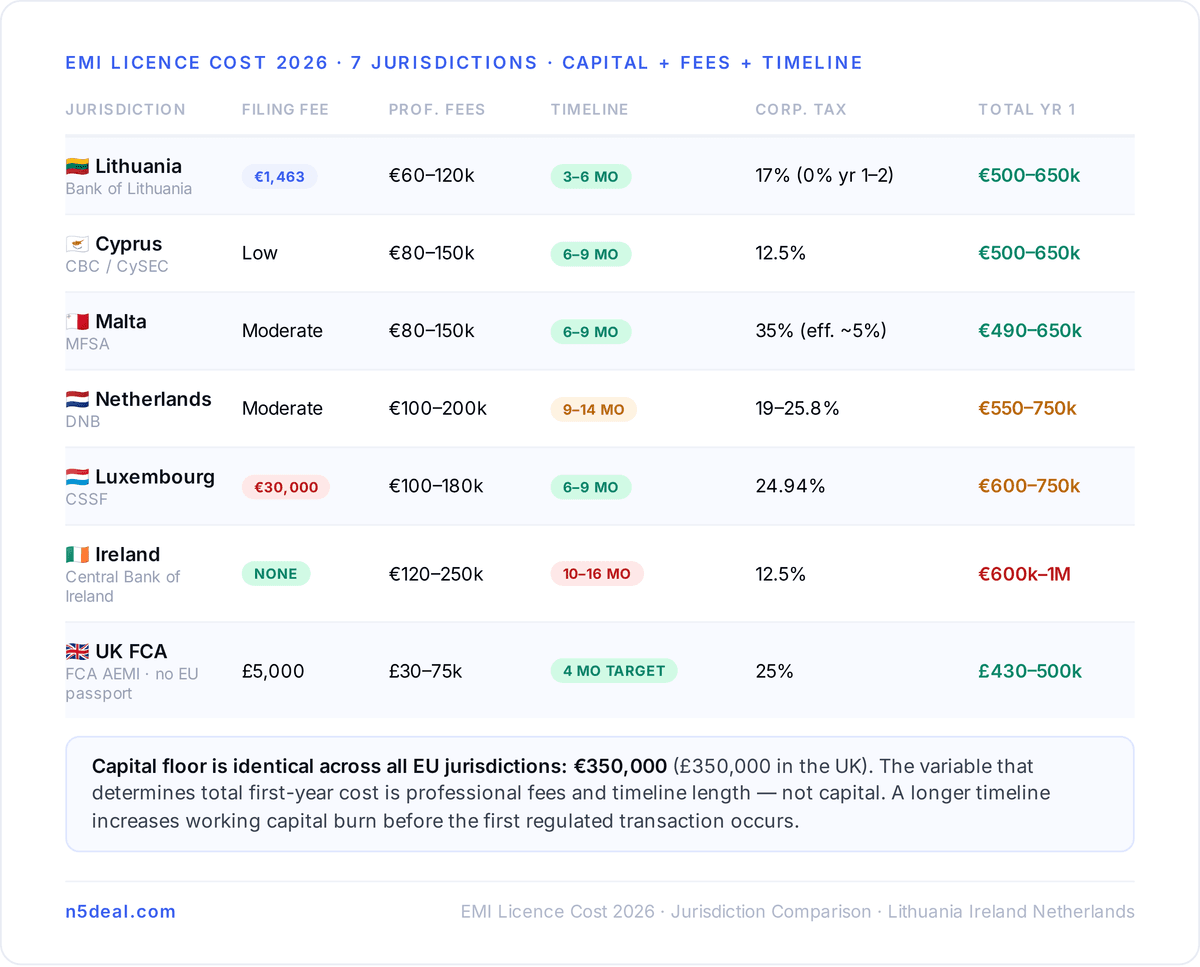
Lithuania hosts the largest population of EMI licences in the EU, with over 100 licensed entities including Revolut's EU entity, Flywire, Banking Circle, and Paysafe. Every exchange with the regulator, every document and every meeting can be in English — rare outside Ireland, the Netherlands, and Malta. The statutory application fee is €1,463, and the statutory review period is 3 months from a complete application, with realistic timelines of 3 to 6 months. Professional fees for a well-prepared Lithuanian application run €60,000 to €120,000. Total first-year cost including capital: €500,000 to €650,000.
Corporate income tax rose to 17% from January 2026, up from 16%. New small companies benefit from a 0% rate for the first two years of operation. Lithuania's CENTROLINK system provides direct SEPA access — reducing dependence on commercial correspondent banks for EUR settlement. Bank of Lithuania runs a structured pre-application newcomer programme and a sandbox for innovative business models. Best for: crypto-adjacent fintechs, pan-EU neobanks, operators prioritising speed and regulator accessibility.
Ireland — Central Bank of Ireland
The Central Bank of Ireland has licensed dozens of EMIs and PIs since PSD2 came into force, including a steady stream of post-Brexit relocations — Stripe, Modulr, Square, Coinbase, and Gemini chose Ireland for their EU entity. Ireland charges no application fee. It charges in time: end-to-end for a well-prepared EMI runs 10 to 16 months. Professional fees reflect the CBI's documentation depth — €120,000 to €250,000 for a standard application. Total first-year cost including capital: €600,000 to €1 million. Corporate tax is 12.5% — among the lowest in the EU.
What Ireland buys that Lithuania doesn't is a supervisory reputation that institutional counterparties, tier-1 correspondent banks, and card schemes recognise globally without additional verification. That recognition compresses post-authorisation onboarding in a way that has a measurable commercial value. Best for: global platforms, post-Brexit relocations, operators for whom institutional credibility is a primary commercial asset.
Netherlands — De Nederlandsche Bank
The Netherlands has attracted a growing cluster of EU-first fintechs — Adyen, Mollie, MoonPay Europe, Bitvavo, and bunq — with four factors explaining the pull: English-language procedure in practice, tier-1 supervisor reputation, deep banking and card-scheme ecosystem, and pragmatic digital-first regulatory approach.
The DNB statutory assessment clock runs 13 weeks from a complete application. Realistic total timelines are 9 to 14 months. Capital requirement is €350,000 for a full EMI scope. Professional fees run €100,000 to €200,000. Corporate tax is 19% on the first €200,000 of profit and 25.8% above that. The Netherlands offers a middle path between Lithuanian speed and Irish credibility — DNB-supervised entities carry institutional recognition comparable to CBI-supervised ones, at a shorter timeline. Best for: DACH and Benelux-focused operators, institutional-grade credibility without Irish timelines.
Cyprus — Central Bank of Cyprus
Cyprus is the preferred jurisdiction for operators who need both an EMI and a MiCA CASP authorisation from the same national competent authority — the combination the most common architecture for retail crypto fintechs requires in 2026. Capital is €350,000 for a full EMI. Timeline runs 6 to 9 months. Professional fees are €80,000 to €150,000. Corporate tax is 12.5%, matching Ireland's rate but with lower professional fees and a faster timeline. Total first-year cost including capital: €500,000 to €650,000.
The dual-structure advantage is specific: a Cyprus entity can hold both EMI authorisation under EMD2 and CASP authorisation under MiCA from CySEC, avoiding the complexity of operating two legal entities in two jurisdictions when the product genuinely requires both. Best for: crypto-fiat operators needing a combined EMI and CASP, tax-efficient EU structure, operators with Southern European or Eastern Mediterranean distribution.
Malta — MFSA
Malta's Financial Services Authority offers an established, dialogue-oriented supervisory relationship that appeals to operators who value substantive pre-application engagement. Capital is €350,000. Timeline is 6 to 9 months. Professional fees are €80,000 to €150,000. Malta's statutory corporate tax rate is 35%, but a shareholder refund system reduces the effective rate to approximately 5% for non-resident shareholders — making it the most tax-efficient structure in the EU for certain ownership arrangements. Total first-year cost including capital: €490,000 to €650,000.
Malta tightened safeguarding and AML expectations through 2025 and 2026, including a May 2026 MFSA circular on investment of client funds. Operators who value the MFSA's established processes and willingness to engage technically with complex product architectures find Malta worth the governance investment. Best for: iGaming payment operators, operators with complex holding structures seeking effective tax rate optimisation, businesses valuing substantive pre-application dialogue.
Luxembourg — CSSF
Luxembourg is not the largest EMI or PI hub in the EU — that title belongs to Lithuania and Ireland — but it is one of the most prestigious. CSSF supervision is high-quality, the banking and fund ecosystem is deep, and Luxembourg EMIs and PIs are routinely accepted by institutional counterparties that would not touch a smaller-jurisdiction licensee.
The CSSF charges a €30,000 filing fee — the highest in the EU — on top of the €350,000 capital requirement. Professional fees run €100,000 to €180,000. Timeline is 6 to 9 months. Corporate tax at 24.94% effective is among the highest in the comparison. Total first-year cost including capital: €600,000 to €750,000. What Luxembourg charges in cost it returns in counterparty access — a CSSF-licensed entity opens banking and institutional relationships that other jurisdictions cannot match for the fund administration and institutional payment market. Best for: fund-ecosystem payment operators, institutional payment services, operators whose primary counterparties are Luxembourg-domiciled funds and family offices.
United Kingdom — FCA
The UK Authorised EMI (AEMI) is a post-Brexit standalone authorisation covering the UK domestic market only — no EU passporting. Capital is £350,000. The FCA's statutory application fee is £5,000, non-refundable. Professional fees for a standard application run £30,000 to £75,000 — substantially lower than most EU equivalents. Complete FSMA applications are targeted for a four-month turnaround, while those deemed incomplete face a ten-month outer limit. Corporate tax is 25%. Total first-year cost including capital: £430,000 to £500,000.
The critical constraint is that the FCA stopped issuing EMI licences freely after 2019 regulatory intervention, making acquisition of an existing FCA-authorised entity often the only practical route for operators who need FCA EMI status quickly. For operators requiring both UK and EU coverage, the dual-licence architecture — FCA AEMI for the UK plus an EU EMI for EEA passporting — is the standard approach. Best for: sterling-centric operations, operators serving UK retail customers exclusively, dual-structure alongside an existing EU EMI.
Conclusion
EMI licence cost 2026 is a total first-year calculation, not a capital figure. Lithuania offers the lowest entry cost and fastest timeline among tier-1 EU supervisors. Ireland costs the most and takes the longest, and delivers the highest institutional credibility return. The Netherlands and Luxembourg sit between them on cost and closer to Ireland on institutional recognition. Cyprus adds the dual EMI and CASP structure advantage for crypto-fiat operators. Malta offers the most tax-efficient effective rate for certain ownership structures. The UK stands alone as a post-Brexit market entry point with no EU passporting and an acquisition-dominated market for FCA EMI status.
For buyers comparing the fresh application path against acquiring an existing licensed entity, N5Deal catalogues EMI-licensed entities across these jurisdictions with documented authorisation scope, compliance history, and banking relationship status. A full overview of available assets is at n5deal.com.
Disclaimer
This page is for informational purposes only. It does not constitute legal, financial, or regulatory advice. Readers should consult qualified professionals before making any decisions.
Comments
Frequently Asked Questions
Clear, concise info to help you understand the process!