
MiCA CASP vs offshore crypto licence is not a philosophical debate about regulatory philosophy. It is a commercial decision about which markets the business intends to serve, at what cost, on what timeline, and with what banking access. The EU's MiCA framework offers the broadest single-licence coverage available anywhere — one CASP authorisation passporting to 450 million consumers across 27 member states. Offshore jurisdictions like the Cayman Islands, Seychelles, and Mauritius offer faster, cheaper entry points for businesses not yet ready for the cost of a tier-1 licence, or for operators serving markets where EU regulation does not apply. Most serious operators in 2026 end up holding both — planned and sequenced rather than pursued as an afterthought. The question is not which is better. It is which comes first, and what each one actually enables.
Key Takeaways
MiCA CASP vs offshore crypto licence is a sequencing decision for most serious operators — the EU licence covers EU retail distribution, the offshore structure covers international markets, and the smart operators run both simultaneously
The crown jewel of the MiCA framework is passporting under Article 63 — one authorisation, obtained in a business-friendly jurisdiction like Cyprus or Malta, grants access to 450 million EU consumers without physical presence in each member state
MiCA capital tiers under Article 67: €50,000 for advice and reception services, €125,000 for custody, exchange, and execution, €150,000 for own-account trading and operating a trading platform — with setup costs running $100,000 to $500,000 and timelines of 6 to 18 months
Offshore setup costs range from $15,000 to $150,000 with timelines of 1 to 10 months — but the cheapest licence is rarely the cheapest outcome: a credential banks won't accept provides market access on paper and not in practice
The enforcement reality in 2026 is binary for European operators: invest in MiCA compliance or exit the EU market — the transitional period for grandfathered VASP operations ended for most EU jurisdictions on July 1 2026
What MiCA CASP Gives You That Offshore Doesn't
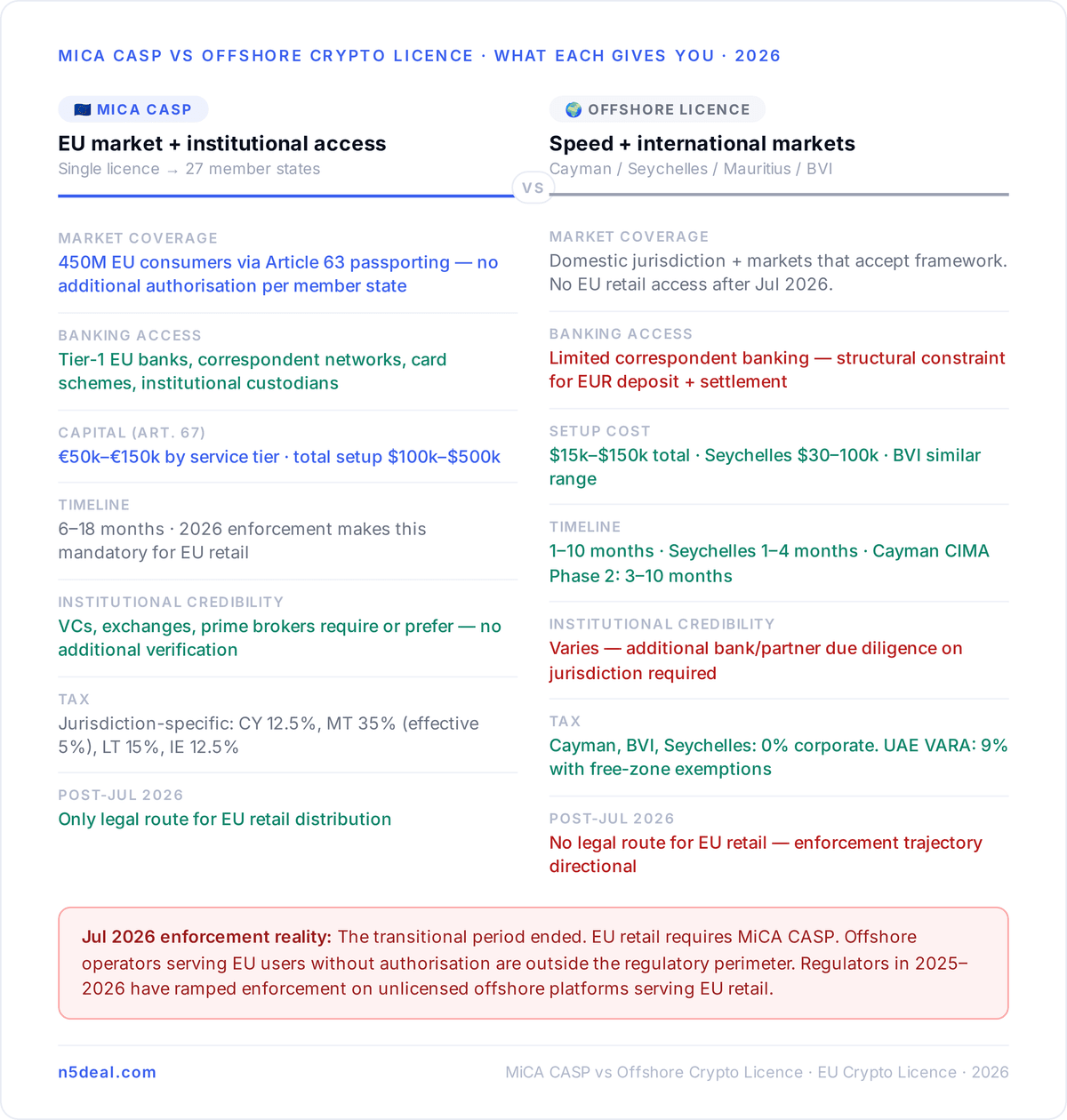
EU-wide passporting. Once authorised under MiCA Article 63, a CASP can provide crypto-asset services across all 27 member states through the right of establishment or the freedom to provide services — without requiring physical presence or a separate authorisation in each host member state. No offshore jurisdiction offers an equivalent. A Cayman licence, a BVI VASP registration, or a Seychelles FSA authorisation provide operating rights in those jurisdictions and, to varying degrees, in markets that accept those frameworks. They do not provide access to EU retail customers. For any operator whose growth thesis includes EU distribution, MiCA is not optional — it is the entry requirement.
Banking access. A licence you cannot bank is not an asset. MiCA CASP authorisation opens relationships with tier-1 EU banks, correspondent banking networks, card scheme memberships, and institutional custodians that apply regulatory recognition as a precondition for onboarding. Traditional correspondent banking for Seychelles IBCs is limited — a structural constraint that makes the offshore structure commercially viable for some product profiles and not for others. An operator who cannot open an EU bank account cannot process EUR deposits, cannot issue EUR-denominated products, and cannot settle in EUR with institutional counterparties. MiCA CASP resolves that constraint.
Institutional counterparty credibility. VCs, exchanges, and custodians prefer or require licensed partners — and in 2026, licensed increasingly means tier-1 regulated. EU MiCA CASP, Singapore MAS, Hong Kong SFC VATP, and UAE VARA are the tier-1 designations that institutional counterparties treat as requiring no additional verification. An operator raising institutional capital or seeking prime brokerage relationships with established counterparties is negotiating from a categorically different position with a MiCA CASP authorisation than with a Seychelles FSA registration.
What Offshore Gives You That MiCA Doesn't
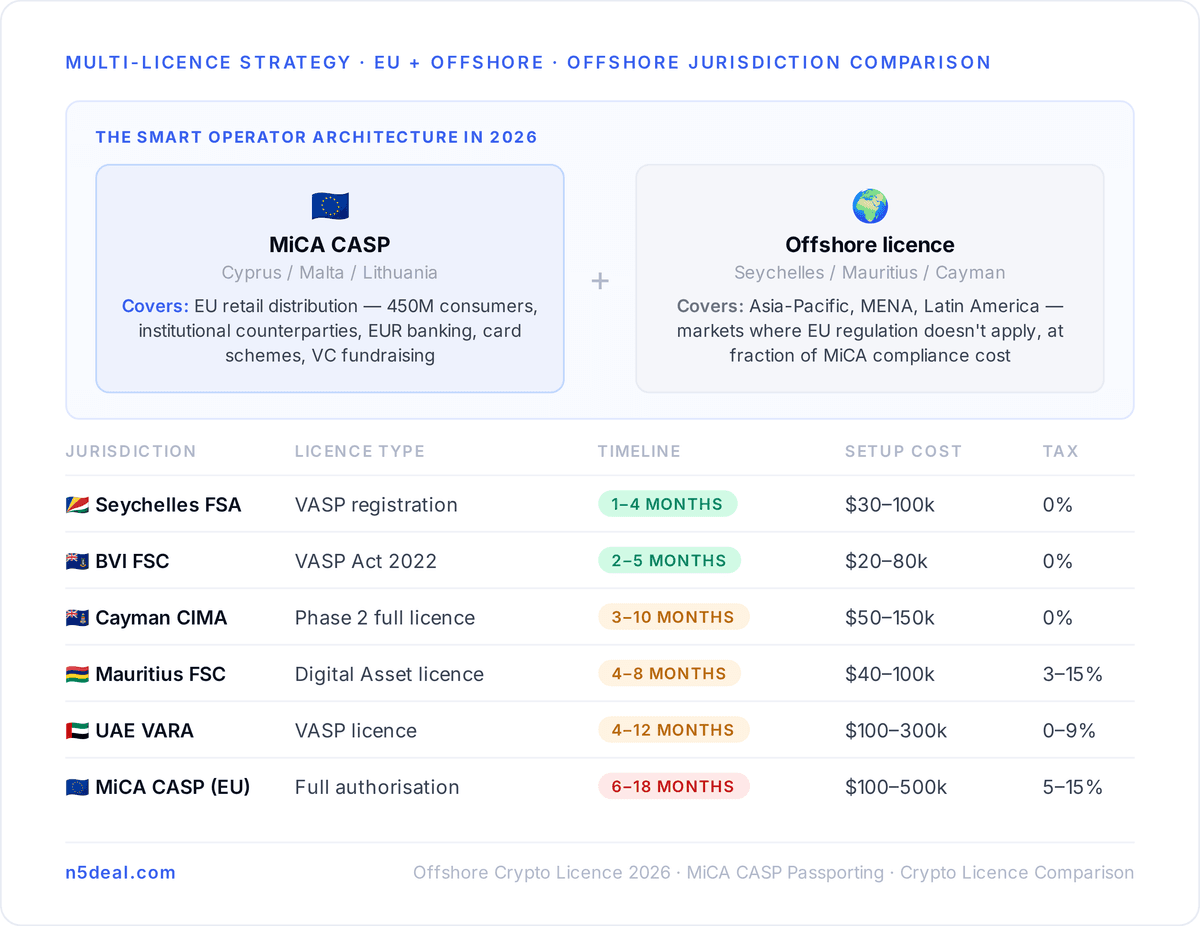
Speed and cost. MiCA CASP authorisation runs 6 to 18 months from submission to determination, with setup costs of $100,000 to $500,000 including capital, professional fees, and compliance infrastructure. Offshore jurisdictions operate on categorically different timelines: Seychelles FSA VASP licensing runs 1 to 4 months at $30,000 to $100,000 total setup cost. BVI FSC under the VASP Act 2022 processes in similar ranges. Cayman Islands CIMA Phase 2 full licensing, mandatory for custody and trading platforms since April 2025, runs 3 to 10 months. For a business that needs market access in a defined commercial window before MiCA authorisation can be obtained, the offshore structure provides a legal operating framework while the EU application progresses.
Tax efficiency. Cayman, BVI, UAE VARA, AIFC Kazakhstan, and El Salvador all offer 0% corporate tax on qualifying activities. UAE applies 9% corporate tax with free-zone exemptions for qualifying businesses. Switzerland applies 0% private capital gains for individuals. MiCA CASP authorisation is jurisdiction-specific for tax purposes — Cyprus, Malta, Lithuania, and Ireland each have their own corporate tax regimes. The tax differential between an offshore structure and an EU CASP is a real variable in the total cost of capital calculation.
Market flexibility for non-EU activity. An operator running a global exchange that serves Asia-Pacific, MENA, and Latin American users alongside EU customers does not need MiCA authorisation for the non-EU user base. An offshore structure — Mauritius FSC for Africa and Asia, Seychelles FSA for global retail, Cayman for institutional — covers those market segments at a fraction of the MiCA compliance cost. The multi-licence strategy emerges from this commercial logic: EU licence for EU distribution, offshore structure for international markets where EU regulation does not apply.
The 2026 Enforcement Reality
European operators face a binary choice: invest in MiCA compliance or exit the EU market. The window for grandfathered operations closes in weeks, not months. The transitional period that allowed existing VASPs to continue operating while awaiting CASP authorisation ended for most EU jurisdictions on July 1 2026. An operator serving EU retail customers from an offshore structure without MiCA authorisation after that date is operating outside the regulatory perimeter — exposing the business and its directors to supervisory enforcement.
In 2025 and 2026, regulators ramped up enforcement on unlicensed offshore platforms serving local EU users. The enforcement trajectory is directional: the compliance investments being forced by MiCA create barriers to entry that protect licensed operators from low-cost offshore competition. The operators who secure CASP authorisation in 2026 hold a structural advantage when enforcement normalises — the offshore operators who were serving EU retail users without authorisation face the opposite outcome.
The Multi-Licence Strategy
The smart operators are running multi-licence strategies: an EU licence, usually a Cyprus MiCA CASP, for EU market access, plus an offshore licence — Mauritius, Seychelles, or similar — for international markets where EU regulation doesn't apply. This is not a workaround — it is the commercially rational architecture for a global crypto operator in 2026. The EU licence covers the highest-compliance, highest-value retail market. The offshore structure covers international distribution efficiently. The two structures serve different purposes and are not substitutable for each other.
For buyers evaluating licensed crypto assets, the dual-structure operator presents a different acquisition profile than a pure MiCA CASP holder. The combined structure has broader geographic reach, more complex regulatory relationships, and a compliance infrastructure that must be maintained across multiple supervisors. Each variable changes the due diligence scope and the post-acquisition integration plan.
Conclusion
MiCA CASP vs offshore crypto licence resolves to a market geography decision layered onto a capital and timeline constraint. EU retail distribution requires MiCA. International markets where EU regulation doesn't apply don't. Most serious operators plan both from the start and sequence the applications so that the offshore structure provides operating capability while the EU authorisation progresses. For buyers evaluating where MiCA CASP-licensed and offshore-licensed crypto entities are available for acquisition, N5Deal catalogues licensed entities across both categories. A full overview of available crypto-licensed assets is at n5deal.com.
Disclaimer
This page is for informational purposes only. It does not constitute legal, financial, or regulatory advice. Readers should consult qualified professionals before making any decisions.
Comments
Frequently Asked Questions
Clear, concise info to help you understand the process!