

Ready-made fintech licence myths are persuasive because they are partially true. A ready-made or shelf-company licence does provide faster market access than a fresh application — in many cases. It does transfer an existing supervisory relationship — to a point. And it does give the buyer a regulatory foundation they didn't have to build from scratch — provided the foundation is actually intact. The problem is that each of those partial truths comes with a condition that the myth omits, and that condition is where the acquisition cost surprises land. The seven below are the most consistent and most expensive ones.
Key Takeaways
Ready-made fintech licence myths produce acquisition surprises that are structural, not transactional — they trace back to misunderstandings about what transfers at close, what requires regulatory approval, and what conditions must be met before the licence can actually be used
The authorisation stays with the licensed entity while the regulator assesses the incoming owner — plan the 10% control trigger, the 60-working-day assessment, buyer evidence requirements, and non-opposition condition as a single transaction workstream, not a formality
A dormant entity may have let its compliance programme lapse, its safeguarding arrangements expire, its AML officer resign, and its banking relationships dissolve — the licence exists on paper while the operational infrastructure that makes it deployable has dissolved around it
The FCA stopped issuing EMI licences freely after 2019 regulatory intervention — acquisition is often the only route for operators who need FCA EMI status, which is precisely why FCA entities command a premium and why a cheaper alternative is not the same asset
Ready-made licence pricing is highly variable and frequently disconnected from actual regulatory value — a dormant entity with no banking relationships and an expired compliance programme is priced for the licence on the register, not for the operational infrastructure required to use it
Myth 1: You Can Start Operating Immediately

The most consistent first surprise in a ready-made licence acquisition is discovering that "active" on the register does not mean "operational on closing day." Most regulators require explicit approval before a change of control takes effect — and that approval process is a substantive review of the incoming buyer, not a notification. Plan the 10% trigger, the 60-working-day assessment, buyer evidence requirements, and non-opposition condition as one transaction workstream.
During that assessment period, the acquired entity continues to operate under its existing ownership structure. The buyer is not permitted to direct the business, instruct the compliance function, or rebrand the entity until the regulator has issued non-opposition. Operational deployment begins after regulatory clearance — not after the purchase price is paid.
Myth 2: The History Doesn't Come With the Licence
A licence is not a transferable credential that separates cleanly from its compliance history. The supervisory correspondence file, any open remediation requirements, unresolved AML audit findings, and conditions attached to the authorisation all transfer with the entity. A register status showing "active" can coexist with an open regulatory query that the seller chose not to disclose, a compliance examination that identified gaps three months before the deal process began, or conditions that limit the scope of permitted activities.
Requesting the full supervisory correspondence file for the preceding three years is the due diligence step that reveals the difference between a clean licence and an active one. These are not the same thing.
Myth 3: A Dormant Entity Reactivates Quickly
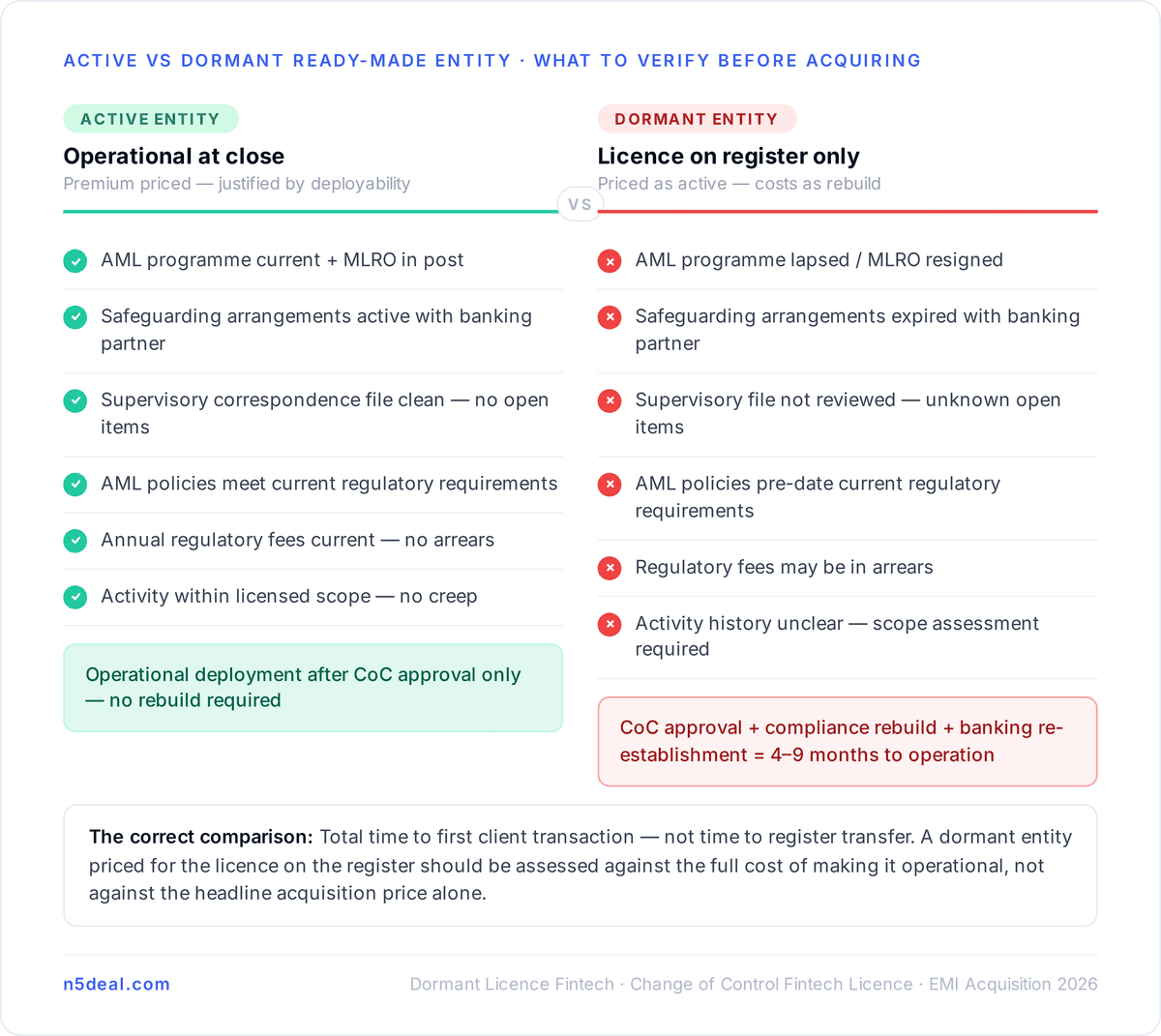
A dormant licensed entity has frequently let more than its operating accounts go inactive. The compliance programme may have lapsed without a current MLRO in post. The safeguarding arrangements required to hold client funds may have expired when the banking partner relationship dissolved. The AML policies may pre-date the regulatory requirements now in force. Verifying recent activity, annual fees, and regulatory standing before acquiring a dormant entity is the step that determines whether the licence represents a usable asset or a shell requiring a compliance rebuild equivalent in cost and time to a fresh application.
The regulator's post-acquisition inspection will assess whether the compliance infrastructure is operational — and will not permit full client-facing operation until it is.
Myth 4: A Cheaper Offshore Licence Is Functionally Equivalent
For institutional counterparties, banking relationships, and card scheme access, supervisory recognition determines what the licence actually enables commercially. A Seychelles FSA securities dealer, a Labuan money broker, or a Mauritius FSC investment dealer each serves a specific commercial profile that is categorically different from what an EU EMI, an FCA-authorised API, or a CSSF-licensed PI provides. The difference is not cosmetic — it is the difference between a supervisor whose name the correspondent bank recognises and one whose recognition requires the bank to conduct their own due diligence on the jurisdiction before opening an account.
The FCA stopped issuing EMI licences freely after 2019 regulatory intervention, making acquisition often the only route for operators who need FCA EMI status. That scarcity is the reason FCA entities command a premium. A cheaper alternative is not the same asset priced differently — it is a different asset serving a different commercial purpose.
Myth 5: The Licence Covers Everything the Current Operator Does
Activity scope creep is among the most consistent compliance gaps in licensed entity acquisitions. An EMI that has added credit-adjacent features. A PI that holds client balances longer than the permitted period for payment transactions. A CASP with exchange authorisation that has informally added custodial services without the relevant service category. Each of these is a gap between the licence's authorised scope and the entity's actual commercial activity — and each transfers to the buyer at close.
Mapping actual commercial activities against the authorised scope of the licence — product by product, revenue line by revenue line — before LOI identifies the gap that any serious buyer's diligence team will find in the data room, and allows the seller to either remediate or disclose rather than having the buyer discover it and retrade.
Myth 6: A Ready-Made Licence Is Always Faster Than Applying Fresh
Often true. Not always. The timeline comparison needs to account for three factors that the headline "faster" claim omits: the change-of-control approval period, any compliance remediation required before the regulator permits full operation, and the time to re-establish banking relationships that may have dissolved during dormancy.
A fresh application to the Bank of Lithuania with a complete and compliant file can receive regulatory assessment in three to six months. A ready-made entity whose change-of-control assessment runs 60 working days, plus two months of compliance infrastructure rebuilding, plus 60 days to establish safeguarding arrangements, is not necessarily the faster path. The correct comparison is total time to operational deployment — not time to register transfer.
Myth 7: The Price Reflects What the Licence Is Worth
Ready-made licence pricing is highly variable and frequently disconnected from actual regulatory value. Pricing is a function of what the seller negotiated and what the buyer's urgency allowed, not a systematic assessment of what the licence enables commercially. A dormant Lithuanian EMI with no banking relationships, an expired compliance programme, and a three-year-old AML policy is listed at a price that reflects the licence on the register — not the operational infrastructure required to actually use it.
The gap between purchase price and total deployment cost is the figure that matters. A well-priced, operationally intact ready-made entity — with active banking relationships, a functioning compliance programme, and a clean supervisory file — is worth a premium that reflects those operational components. A dormant entity that requires a compliance rebuild, banking relationship establishment, and a 60-working-day regulatory approval period should be priced accordingly.
Conclusion
Ready-made fintech licence myths persist because the underlying proposition — faster market access than a fresh application — is genuinely true in the right circumstances. The circumstances that make it true are a clean supervisory file, an operational compliance programme, active banking relationships, and a change-of-control process that the buyer is prepared for. For buyers evaluating which ready-made licensed entities actually meet those conditions, N5Deal lists verified licensed entities with background documentation on each listing to support the review process. A full catalogue is at n5deal.com.
Disclaimer
This page is for informational purposes only. It does not constitute legal, financial, or regulatory advice. Readers should consult qualified professionals before making any decisions.
Comments
Frequently Asked Questions
Clear, concise info to help you understand the process!