

Licensed company pre-sale mistakes don't announce themselves. They accumulate quietly in the two to three years before a founder decides to sell — in how revenue is reported, how the compliance programme is structured, how contracts are written, and what expectation the founder anchors their asking price to. By the time a serious buyer opens the data room, those mistakes have already determined the range of outcomes available. The six below account for the most consistent and most avoidable sources of multiple compression in licensed fintech M&A — and every one of them is fixable before a process starts.
Key Takeaways
Licensed company pre-sale mistakes are structural, not transactional — they are built into the business before any buyer conversation begins, and the cost is paid in the negotiation room
The most frequently cited obstacle to fintech M&A closings is inflated seller expectations anchored to 2021 peak multiples — founders who benchmark against outdated comparables either fail to attract serious buyers or face retrading in the LOI-to-close process
Companies in ambiguous regulatory environments, or reliant on terminable banking partnerships, face significant discounts — both conditions are fixable before sale if identified early enough
When SaaS, transaction, and interest income sit in one reporting line, a buyer cannot underwrite the capital-light premium the seller has earned — fix the reporting first
A compliance programme that runs on the founder's judgment rather than documented procedures is not a transferable asset — it is a dependency that disappears at close and that every serious buyer's diligence team will identify
Mistake 1: Anchoring to a Multiple That No Longer Exists
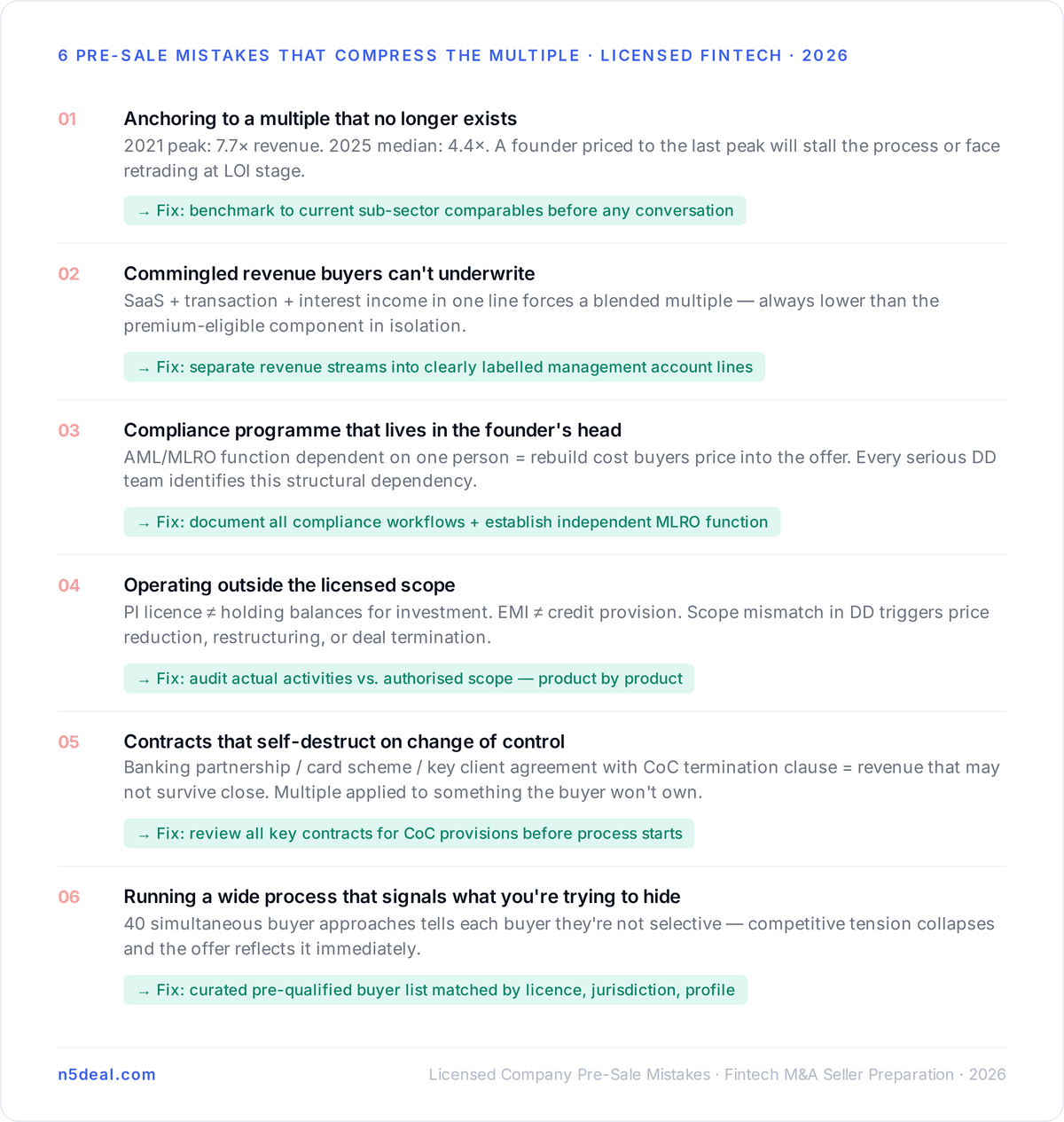
The most common reason a fintech deal dies is a seller priced to the last peak. If the expectation starts with a 2021 comparable, the process stalls before it begins. Global fintech M&A purchase multiples averaged 4.4x EV/LTM revenue through mid-2025, down from 7.7x at the 2021 peak. A founder who raised at a 15x revenue valuation in 2021 and expects to sell at a comparable multiple in 2026 is not mispricing their business — they are describing a different market that no longer exists.
The fix is simple and the data is available: review the fintech M&A multiples benchmark for the specific sub-sector, licence type, and revenue range before any price discussion begins. Payments companies trade at 4 to 6x revenue for established operators. Lending platforms sit closer to 2.5x. Valuations above 10x are reserved for companies demonstrating defensibility through data moats and AI-native compliance infrastructure. Starting from the right number changes every downstream conversation.
Mistake 2: Commingled Revenue That Buyers Can't Underwrite
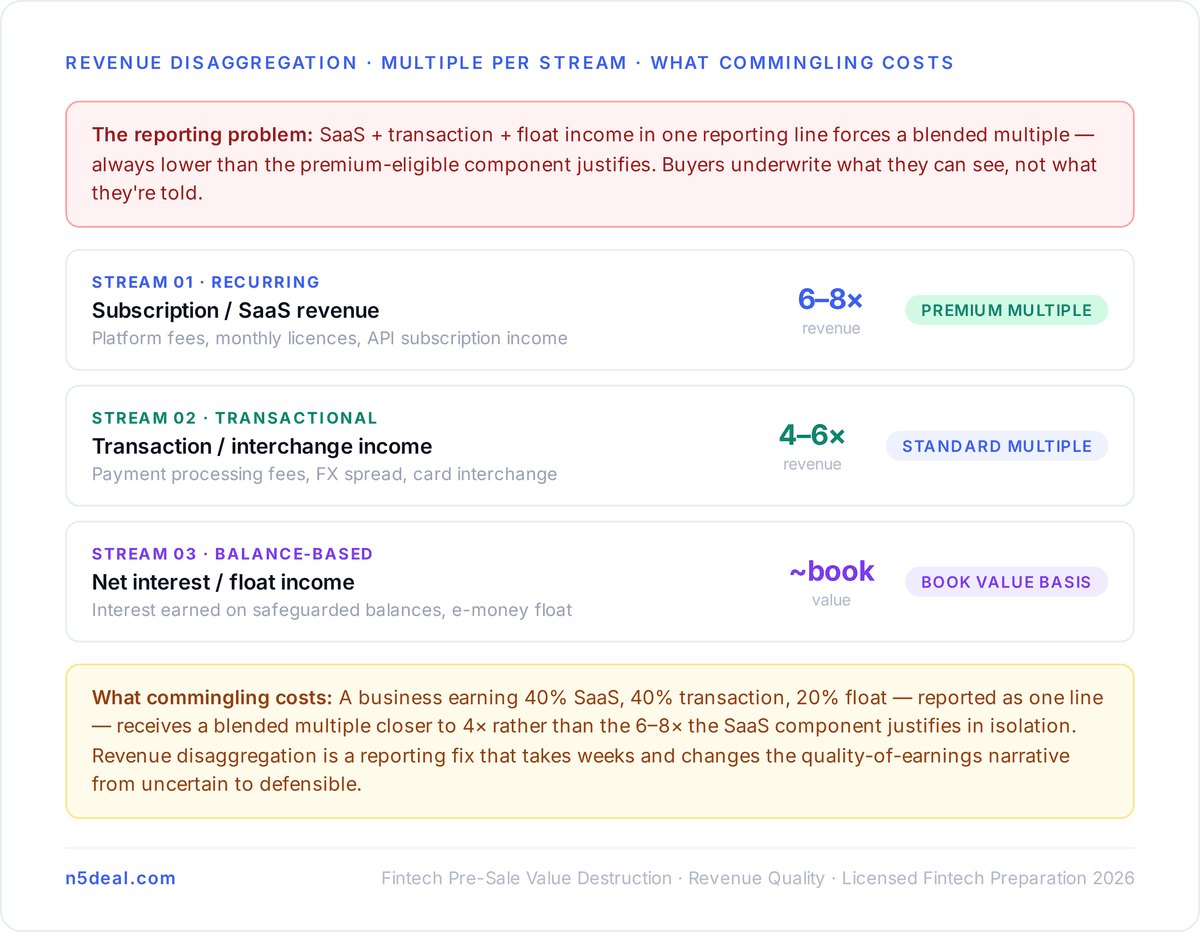
When SaaS, transaction, and interest income sit in one reporting line, a buyer cannot underwrite the capital-light premium the seller has earned. Different revenue streams carry different multiples: subscription income valued at 6 to 8x, transaction and interchange income at 4 to 6x, net interest income closer to book value. A business that earns all three but reports them as a single revenue line forces the buyer to apply a blended multiple — always lower than the premium-eligible component would justify in isolation.
Revenue disaggregation is a reporting fix, not an operational one. Separating recurring subscription fees from transaction-based income from float income into clearly labelled management account lines takes weeks to implement and changes the quality-of-earnings narrative from uncertain to defensible.
Mistake 3: A Compliance Programme That Lives in the Founder's Head
The compliance officer who is the founder. The AML programme that runs on accumulated judgment rather than documented procedures. The MLRO whose departure creates an immediate regulatory gap. These are not compliance failures — they are structural dependencies that every serious buyer's diligence team will identify, because a compliance function that disappears at close is not a compliance function the buyer is acquiring. It is a rebuild cost they will price into the offer.
The fix is documentation and institutional structure — written procedures for every compliance workflow, an MLRO whose function is independent of the founding team's presence, and a testing and review programme whose output exists in files a buyer can read. None of this requires regulatory engagement; it requires time and deliberate effort that only happens if the founder allocates it before the process starts.
Mistake 4: Operating Outside the Licensed Scope
A payment institution licence does not permit holding client balances for investment purposes. An EMI authorisation does not extend to credit provision without a separate licence. A CASP authorisation for exchange services does not cover custody. The most consistent compliance gap in licensed fintech acquisitions is an entity that has grown its product offering beyond the boundaries of its authorisation — organically, incrementally, and often without realising it.
This gap is not just a regulatory problem. It is a valuation problem. A licence with scope mismatches discovered in due diligence triggers either a price reduction to cover the remediation cost, a restructuring of the transaction to exclude the non-compliant activities, or a deal termination. Auditing actual commercial activities against licensed scope — product by product, revenue line by revenue line — before initiating any process is the preparation step that prevents the most expensive diligence findings.
Mistake 5: Contracts That Self-Destruct on Change of Control
Banking partnership agreements. Card scheme contracts. Key client service agreements. These are the commercial relationships that generate the revenue the multiple is applied to — and in a significant proportion of licensed fintech businesses, one or more of them contains a change-of-control termination clause that the founder has never read carefully. Banking partnerships that are terminable on change of control produce significant valuation discounts — because a buyer who cannot confirm that the banking relationship survives close cannot price the revenue it supports.
Contract review is legal work that can be completed in weeks and produces a definitive map of which relationships require consent, which terminate automatically, and which are freely assignable. That map changes the negotiation posture from reactive — discovering a termination clause in the data room — to proactive, where the seller either resolves the issue before process or discloses it with their framing rather than the buyer's.
Mistake 6: Running a Wide Process That Signals What You're Trying to Hide
A sale process that reaches 40 buyers simultaneously tells each of them the same thing: the seller is not selective, which means either no qualified buyer has shown interest, or the seller is under pressure. Both interpretations compress the competitive dynamic that produces a strong offer. Strategic acquirers pay premiums for platform integration potential, customer base access, and regulatory licences — but they pay those premiums in competitive processes, not in situations where they are the only credible bidder.
The most valuable sale processes are confidential and curated. A pre-qualified list of buyers who match the asset's licence type, jurisdiction, and commercial profile by design reduces information leakage, maintains competitive tension, and shortens the process timeline without sacrificing price. Licensing audit, revenue disaggregation, and buyer mapping should be finished before launch — not improvised during diligence.
Conclusion
Licensed company pre-sale mistakes are preparation failures, not negotiation failures. The multiple a seller achieves is largely determined by decisions made 12 to 24 months before any buyer conversation begins — in how revenue is structured, how the compliance programme is documented, how contracts are written, and how the process is managed. For sellers who want to understand how their business would price today and which buyers are active in their market, N5Deal provides a confidential, pre-qualified buyer network across licensed financial businesses in 36+ jurisdictions. A full overview of how to list is at n5deal.com.
Disclaimer
This page is for informational purposes only. It does not constitute legal, financial, or regulatory advice. Readers should consult qualified professionals before making any decisions.
Comments
Frequently Asked Questions
Clear, concise info to help you understand the process!