

Distressed fintech seller M&A strategy is defined by a constraint that most exit frameworks don't account for: the seller has less time than the optimal process requires, and the buyer knows it. In July 2026, PayEm sold to Top Group for a headline price of $500,000 — despite having product, investors, customers, and a category with real demand. The company had assets of approximately NIS 47 million against liabilities of NIS 51 million, creating a negative equity position, with revenue of NIS 19 million and a net loss of NIS 17 million. The acquisition suggests the buyer was purchasing not just technology, but a distressed asset with potential operational synergies. The story is not about PayEm's product or market. It is about what happens when the information asymmetry between a distressed seller and a motivated buyer is allowed to run to its logical conclusion.
Key Takeaways
Distressed fintech seller M&A strategy is not a binary choice between speed and value — it is a framework for identifying which specific items most compress the buyer's discount, and whether any of them can be addressed in 60 to 90 days
Distressed sale processes often commence on the assumption that a solvent transaction is achievable. Sellers invariably seek to avoid the impression of a distressed sale despite underlying financial stress — and strategic reviews or refinancing processes may operate as stalking horses, generating unsolicited approaches from interested parties
Mid-sized fintech assets in the $100M to $1B range face a liquidity squeeze in 2026 as buyers prioritise either scale or specific capabilities — meaning the cohort most likely to face a distressed sale situation is also the cohort with the fewest natural buyers
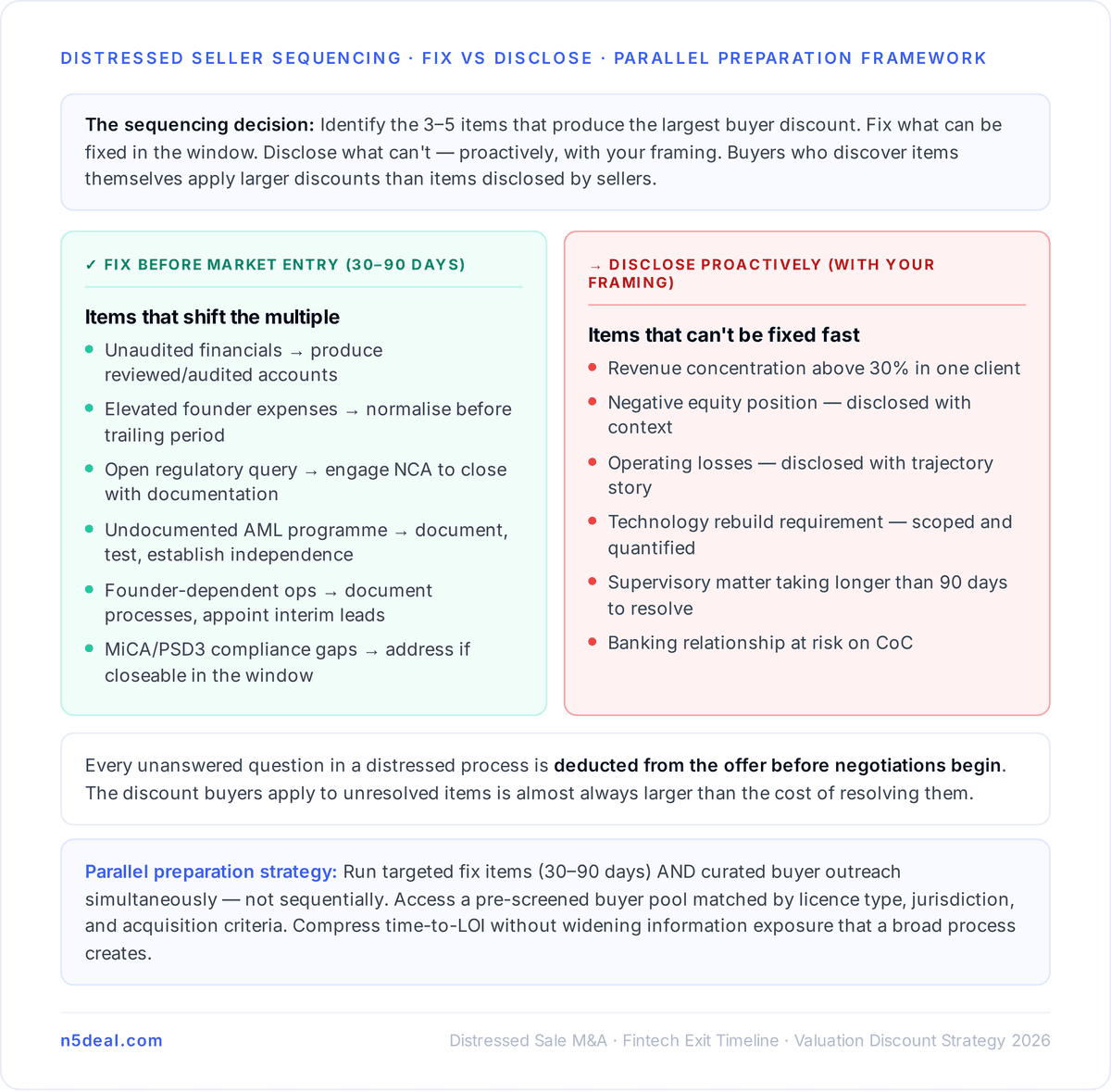
Every unanswered question in a distressed process is deducted from the offer before negotiations begin — buyers price uncertainty conservatively, and the discount they extract on unresolved items is almost always larger than the cost of resolving them
Earn-outs account for approximately 25 to 30% of fintech M&A deals — making them the primary tool distressed sellers use to bridge the gap between their asking price and what a buyer will pay given the information risk
What Creates the Distress Premium for Buyers
A distressed seller is not just a seller in a hurry. They are a seller whose timeline constraint is visible — to advisors, to potential buyers, to the market if the process drags long enough to generate rumour. That visibility is the mechanism through which buyers extract their discount: they wait, they make sequential offers that decrease as the seller's runway shortens, and they use the information asymmetry created by insufficient preparation to justify price reductions in due diligence.
Whether a solvent sale is achievable often only becomes clear as the process unfolds — companies frequently believe there is sufficient equity value to support a sale that repays creditors in full, particularly where there is a viable core business or a good asset is being sold to address short-term liquidity pressure. The process may be conducted quietly to avoid adverse attention.
The distressed seller's strategic error is treating the dilemma as binary. Speed and preparation are not mutually exclusive — they exist on a spectrum where even 60 to 90 days of targeted preparation changes the information position the buyer starts from, and therefore the price they can justify internally.
The Three Archetypes of Distressed Fintech Seller
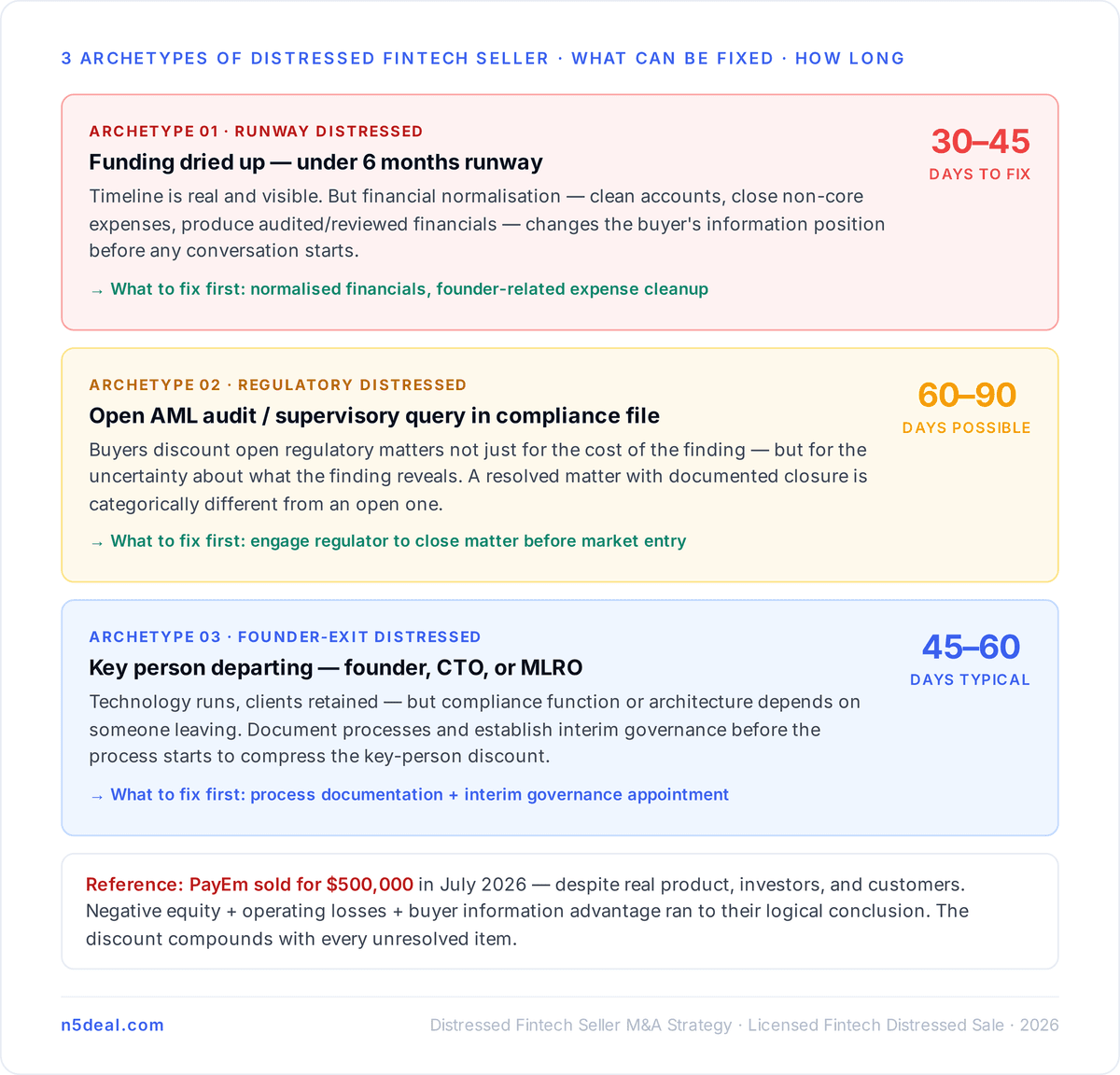
Runway distressed: Funding has dried up with less than six months of operating capital remaining. The timeline constraint is real. But financial normalisation — cleaning up accounts, closing non-core expense lines, producing audited or reviewed financials — can often be completed in 30 to 45 days. A buyer who sees normalised financials and a clean recent period is starting from a different information position than one who sees unaudited trailing numbers with elevated founder-related expenses.
Regulatory distressed: An open regulatory matter, a pending AML audit, or an unresolved supervisory query is sitting in the compliance file. Buyers discount these heavily — not just for the cost of the finding, but for the uncertainty about what the finding will reveal. In specific cases, engaging the regulator to close the matter before entering a process is possible within 60 to 90 days. A resolved finding with documented closure is categorically different from an open one, regardless of their underlying similarity.
Founder-exit distressed: A key person departure — founder, CTO, MLRO — has made the company operationally viable but buyer-diligence-vulnerable. The technology runs, the clients are retained, but the compliance function or the technical architecture depends on someone who is leaving. Documenting processes and establishing interim governance before the process starts compresses the discount buyers apply to key-person risk.
What the Multiple Differential Actually Looks Like
Global fintech M&A purchase multiples averaged 4.4x EV/LTM revenue through mid-2025, down from roughly 7.7x at the 2021 peak, with North American targets commanding a premium at 6.4x. A distressed seller does not operate at the category median. They operate at the lower bound of the range that applies to their category — and then face further compression from each specific uncertainty a buyer identifies in due diligence.
Being fully compliant with incoming regulations like PSD3 or MiCA can be a major value driver — it makes a company a "plug-and-play" acquisition for buyers who want immediate market access without spending months sorting out compliance headaches. The inverse is also true: a company that is not compliant with applicable regulations, or whose compliance posture cannot be verified from available documentation, faces a discount that is applied before any other negotiation begins.
The practical implication for a distressed seller is a sequencing decision, not a speed decision. Identify the three to five items that will produce the largest buyer discount — the open regulatory matter, the unaudited financials, the undocumented compliance programme, the founder-dependent revenue — and determine whether any of them can be addressed in the available window. The items that can be addressed should be addressed before any buyer conversation begins. The items that can't be addressed should be disclosed proactively, with the seller's framing, rather than discovered by the buyer in due diligence.
The Alternative to Binary: Parallel Preparation
The most effective distressed seller strategy is neither rushing to market nor waiting for full preparation. It is running preparation and market outreach in parallel — using a curated buyer approach (not a broad process) to control information flow while addressing the most visible discount items simultaneously.
Acquirers pay premiums for plug-and-play assets — and the market has bifurcated into high-volume capability tuck-ins (65% of deals) and transformational megadeals, with mid-sized assets facing a liquidity squeeze as buyers prioritise either scale or specific capabilities. A distressed seller who can frame their asset as plug-and-play — immediately deployable, licence clean, compliance documented, technology independent of the founding team — is selling a different asset than one who enters the market with those items unresolved.
The buyer network is the other variable. A distressed seller who accesses a curated pool of buyers who have already screened for assets matching the profile — licence type, jurisdiction, revenue range, sector — compresses the time-to-LOI without broadening the information exposure that a wide process creates. The goal is not to reach every possible buyer quickly. It is to reach the buyers most likely to pay the relevant range quickly, while the distress premium hasn't had time to compound.
Conclusion
Distressed fintech seller M&A strategy is a sequencing problem, not a speed problem. The question is not whether to sell fast or sell right — it is which specific preparation items shift the multiple enough to justify the 60 to 90 days they require, and how to run buyer outreach in parallel with that preparation rather than after it. For distressed sellers needing access to a pre-screened buyer network without the timeline cost of a full process, N5Deal connects licensed fintech assets with buyers who have already qualified their interest by licence type, jurisdiction, and acquisition criteria. A full overview of how to list is at n5deal.com.
Disclaimer
This page is for informational purposes only. It does not constitute legal, financial, or regulatory advice. Readers should consult qualified professionals before making any decisions.
Comments
Frequently Asked Questions
Clear, concise info to help you understand the process!