

First-time fintech acquirer mistakes are consistent enough to have a pattern. 40% of acquired fintechs failed or were sold post-acquisition between 2014 and 2020, and 60% of fintech companies paid at least $250,000 in compliance fines last year — primarily due to insufficient transaction monitoring and customer due diligence. Both statistics share the same root: buyers who didn't understand what they were acquiring until after they owned it. Fintech M&A is not a standard asset acquisition. It is a regulated transaction where the licence, the compliance infrastructure, and the supervisory relationship are as material as the revenue multiple — and first-time acquirers who approach it with a general M&A framework discover the gap in due diligence, not before it.
Key Takeaways
First-time fintech acquirer mistakes cluster around five consistent patterns — each avoidable with pre-LOI preparation
A 2025 Deloitte case study shows a fintech acquirer adjusted a target's enterprise value from $160.26 million to $66.99 million after identifying a $600,000 civil money penalty during due diligence — a 56% reduction driven by regulatory risk, not financial performance
Technology due diligence re-trades 30 to 40% of software-heavy deals, with typical price reductions of 5 to 25% when buyers surface material findings in code quality, cybersecurity, IP ownership, or third-party licence exposure
Change of control approval is not a formality in regulated fintech — it is a process that can take 3 to 9 months and require the acquiring entity to demonstrate its own regulatory fitness
Rushing due diligence to meet an artificial deadline is among the most costly mistakes a buyer can make — most mid-market deals complete due diligence in 30 to 90 days, but complex regulated deals can take 4 to 6 months
Mistake 1: Treating the Licence as a Given
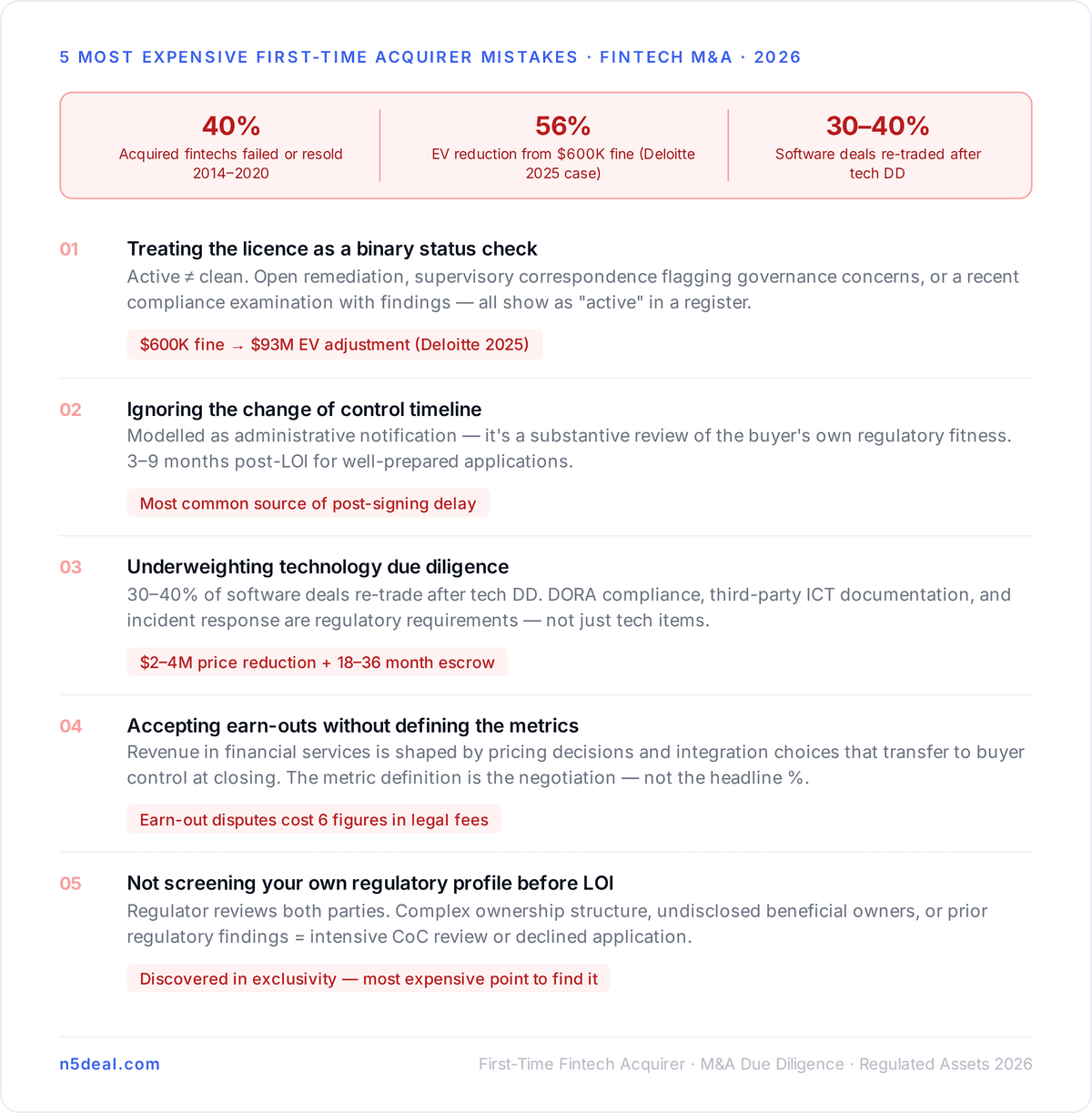
The licence is not a binary status — active or inactive. It is a relationship between the licensed entity and its supervising authority that has a history, an ongoing correspondence record, and conditions that may not appear in a headline status check. Good diligence of fintechs should involve assessing regulatory events noted in public filings and correspondence from regulators, plus responses and follow-up; reviewing problems noted on internal exams and resulting remedial actions; and reviewing customer complaints and any follow-up.
First-time acquirers who confirm that a licence is active and move on have confirmed the minimum. A licence with open remediation requirements, supervisory correspondence that flagged governance concerns, or a compliance examination that identified gaps three months before the deal process began is categorically different from a clean licence — even if both show as "active" in a register check.
Mistake 2: Ignoring the Change of Control Timeline
If the target or any of its affiliates is subject to state or federal regulation, the purchaser should consider whether it needs regulatory approval for the M&A transaction. Generally, either the licensed money transmitter or proposed new control person must obtain written approval from the relevant state regulator prior to the date a change-of-control transaction closes.
First-time acquirers consistently undercount the change of control timeline because they model it as an administrative notification rather than a substantive review. Regulators assess the acquiring entity's own regulatory standing, governance structure, and fitness — and a buyer with no prior regulated entity experience, unclear governance, or open compliance matters in other jurisdictions will face a more intensive review than one who is already supervised. Building the change of control timeline into the deal structure before LOI prevents the most common source of deal delay in regulated fintech transactions.
Mistake 3: Underweighting Technology Due Diligence
Technology due diligence re-trades 30 to 40% of software-heavy deals. On a $50 million acquisition, a single open security vulnerability cluster combined with an unaddressed open-source licensing risk routinely costs the seller $2 to $4 million in adjusted purchase price, plus an indemnity escrow held for 18 to 36 months.
For regulated fintechs specifically, technology due diligence covers more than code quality. DORA compliance posture, third-party ICT provider oversight documentation, and incident response procedures are all regulatory requirements that the acquirer inherits. A first-time buyer who conducts financial and compliance diligence but treats technology as a secondary workstream will price the wrong asset.
Mistake 4: Accepting Earn-Out Structures Without Defining the Metrics
First-time buyers in fintech frequently accept earn-out structures to bridge valuation gaps without specifying the accounting policies, allocation methodologies, and operational constraints that govern how earn-out metrics are calculated 18 months post-closing. Revenue in financial services is shaped by pricing decisions, product prioritisation, and integration choices that transfer to buyer control at closing. A seller whose earn-out is tied to revenue growth over 24 months has no contractual right to demand the buyer maintain the commercial conditions that generated that revenue historically. The negotiation that matters is the metric definition — not the headline earn-out percentage.
Mistake 5: Not Screening the Buyer Pool Before Exclusivity
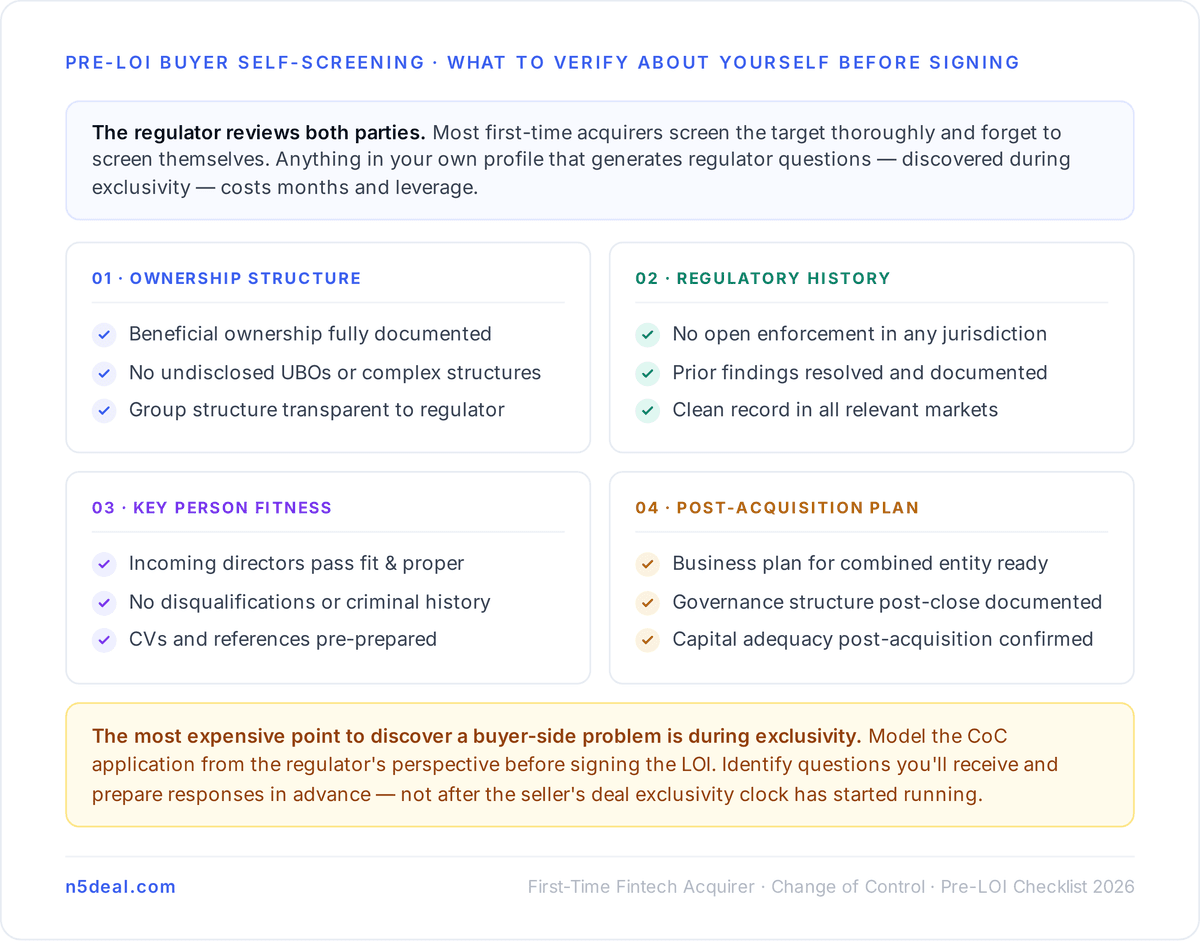
This mistake is unique to regulated fintech: first-time acquirers enter exclusivity with a seller without verifying that their own regulatory profile will support a change of control application. The regulator reviews both parties. A buyer with complex ownership structure, undisclosed beneficial owners, or a history of regulatory findings in other entities will encounter a more intensive review — or a declined application — after the exclusivity period has been spent.
The practical preparation is straightforward: before signing an LOI, model the change of control application from the regulator's perspective. Identify any items in the buyer's own regulatory history or governance structure that will generate questions, and prepare the responses in advance rather than discovering them during the application.
Conclusion
First-time fintech acquirer mistakes are information problems that surface at the wrong time. Every item on this list is knowable before LOI — the question is whether the buyer has built the process to find it in advance or will find it in the data room under time pressure. For buyers evaluating licensed fintech assets and wanting to understand what pre-screened documentation looks like from the first point of contact, N5Deal presents licensed entities with the compliance and regulatory documentation that experienced acquirers require at the screening stage. A full catalogue of available assets is at n5deal.com.
Disclaimer
This page is for informational purposes only. It does not constitute legal, financial, or regulatory advice. Readers should consult qualified professionals before making any decisions.
Comments
Frequently Asked Questions
Clear, concise info to help you understand the process!