

Austria FMA license M&A value is built on a comparison that most founders make too late: Germany is the largest consumer fintech market in the EU by population, but BaFin is one of the most documentation-heavy and processing-intensive supervisors in Europe. Austria gives access to the same DACH market through a regulator that combines Germanic rigour with a pragmatic processing tempo that BaFin consistently fails to match. An FMA-authorised payment institution or EMI can passport into Germany through a standard notification procedure — no separate BaFin authorisation required. For a buyer who needs DACH market access without the BaFin overhead, an Austrian-licensed entity is not the second option. It is the better-structured first one.
Key Takeaways
Austria FMA license M&A value is anchored to DACH market access — an FMA-authorised entity passports into Germany through notification, eliminating the need for a separate BaFin licence
Austria has 9 authorised MiCA CASPs as of May 4 2026 — more than Lithuania and Luxembourg — making it the EU's most underrated crypto licensing jurisdiction by active CASP count relative to its profile
The FMA functions as a one-stop supervisory authority covering banks, payment institutions, EMIs, investment firms, and CASPs — no dual-authority structure as in Germany, where BaFin and the Deutsche Bundesbank split responsibilities
Austrian law provides an Auskunftsbescheid — a functionally equivalent instrument to a no-action letter — allowing applicants to obtain regulatory certainty about their business model before committing to a full licence application
Austria's geographic position as a gateway to both DACH and CEE markets — with Vienna hosting the regional headquarters of Erste Bank, Raiffeisen, and UniCredit's Austrian operations — makes FMA-licensed entities operationally credible to the counterparties that matter most in both regions
Why FMA, Not BaFin
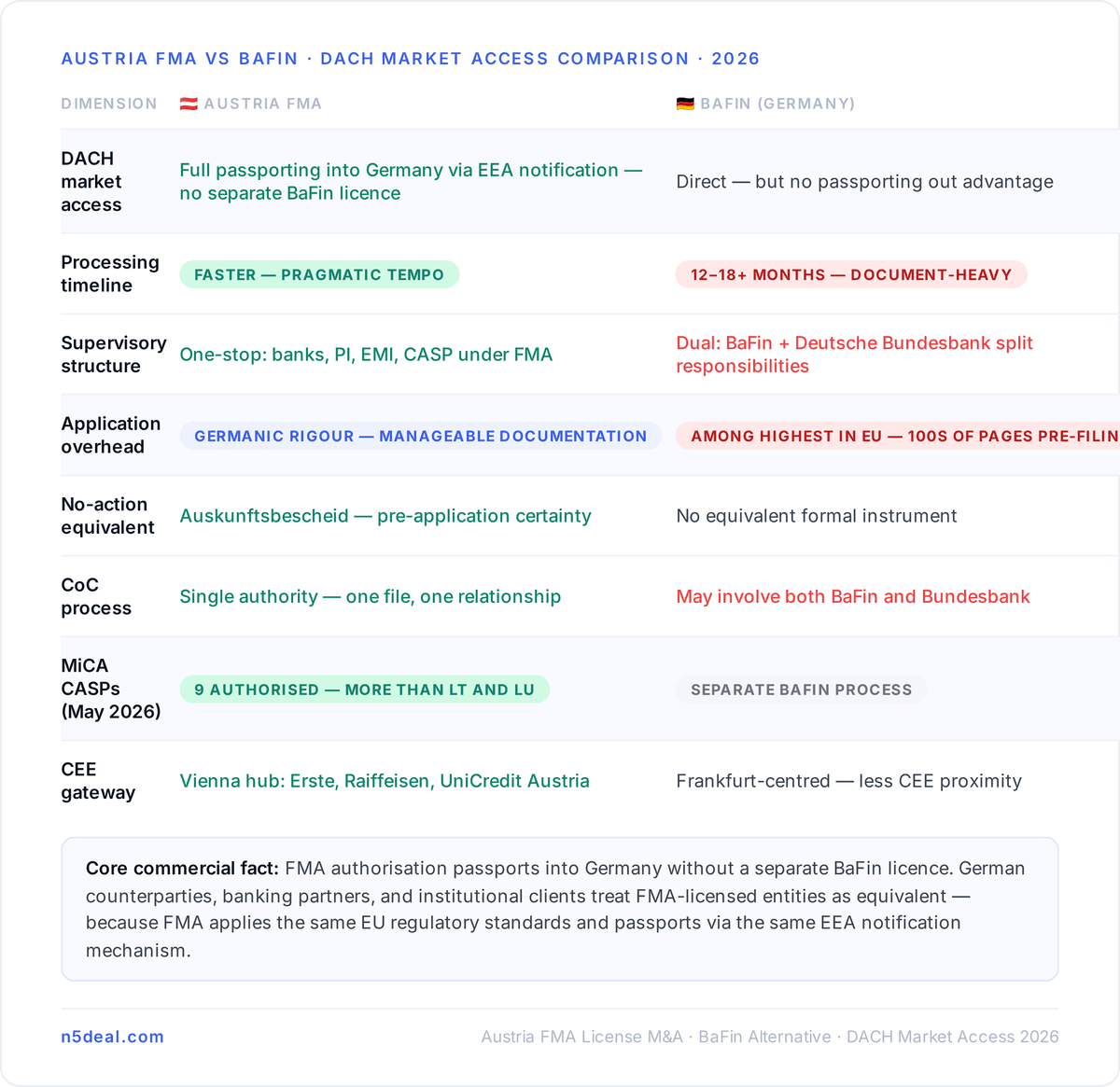
The practical comparison is straightforward. BaFin's documentation requirements are among the most extensive in the EU — application files for payment institution authorisation routinely exceed several hundred pages of structured documentation before a pre-filing meeting is granted. Processing timelines regularly run 12 to 18 months for complete applications. BaFin and the Deutsche Bundesbank share supervisory responsibilities for different regulated entity types, creating a dual-authority dynamic that adds coordination complexity to the application and change-of-control processes.
Austria is the under-the-radar outperformer with 9 authorised CASPs, ahead of Lithuania, Luxembourg, and several other better-known hubs. FMA combines Germanic regulatory rigour with a more pragmatic processing tempo than BaFin.
That combination — rigour without overhead — is what makes the FMA attractive for DACH-focused operators who need a supervisor that takes compliance seriously but doesn't impose process costs disproportionate to the risk profile of a licensed payment institution or EMI. For founders who have built for the German market, Austria provides a supervised regulatory relationship that German counterparties, banking partners, and institutional clients recognise immediately as equivalent to BaFin — because the FMA applies the same EU regulatory standards and the FMA-licensed entity passports into Germany through the same EEA notification mechanism.
The One-Stop Authority Advantage
The FMA acts as the central regulatory authority for companies situated in Austria. It oversees licensing, supervision and enforcement for banks, investment firms, payment institutions and CASPs. Its jurisdiction extends to both prudential and conduct supervision. This includes the enforcement of AML requirements. The FMA therefore functions as a one-stop authority for most fintech business models operating within the Austrian financial market.
That one-stop structure has a specific M&A implication. A change-of-control process for an FMA-licensed entity involves one regulator, one file, one supervisory relationship. A comparable process for a BaFin-supervised entity may involve both BaFin and the Deutsche Bundesbank depending on the licence type. For buyers planning an acquisition timeline, the single-authority structure compresses the regulatory approval phase in a way that dual-authority jurisdictions do not.
The Auskunftsbescheid — Austria's equivalent of a no-action letter — is an additional practical advantage for buyers who want regulatory certainty before committing to a full acquisition process. A buyer can obtain an FMA determination on whether a proposed post-acquisition business model requires additional authorisation before the deal is structured around assumptions that the regulator may later challenge.
The DACH and CEE Gateway
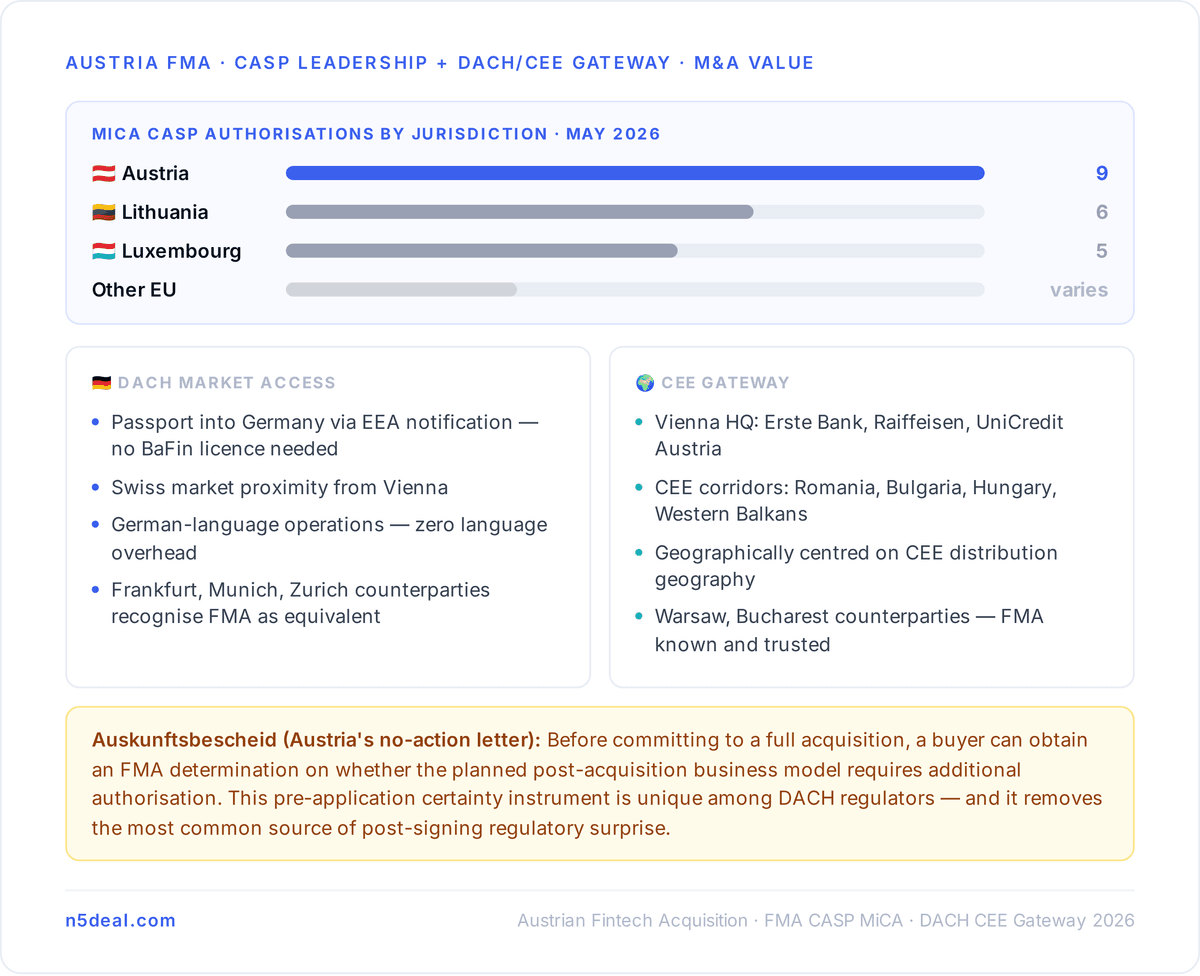
Austria's geographic and commercial position reinforces the FMA licence's commercial value. Vienna is the regional headquarters of Erste Bank Group, Raiffeisen Bank International, and UniCredit's Austrian operations — three of the largest banking groups in CEE. A fintech licensed by the FMA operating from Vienna has natural proximity to the banking partners, institutional clients, and regulatory counterparties that matter most in both DACH and Central European distribution.
For payment institutions and EMIs targeting CEE corridors — remittance flows into Romania, Bulgaria, Hungary, and the Western Balkans — Austria provides a supervisory home that sits geographically at the centre of the relevant distribution geography. Lithuania is faster for EU-wide licensing. Ireland is better for institutional credibility and post-Brexit EU access. Austria is the right answer for DACH-native and CEE-oriented commercial strategies that need a regulator their counterparties in Frankfurt, Zurich, Warsaw, and Bucharest already know.
Conclusion
Austria FMA license M&A value is the product of one core commercial fact and three supporting advantages. The core fact: FMA authorisation passports into Germany without a separate BaFin licence. The supporting advantages: a one-stop supervisory authority that covers the full fintech stack without dual-regulator complexity; 9 active MiCA CASPs as of May 2026 making Austria the EU's most underrated crypto licensing jurisdiction; and Vienna's position as the gateway to both DACH and CEE markets. For buyers mapping where Austrian-licensed payment and fintech assets are available for acquisition, N5Deal catalogues licensed entities across EU jurisdictions with the compliance documentation needed to assess supervisory standing before formal processes begin. A full overview of available assets is at n5deal.com.
Disclaimer
This page is for informational purposes only. It does not constitute legal, financial, or regulatory advice. Readers should consult qualified professionals before making any decisions.
Comments
Frequently Asked Questions
Clear, concise info to help you understand the process!