

Liechtenstein Blockchain Act M&A value in 2026 rests on a single structural innovation that no other jurisdiction has replicated in the same form: the Token Container Model. The TVTG — the Law on Tokens and Trusted Technology Service Providers, enacted January 1 2020 — was the first comprehensive legal framework for the token economy globally. It preceded MiCA by four years. What made it significant then, and what makes TVTG-licensed entities still worth acquiring in 2026, is not just the compliance track record those four years produced. It is the civil law architecture the TVTG created for tokenising rights — any rights, not just financial instruments — under a technology-neutral framework that MiCA did not displace and cannot replicate.
Key Takeaways
The Liechtenstein Blockchain Act M&A value rests on the Token Container Model — a civil law basis for the ownership, transfer, and enforcement of any rights in tokens, including patents, real estate, music rights, and trademark rights, that no other EEA jurisdiction provides in equivalent form
The EEA MiCA Implementation Act entered into force in Liechtenstein on February 1 2025 — Liechtenstein is part of the EEA, not the EU, but MiCA applies through the EEA mechanism, giving CASP authorisations EU-equivalent passporting rights
The TVTG was strategically amended in 2024 and 2025 to align with MiCA — entities that completed the transition now operate under both frameworks simultaneously, with the TVTG providing civil law tokenisation rights that MiCA doesn't cover
FMA supervision is among the most accessible in the EEA for well-prepared applicants — the FMA Regulatory Laboratory specifically supports fintech and blockchain companies through registration and licensing processes
TVTG-registered entities with clean FMA compliance histories are a specific acquisition target for RWA tokenisation platforms, institutional digital asset programmes, and structured product issuers that need civil law certainty for non-financial rights tokenisation
What the Token Container Model Actually Provides
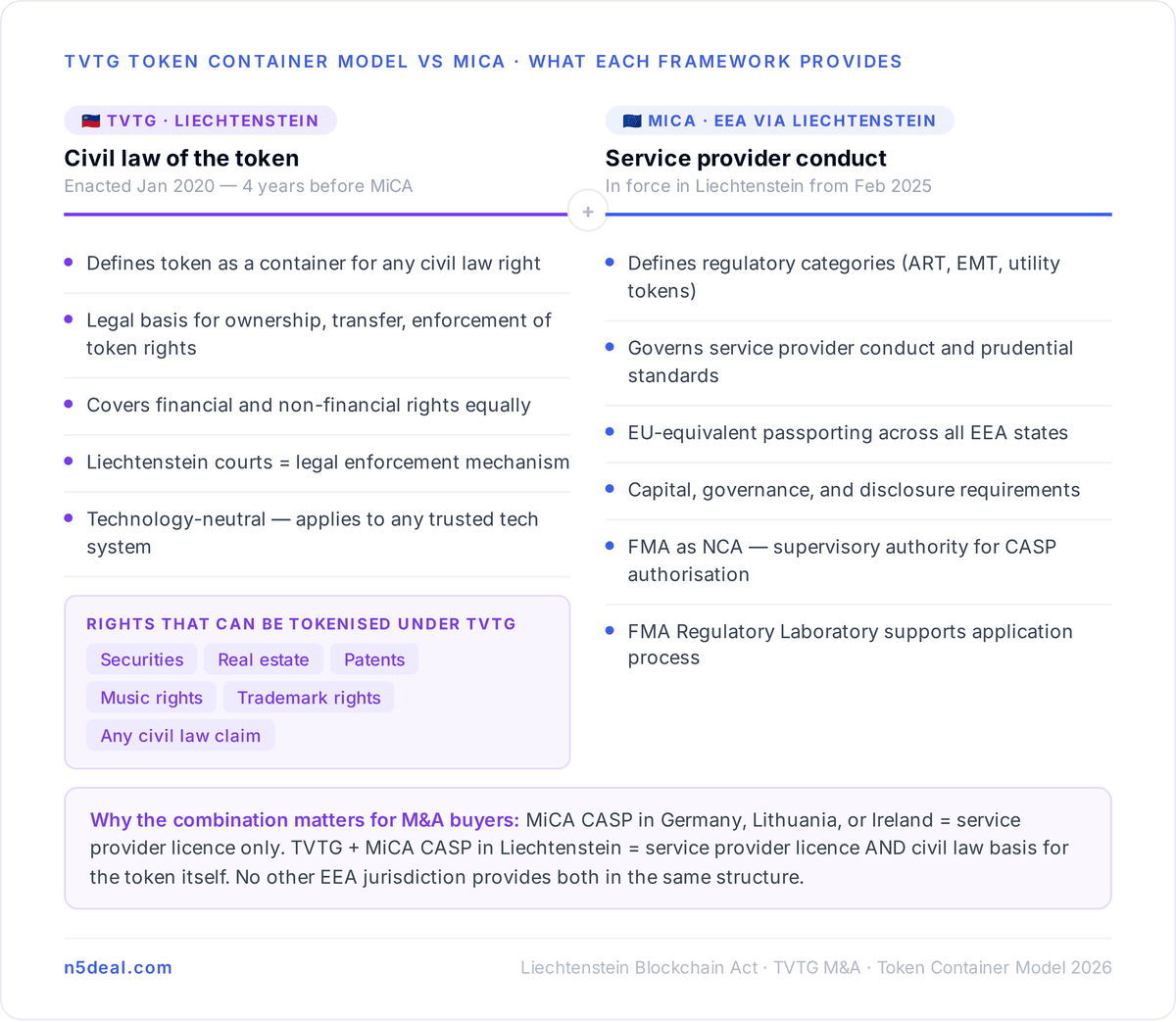
The Token Container Model defines the token as a container where all types of rights may be placed — not just securities, but patents, music rights, trademark rights, real estate rights, and any other civil law claim. This is a legal innovation, not a technical one. It means a TVTG-registered entity can issue a token that represents a legally enforceable claim against an underlying asset under Liechtenstein civil law — with the FMA as supervisor and the Liechtenstein courts as the legal enforcement mechanism.
The TVTG creates a new civil law for tokens and the legal basis for the ownership, possession, and disposition rights over tokens on trusted technology systems. It does not only cover digital assets such as Bitcoin — it creates the legal basis for the tokenisation of analogue assets. That scope is what distinguishes a Liechtenstein TVTG-registered entity from a MiCA CASP operating under any other EU/EEA framework. MiCA governs service provider conduct. The TVTG governs the civil law status of the token itself.
For buyers evaluating RWA tokenisation infrastructure, the combination matters. A MiCA CASP authorisation provides the service provider licensing. The TVTG Token Container Model provides the civil law basis for the token the platform issues. Together, they create a legal architecture for institutional-grade tokenisation that a bare MiCA CASP in Germany, Lithuania, or Ireland cannot replicate without additional jurisdictional steps.
MiCA Integration and What It Changed
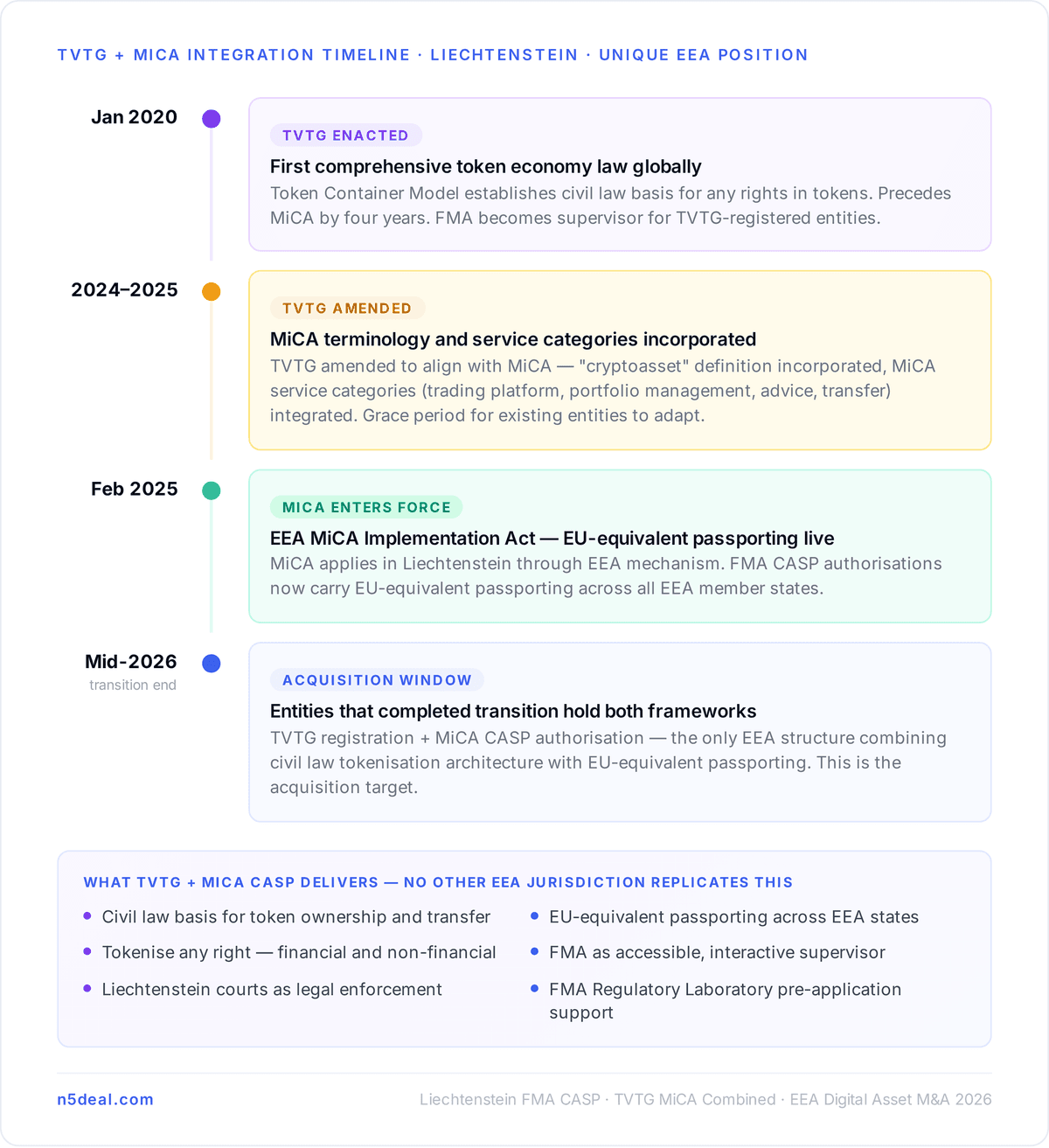
The EEA MiCA Implementation Act entered into force on February 1 2025, integrating MiCA into the EEA framework and making it applicable in Liechtenstein through the standard EEA mechanism. The TVTG was amended in 2024 and 2025 to align terminology — the definition of "cryptoasset" was incorporated into the TVTG, partially replacing the "token" definition, and MiCA service categories such as operating a trading platform, providing advice on cryptoassets, portfolio management, and transfer services were incorporated into the TVTG framework.
Existing TVTG-registered entities operating under the old rules were given a grace period to adapt and apply for MiCA licences — a transition timeline running through mid-2026. Entities that completed the transition now hold both TVTG registration and MiCA CASP authorisation, giving them EU-equivalent passporting rights alongside the civil law tokenisation architecture that the TVTG uniquely provides.
The MiCA integration did not render the TVTG redundant — it layered a conduct and prudential framework on top of a civil law architecture that was already operational. For buyers, the combined structure is the acquisition target, not either framework in isolation.
Why Liechtenstein's FMA Is a Specific Advantage
Liechtenstein is a small jurisdiction with a regulatory authority that processes licensing applications for a fraction of the entity volume that the Bank of Lithuania, CSSF, or FCA supervise. The FMA Regulatory Laboratory specifically supports fintech and blockchain companies in the registration process. That support function produces faster, more interactive licensing relationships than larger supervisors provide — and in a change-of-control context, it means the FMA is more accessible for the pre-application conversations that determine whether a transaction can close on the intended timeline.
The practical advantage is the FMA relationship itself. An entity with an established FMA supervisory relationship, clean compliance history, and completed MiCA transition is positioned to support a change-of-control process with a regulator that knows the entity's file, responds directly, and makes decisions without the queue delays that characterise higher-volume supervisors.
Conclusion
The Liechtenstein Blockchain Act still matters in 2026 because the Token Container Model provides a civil law tokenisation architecture that no other EEA jurisdiction replicates at the same legal depth, and because MiCA integration has layered EU-equivalent passporting rights onto that architecture rather than replacing it. TVTG-registered entities that completed the MiCA transition are the only digital asset operators in the EEA that hold both frameworks simultaneously. For buyers mapping where Liechtenstein-licensed digital asset entities are available for acquisition, N5Deal catalogues licensed entities across EEA jurisdictions with the compliance documentation needed to assess supervisory standing. A full overview of available assets is at n5deal.com.
Disclaimer
This page is for informational purposes only. It does not constitute legal, financial, or regulatory advice. Readers should consult qualified professionals before making any decisions.
Comments
Frequently Asked Questions
Clear, concise info to help you understand the process!