

An overpriced fintech asset is not always the result of a dishonest seller. It is usually the result of a seller who benchmarked against the wrong comparables, an advisor who pitched on peak-cycle data, and a buyer who didn't push back hard enough on the numbers before signing an LOI. The most frequently cited obstacle to fintech M&A closings is inflated seller expectations anchored to 2021 peak multiples — founders who benchmark against outdated comparables or venture pricing rather than current M&A data either fail to attract serious buyers or face retrading in the LOI-to-close process. Retrading after LOI is expensive for everyone. Spotting the overprice before LOI is the buyer's job — and it requires knowing which specific signals to look for.
Key Takeaways
Overpriced fintech asset identification starts with the multiple benchmark — median fintech M&A multiples compressed from 7.7x revenue in 2021 to 4.2–4.4x through 2025; any asset priced materially above current comparables requires specific justification
Revenue concentration is the single most common structural reason a fintech trades below its headline valuation — if 40% of revenue relies on a single client or banking partner, the entire valuation is at risk
Of approximately 650 challenger banks globally, only 92 are profitable — growth without unit economics is not a valuation driver in the current market and should not be priced as one
Excessive add-backs are the most consistent accounting signal of a managed earnings presentation — buyers who accept adjusted EBITDA without auditing each add-back are pricing fiction
Licence status overstated is a specific fintech risk — an active VASP registration presented as equivalent to a MiCA CASP authorisation is a valuation error worth 30 to 50% of the headline price
Red Flag 1: The Multiple Is Anchored to a Market That No Longer Exists
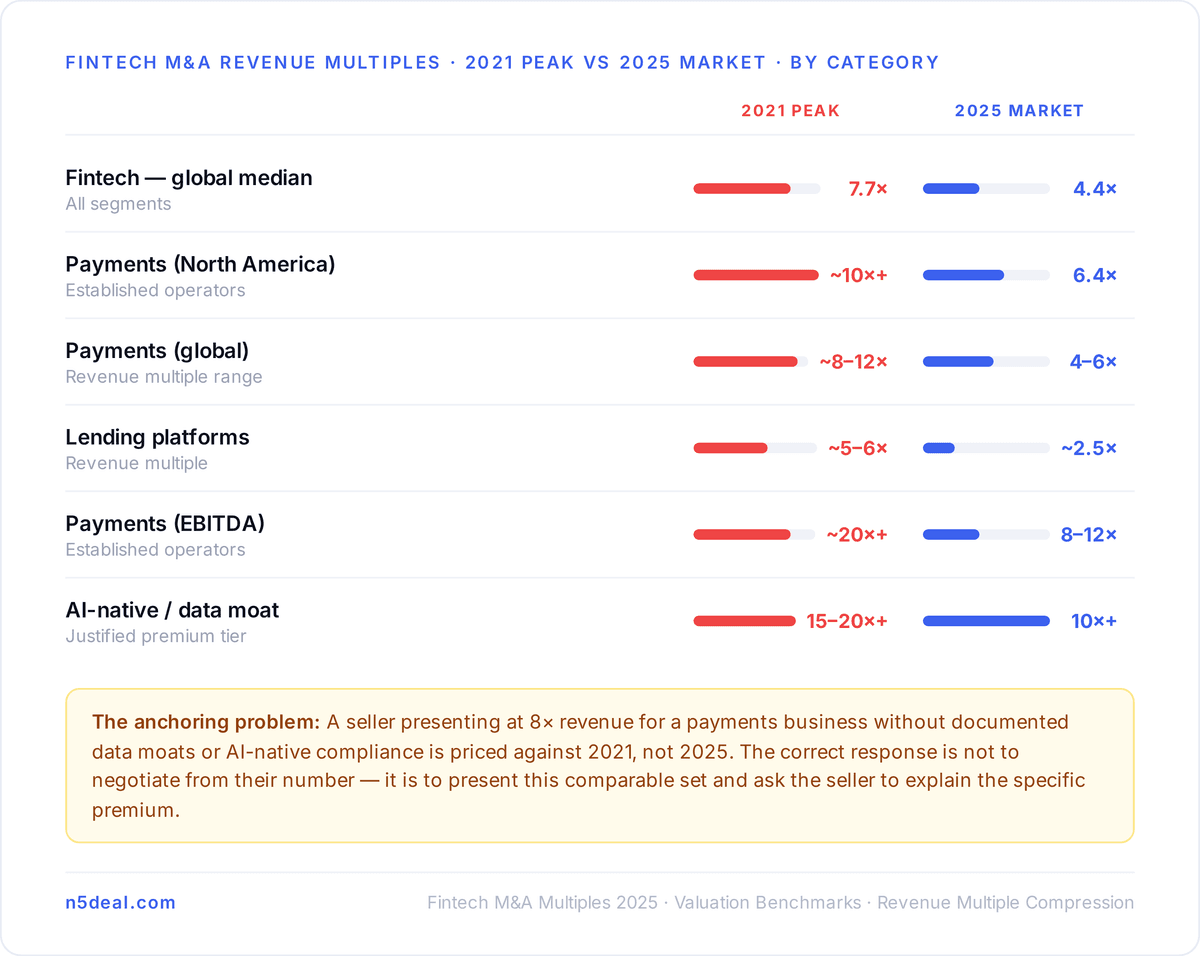
The current benchmark is specific. Global fintech M&A purchase multiples averaged 4.4x EV/LTM revenue through mid-2025, with North American targets commanding a premium at 6.4x. Lending platforms trade at approximately 2.5x. Payments companies trade at 4–6x revenue and 8–12x EBITDA for established operators. Valuations above 10x revenue are reserved for companies demonstrating defensibility through data moats and AI-native operations.
A seller presenting at 8x revenue for a payments business without documented data moats, AI-native compliance infrastructure, or proprietary network effects is anchored to 2021. The correct response is not to negotiate from their number — it is to present the current comparable set and let the seller explain the specific premium being asked for. If the explanation doesn't map to the four structural advantages that justify above-10x pricing in 2026, the premium is sentiment, not value.
Red Flag 2: Revenue Concentration Above 30%
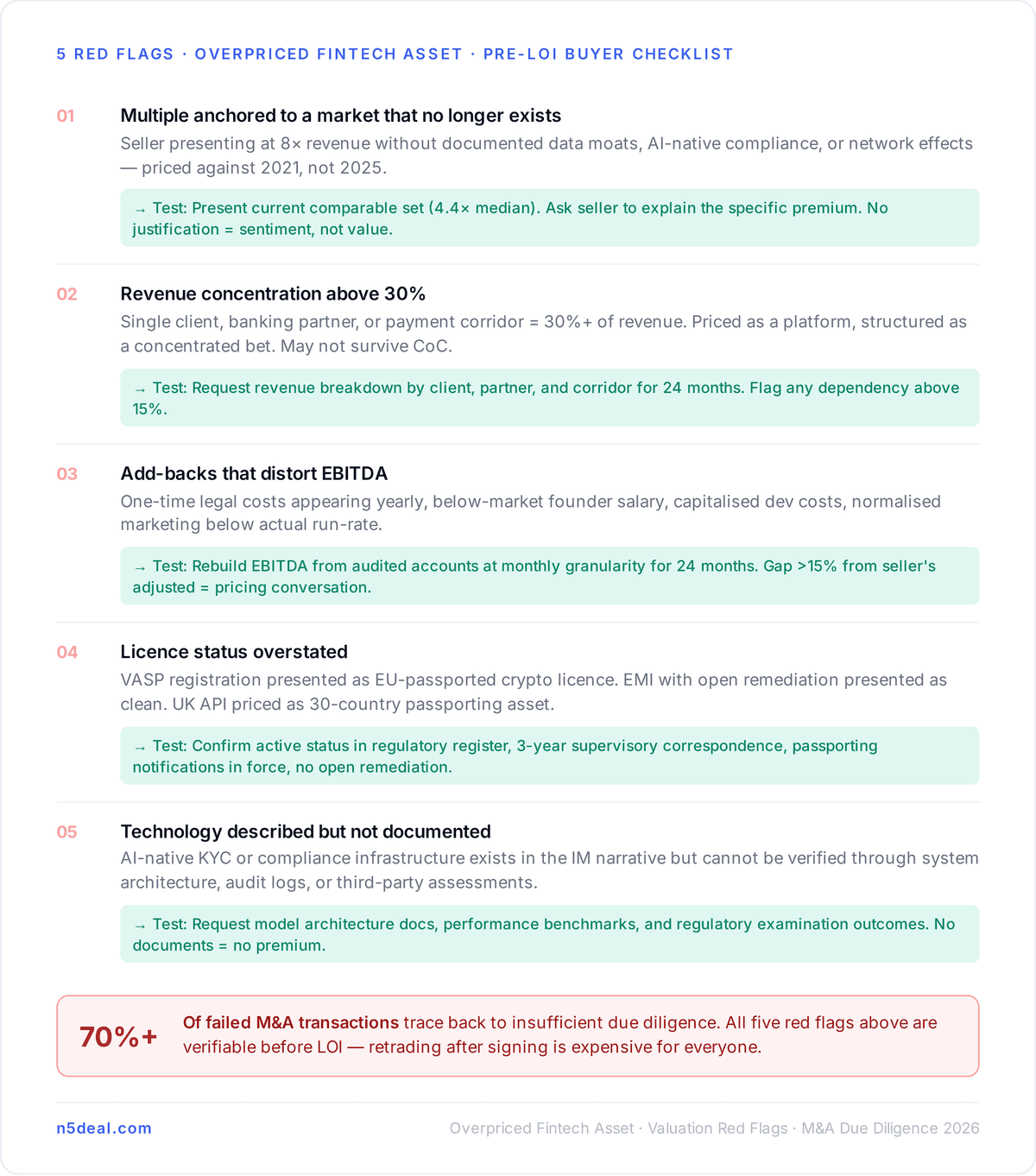
Revenue concentration compresses multiples in fintech because one regulatory change or partner termination can eliminate a revenue stream entirely. A company where a single enterprise client, a single banking partner, or a single payment corridor represents 30% or more of revenue is not a diversified asset — it is a concentrated bet priced as a platform.
The concentration risk in regulated fintech is compounded by the nature of the dependencies. A banking partner relationship for safeguarding arrangements, or a single card scheme connection, is not just a revenue concentration — it is an operational dependency that may not survive a change of control. Buyers who discover a 40% revenue concentration in the data room after signing LOI face a repricing conversation. Buyers who identify it during screening avoid the conversation entirely.
Red Flag 3: Add-Backs That Distort EBITDA
Excessive add-backs are the most consistent accounting signal of a managed earnings presentation. The specific items to interrogate: one-time legal costs that appear every year, founder salary adjustments that assume compensation below market rate, capitalised development costs that belong in operating expense, and marketing spend normalisation that assumes a lower run-rate than the business actually requires.
Red flags do not automatically terminate transactions — they identify areas where valuation must be recalibrated. The buyer's job is to rebuild EBITDA from audited accounts and management accounts at monthly granularity for 24 months, then compare the result to the seller's adjusted figure. A gap of more than 15% between reported adjusted EBITDA and reconstructed EBITDA is a pricing conversation, not a negotiating point.
Red Flag 4: Licence Status Overstated
This is the fintech-specific valuation error that general M&A frameworks miss. An active VASP registration in Estonia presented as an EU-passported crypto licence is not the same asset. A Lithuanian EMI with an outstanding remediation requirement is not the same asset as one with a clean supervisory file. A UK API with no EEA passporting is not the same asset as a CBI-licensed EMI with 30-country passporting rights.
Non-compliant companies face deal-breaking risk during due diligence, while compliant companies differentiate themselves. The licence status verification is a binary question that should be answered before the valuation conversation begins, not after the due diligence process reveals a mismatch. Confirm current licence status, scope, supervisory correspondence history, and passporting notifications in force before accepting any price that includes a licence premium.
Red Flag 5: Technology Described But Not Documented
AI capabilities and compliance infrastructure are among the most common sources of valuation inflation in 2026 because they are hard to verify from the outside and easy to describe in an IM. The specific test: can the technology described in the information memorandum be verified through documented system architecture, audit logs, and third-party assessments — or does it exist primarily in the founder's narrative?
More than 70% of failed M&A transactions trace back to insufficient due diligence. For technology-driven fintech assets, the due diligence gap is almost always between what the IM describes and what a technical review confirms. A fintech that claims AI-native KYC infrastructure should be able to produce documented model architecture, performance benchmarks, and regulatory examination outcomes. One that can't produce those documents is claiming a premium it hasn't earned.
Conclusion
Overpriced fintech asset identification is a pre-LOI discipline, not a post-signing discovery. The five signals — multiple anchored to 2021, revenue concentration above 30%, add-backs that distort EBITDA, licence status overstated, and technology undocumented — are all verifiable before a buyer commits to exclusivity. For buyers mapping available licensed fintech assets with pre-screened documentation, N5Deal presents assets with the regulatory and financial information that allows preliminary valuation assessment before formal processes begin. A full catalogue of available assets is at n5deal.com.
Disclaimer
This page is for informational purposes only. It does not constitute legal, financial, or regulatory advice. Readers should consult qualified professionals before making any decisions.
Comments
Frequently Asked Questions
Clear, concise info to help you understand the process!