
Swiss FINMA license M&A premium is not a marketing claim — it is a scarcity premium with a specific regulatory foundation. As of April 2025, only four companies hold an active Swiss FinTech Licence under Article 1b of the Banking Act. FINMA initially granted licences to six entities, but two were revoked because the companies no longer met regulatory requirements. Four active licences for a financial services jurisdiction of Switzerland's standing is not a market failure — it is a reflection of how demanding FINMA's entry and maintenance standards are. That demanding standard is precisely what makes a FINMA-supervised asset credible to institutional counterparties globally, and why it commands a premium in deal processes.
Key Takeaways
Swiss FINMA license M&A premium is driven by scarcity, regulatory reputation, and direct SNB access — four active FinTech Licence holders as of 2025, with two revoked for non-compliance
The Swiss FinTech Licence allows a company to open a sight deposit account with the Swiss National Bank and directly access the SIC payment system — no intermediary bank required. This is a benefit unavailable to EU EMI licence holders
Crypto Valley venture funding reached $728 million across 31 deals in 2025, with Switzerland accounting for approximately 45–50% of disclosed European blockchain venture funding in Q1 2026
The Federal Council's FinIA reform consultation, which closed in February 2026, proposes replacing the FinTech Licence with two new categories — Payment Instrument Institution and Crypto-Institution — expected in force from 2027 with a transition period
Switzerland does not offer EU passporting — FINMA authorisation covers Switzerland only; EU market access requires a separate MiCA CASP authorisation
What the Swiss FinTech Licence Actually Is
The FinTech licence allows institutions to accept public deposits of up to CHF 100 million or crypto-based assets, provided these are not invested and no interest is paid on them. The institution must be incorporated in Switzerland and conduct its business activities in Switzerland.
The Swiss FinTech Licence is more than a Swiss EMI licence. One of the key benefits is that a fintech company may open a sight deposit account with the Swiss National Bank and directly access the SIC payment system without requiring an intermediary bank. That direct central bank access distinguishes a Swiss FinTech Licence from an EU EMI authorisation in a way that institutional counterparties recognise immediately. It is not a theoretical advantage — it changes the counterparty risk profile of the entity in ways that affect banking relationships, correspondent access, and the due diligence response from institutional clients.
The minimum capital requirement is CHF 300,000 — below an EU EMI's EUR 350,000 equivalent — but the substantive requirements are more demanding: at least two locally resident executive directors, three board members with one-third independent of management, and an external auditor approved by the Federal Audit Oversight Authority.
Why FINMA's Reputation Produces the Premium
Switzerland's financial supervisory reputation is among the most globally recognised of any jurisdiction. A FINMA licence is considered one of the most respected certifications in the global financial industry — acquiring a FINMA licence strengthens operational integrity, improves investor confidence, and enables long-term access to Swiss and global financial markets.
The FINMA licence decision is one of the few regulatory choices that produces compounding returns. A FinTech licence obtained with the right architecture shortens every subsequent authorisation upgrade. FINMA's October 2025 proposals confirm that the activity-based licensing framework will expand — more product features will require direct authorisation.
For M&A buyers, that compounding dynamic is the strategic argument. A FINMA-supervised entity doesn't just provide Swiss market access — it provides a compliance architecture that institutional counterparties, family offices, and corporate treasury teams trust without extensive verification. That trust compression reduces onboarding friction in ways that a fresh Swiss entity or an SRO-only registered company cannot replicate.
The 2026 Window Before the Framework Changes
The Swiss Federal Council proposed in late 2025 replacing the FinTech Licence with two new categories: a Payment Institution Licence for payment activities including stablecoin issuance, and a Crypto-Institution Licence for custodial and trading activities. The proposals are under public consultation and will not enter into force before 2028.
This transition creates a specific acquisition window. An entity holding an active FinTech Licence in 2026 will migrate to the new framework under a transition period — maintaining its operating rights while the new categories come into force. A buyer acquiring a compliant FinTech Licence holder in 2026 acquires both the current operating rights and the preferential transition position into the 2027-2028 framework. That combination is what makes 2026 the logical acquisition window for Swiss fintech assets.
The SRO route — through VQF, PolyReg, or ARIF — provides a faster and lower-cost entry point for crypto-focused operators. VQF SRO membership typically takes four to eight weeks from complete application submission. SRO membership and FINMA authorisation differ on timeline, capital, regulator, cost, audit, and scope of permitted activities. For buyers who need Swiss market credibility without the FinTech Licence's capital and governance requirements, SRO-registered assets represent a different acquisition profile at a different price point.
Conclusion
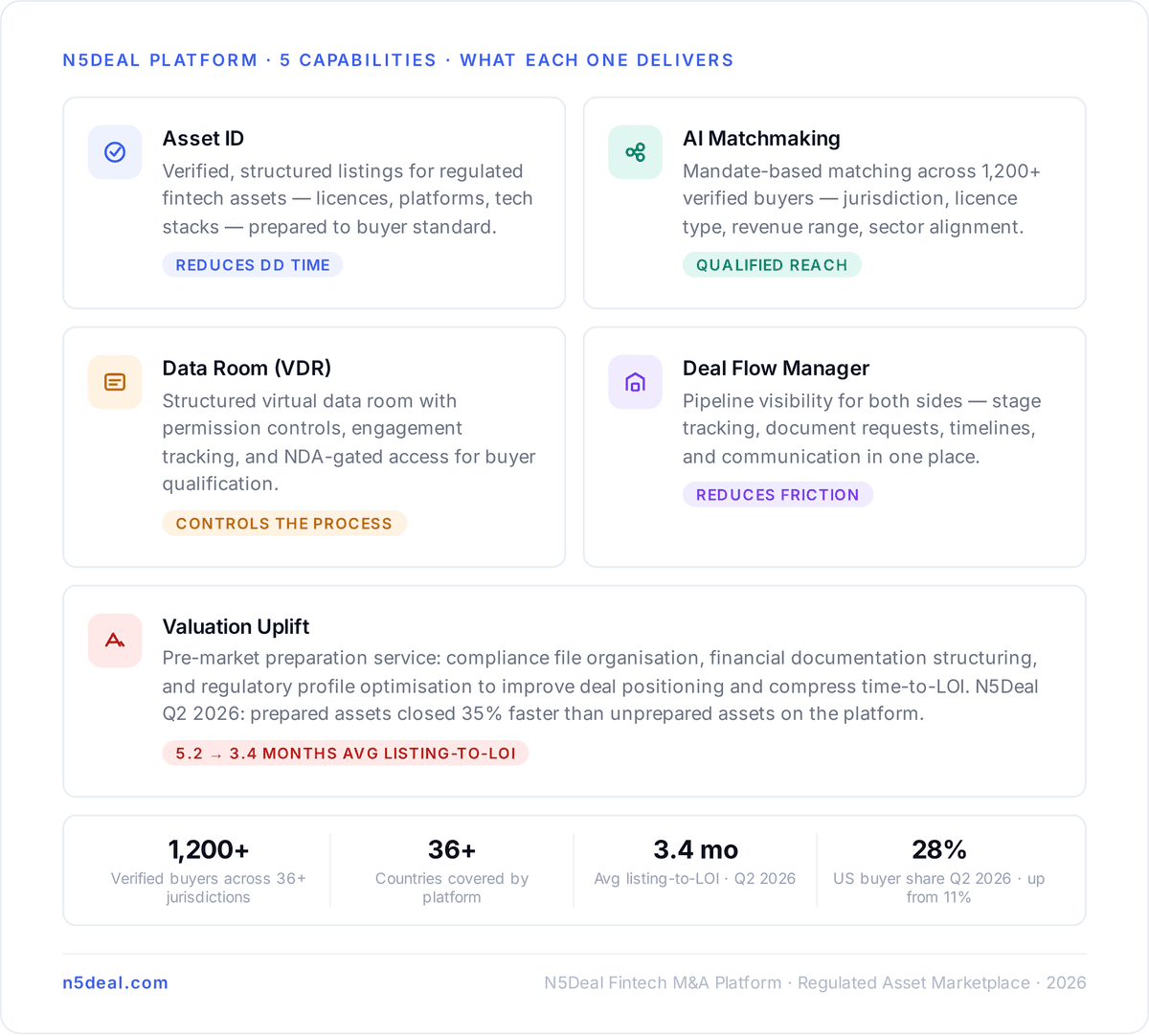
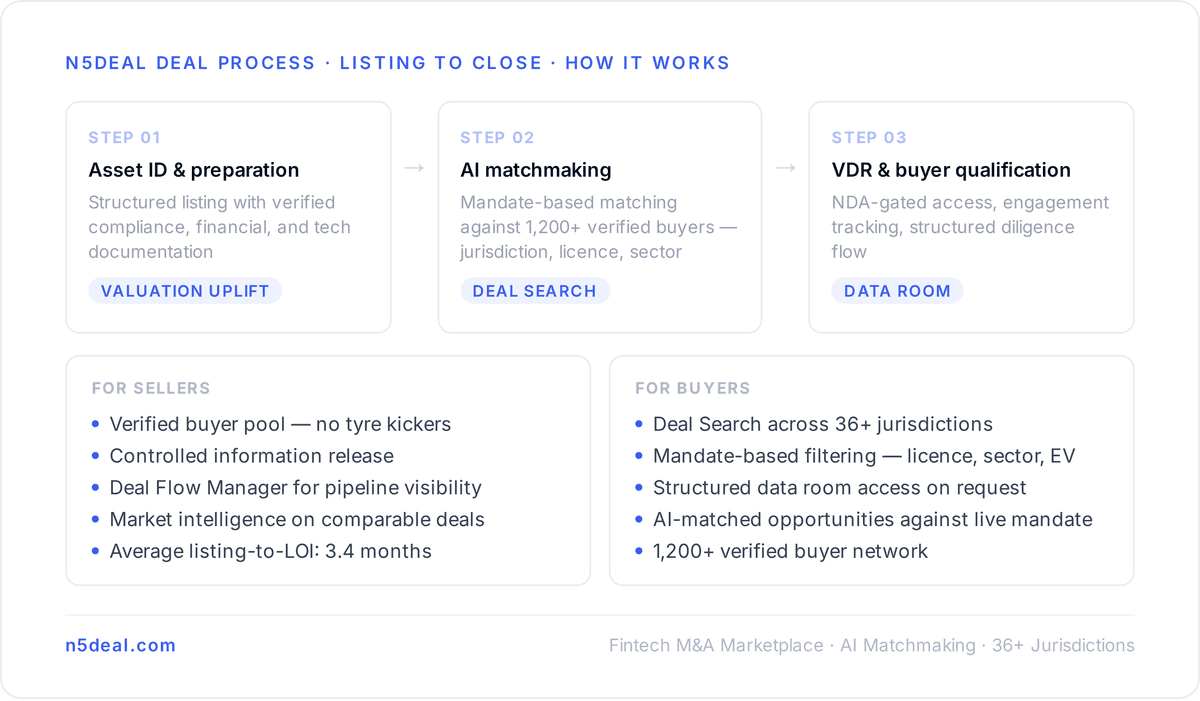
The Swiss FINMA license M&A premium reflects three compounding factors: a scarcity supply created by FINMA's rigorous admission standards, a direct SNB access benefit unavailable in equivalent EU frameworks, and a supervisory reputation that institutional counterparties globally treat as a credibility signal requiring no additional verification. The 2026 window before the FinIA reform takes effect adds a fourth factor: transition position preference for current licence holders. For buyers mapping where Swiss-licensed fintech assets are available for acquisition, N5Deal catalogues licensed entities with documented authorisation scope and compliance history. A full overview of available licensed assets is at n5deal.com.
Disclaimer
This page is for informational purposes only. It does not constitute legal, financial, or regulatory advice. Readers should consult qualified professionals before making any decisions.
Comments
Frequently Asked Questions
Clear, concise info to help you understand the process!