

Estonia crypto license M&A 2026 operates in a market defined by what was removed. Since 2019, the number of crypto licences in Estonia decreased tenfold — from over 1,200 to under 100 by 2023. The amended Prevention of Money Laundering and Terrorist Financing Act, effective March 15 2022, required firms to have legitimate links to Estonia, increased licensing fees and capital requirements, and introduced the FATF Travel Rule. What that purge produced is something unusual in EU crypto licensing: a small, survivor-selected pool of entities that passed genuine supervisory scrutiny before the MiCA framework arrived. The question for buyers is not whether the Estonia story is over — it's whether the 100 entities that survived the FIU's enforcement regime are worth more or less than the market currently prices them.
Key Takeaways
Estonia crypto license M&A 2026 targets the survivor pool from one of the most aggressive VASP enforcement campaigns in EU history — 1,200 licences reduced to under 100 active
Approximately 200 firms voluntarily shut down or had authorisations revoked; the FIU revoked approximately the same number for non-compliance — entities that survived did so because they met genuine operational and AML standards, not paperwork minimums
All FIU-issued VASP licences expire July 1 2026 — operators must have FSA MiCA CASP authorisation to continue; this deadline is creating a motivated seller population among those who cannot complete the transition
The Estonian FSA assumed regulatory responsibilities for CASPs from January 2025. Existing FIU-licensed VASPs may operate until July 1 2026 but must file a new application with the FSA — old licences are not automatically converted to CASP authorisations
A fully FSA-authorised Estonian CASP carries MiCA EU-wide passporting rights across all 27 member states — the same commercial value as any other MiCA-authorised entity, but with a compliance history that has survived two distinct regulatory regimes
What the Purge Actually Selected For
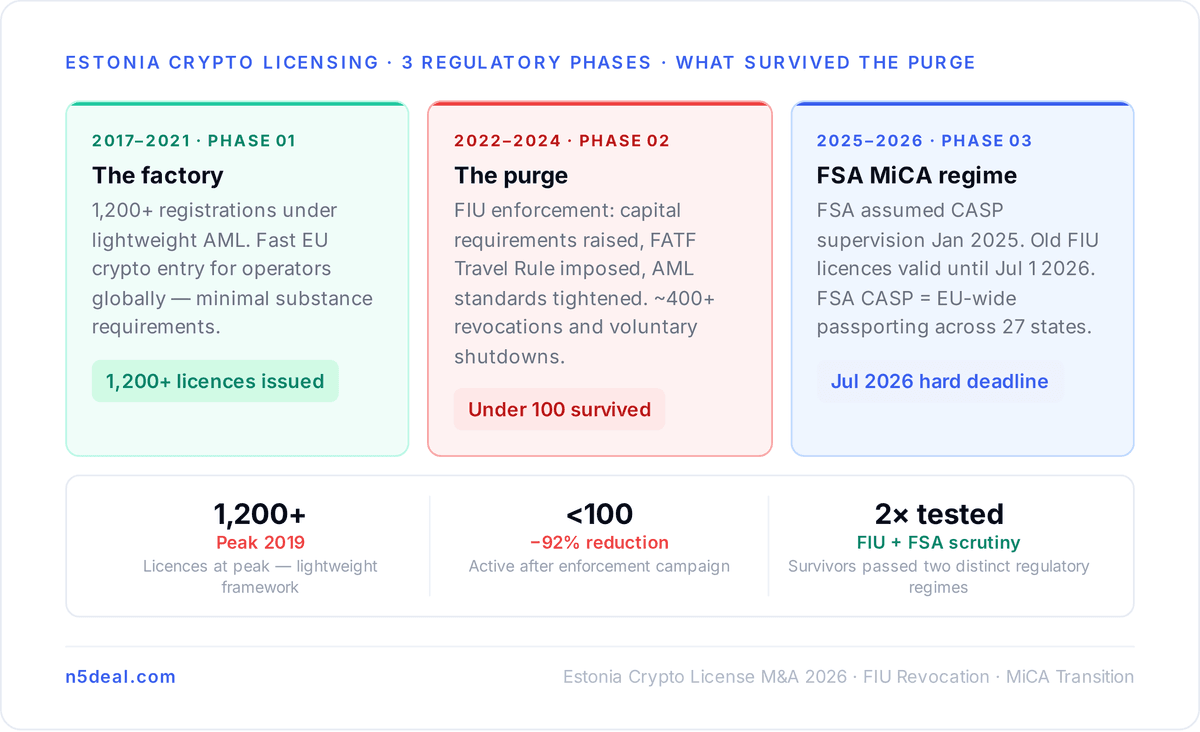
Estonia's crypto regulatory history runs in three phases. The first, from 2017 to 2021, produced the licence factory — over 1,200 registrations issued under a lightweight AML framework that attracted operators from across the world seeking a fast EU crypto entry point. The second, from 2022 to 2024, was the FIU's enforcement campaign — capital requirements raised, substance requirements imposed, AML standards aligned with FATF, and revocations issued at scale for non-compliance. The third, from 2025 onward, is the FSA's MiCA regime — full CASP authorisation replacing the legacy VASP framework, with the July 2026 deadline as the hard cutoff.
What survived the second phase is a population of operators that maintained genuine Estonian economic substance, demonstrated functioning AML programmes under active supervisory scrutiny, and met the capital requirements the FIU imposed as barriers to entry. Since 2022, the FIU adopted a restrictive approach toward VASPs, creating a challenging regulatory environment for new entrants and requiring firms to have real and actual economic activity in Estonia for six consecutive months. The entities that cleared that bar have compliance histories that are more thoroughly documented — and more thoroughly tested — than most equivalent EU crypto registrations.
The July 2026 Deadline and Its M&A Implications
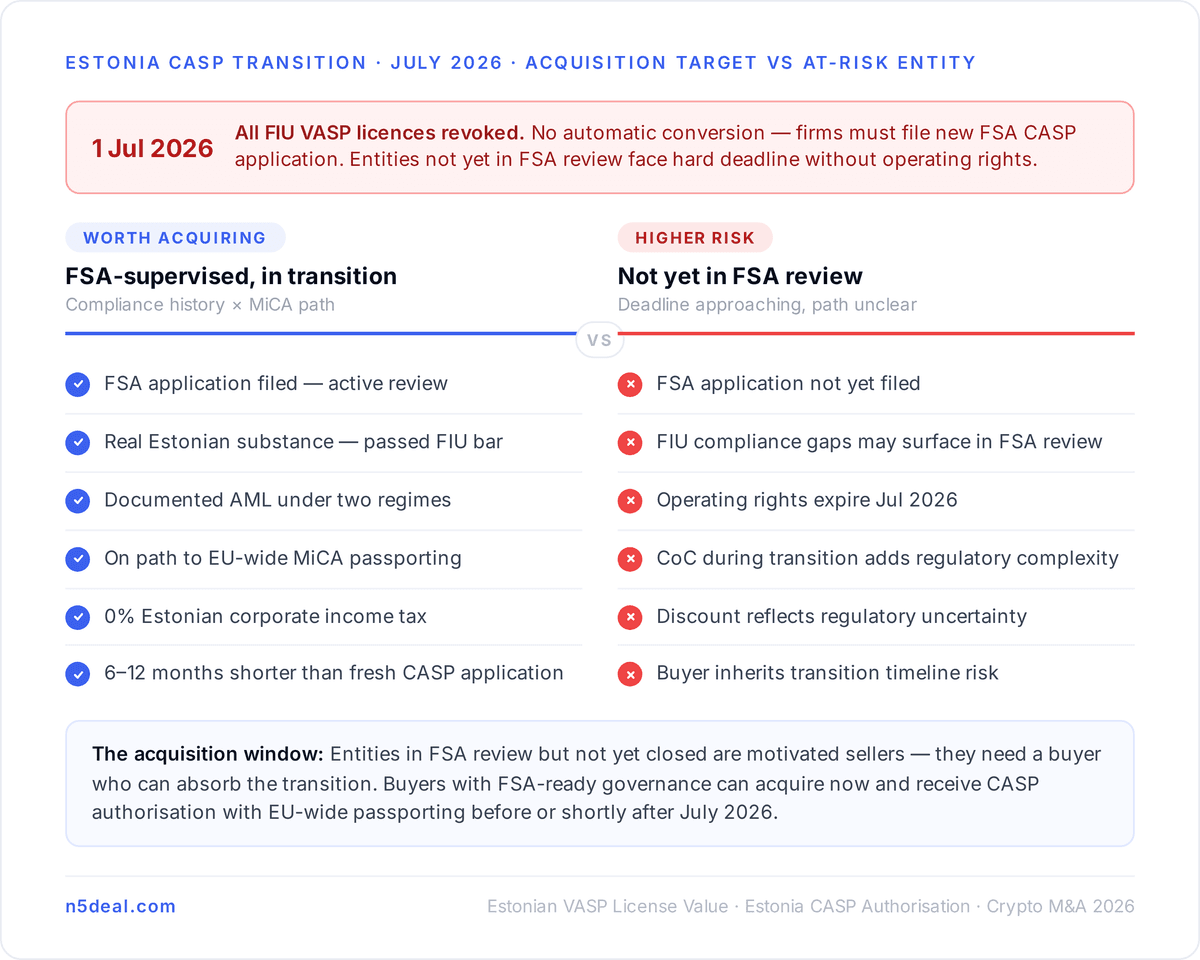
All VASP licences issued under the old regime will be officially revoked on July 1 2026. To avoid suspension of services, existing market participants must proactively migrate to the CASP framework — this involves a new assessment of compliance systems to meet the higher MiCA standards.
The transition is not automatic conversion. Existing VASP licences remain valid until July 1 2026 with no automatic conversion — firms must reapply to the FSA to continue beyond that date, with the grace period not equivalent to grandfathering of old licences. Entities that have already filed FSA applications and are in active review are in the most commercially valuable position: they carry valid operating rights through July 2026 and are positioned to receive MiCA CASP authorisation with EU-wide passporting from the same supervisory body.
Entities that have not yet filed, or whose FSA applications have encountered compliance gaps, are in a different position — they face the same July 2026 cliff that all European VASP operators face, but with the additional complexity of an FIU compliance history that the FSA will review as part of its own assessment.
What a Post-Purge Estonian CASP Is Actually Worth
Capital requirements under MiCA CASP authorisation range from EUR 50,000 for Class 1 services through EUR 125,000 for Class 2 services to EUR 150,000 for custody and administration — tiered by service scope. Those are the minimum numbers. What makes a post-purge Estonian CASP worth more than the capital requirement is the combination of verified compliance history, FSA supervisory relationship, EU-wide passporting rights on authorisation, and a 0% corporate income tax environment that adds operational cost advantage for group structures.
Estonia has a clear and favourable legal and tax environment, including 0% corporate income tax, making it an attractive licensing destination. Despite its small population of 1.3 million, Estonia is known as one of the world's most digitally advanced nations.
The acquisition case is specific: a buyer who needs MiCA EU-wide crypto market access, has the capital and governance to pass FSA change-of-control review, and can deploy the acquired entity's compliance infrastructure without a full rebuild is acquiring something that would take 6 to 12 months to create through a fresh CASP application — and something that carries two layers of regulatory scrutiny that a fresh application would not.
Conclusion
Estonia crypto license M&A 2026 is a survivor-selection acquisition story. The market that existed in 2019 was not worth buying — 1,200 licences, many with identical business plans and no real operational substance, at a price that reflected their ease of acquisition. The market that exists now is the product of three years of enforcement — under 100 entities, a transition deadline that creates urgency on both sides, and MiCA passporting rights that make a fully authorised Estonian CASP commercially equivalent to any other EU CASP. For buyers mapping where post-purge Estonian crypto assets are available with documented FSA transition status, N5Deal catalogues licensed entities across the EU crypto space. A full overview of available crypto-licensed assets is at n5deal.com.
Disclaimer
This page is for informational purposes only. It does not constitute legal, financial, or regulatory advice. Readers should consult qualified professionals before making any decisions.
Comments
Frequently Asked Questions
Clear, concise info to help you understand the process!