
Passporting in the EU After MiCA: What Still Works and What Doesn't
EU passporting MiCA 2026 is not a settled question for most operators — it's a moving compliance target with a hard deadline attached. The single market access that European financial regulation promises is real, but it doesn't apply uniformly across all licence categories and it doesn't transfer automatically from pre-MiCA national registrations to pan-EU operating rights. Understanding exactly which authorisations still carry full passporting rights, which have been grandfathered with restrictions, and which are now defunct is the starting point for any founder or buyer making decisions about EU market access through a licensed entity.
Key Takeaways
EU passporting MiCA 2026 creates a two-tier market: full MiCA-authorised CASPs can passport across all 27 EU member states; grandfathered VASPs operating under national regimes cannot passport during the transition period
ESMA states that after 1 July 2026, any entity providing crypto-asset services to EU clients without a MiCA licence will be in breach of EU law and must cease offering those services
EMI and PI passporting under PSD2 is unaffected by MiCA — these licences retain full EEA passporting rights across 30 countries and the PSD3 transition does not remove that
The grandfathering window has largely closed for planning purposes — businesses that had not applied before mid-2025 face a narrow timeline to achieve authorisation before enforcement becomes universal on 1 July 2026
A MiCA CASP authorisation acquired from a single EU member state passports across all 27 member states — making it the equivalent of the EMI passport but for crypto-asset services
What Still Works: EMI and PI Passporting Is Unchanged
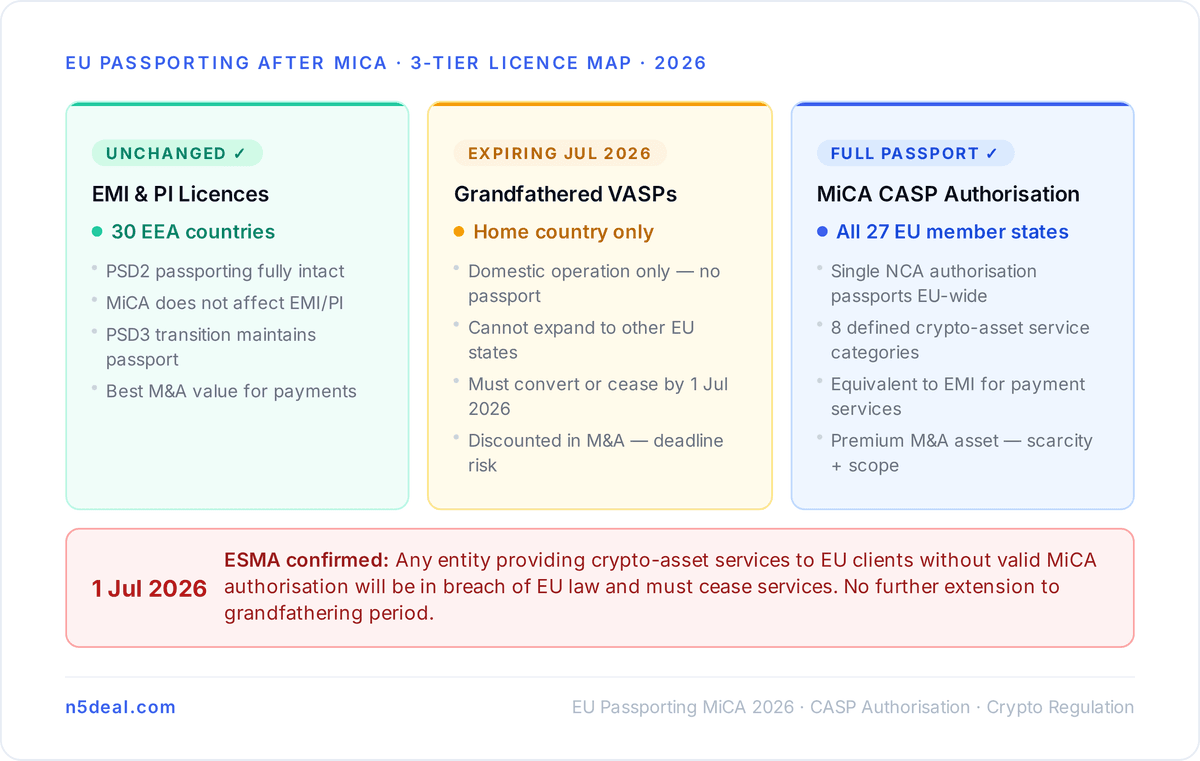
The most important clarification for EU-licensed payment fintechs is that MiCA does not affect EMI or PI passporting. The Electronic Money Directive and PSD2 frameworks remain operational under the current regime, and PSD3 — which will eventually replace PSD2 — maintains the passporting mechanism for payment and e-money services. An EMI authorised in Lithuania, Ireland, or the Netherlands retains full passporting rights across all 30 EEA member states today, and those rights are not affected by the crypto asset framework.
This distinction matters in M&A because buyers evaluating EU-licensed entities need to assess which regulatory framework the licence operates under before drawing conclusions about passporting status. A Lithuanian EMI that also holds a VASP registration has two separate regulatory relationships — the EMI passport is intact, the VASP registration does not passport under MiCA's transition rules.
What Doesn't Work: Grandfathered VASPs Cannot Passport
Firms authorized under national regimes before December 30, 2024, may continue operating domestically until July 2026 — but they cannot passport across the EU. Only MiCA-authorized firms gain full passport rights. A firm established in Estonia in 2021 can serve Estonian customers during transition, but must obtain MiCA authorisation to expand elsewhere.
This is the most consequential misunderstanding in the current EU crypto licensing landscape. A VASP registration — a national registration under pre-MiCA rules in Lithuania, Estonia, or any other EU jurisdiction — does not provide EU-wide operating rights during the grandfathering period. It provides continued operation in the home jurisdiction only. An operator who built an EU expansion strategy on the assumption that their Estonian or Lithuanian VASP registration would passport during transition does not have that right.
The practical consequence is a two-tier market operating simultaneously: MiCA-authorised CASPs with full EU passport rights, and grandfathered VASPs with domestic-only operating rights until July 1 2026, after which they must either have MiCA authorisation or stop. After 1 July 2026, all CASPs operating in the EU must hold valid MiCA authorisation regardless of prior national registration status.
MiCA CASP Authorisation: The New Pan-EU Passport for Crypto
MiCA creates a single EU-wide licensing regime — a CASP authorisation issued by one member state national competent authority passports across all 27 EU member states and the EEA. This is the MiCA architecture's most significant commercial feature: a single application, one regulator relationship, and full pan-EU access.
The MiCA CASP passport covers eight defined crypto-asset service categories, including custody and administration, operation of a trading platform, exchange against fiat or other crypto-assets, execution of orders, placement, reception and transmission of orders, providing advice, and portfolio management on crypto-assets. An entity seeking to offer all eight categories must declare all eight in its application — the passport covers the authorised service list, not a broader scope.
For M&A buyers evaluating crypto assets for pan-European acquisition, a MiCA-authorised CASP is therefore the equivalent of an EMI or PI for payment services: a single authorisation that provides legal EU-wide operating rights without the need for separate national applications. The strategic value of an already-authorised CASP in the current market is the same as the strategic value of an EMI with active passporting — it eliminates a 12 to 24 month licensing process and provides commercial deployability from day one.
The July 1 2026 Deadline and Its M&A Implications
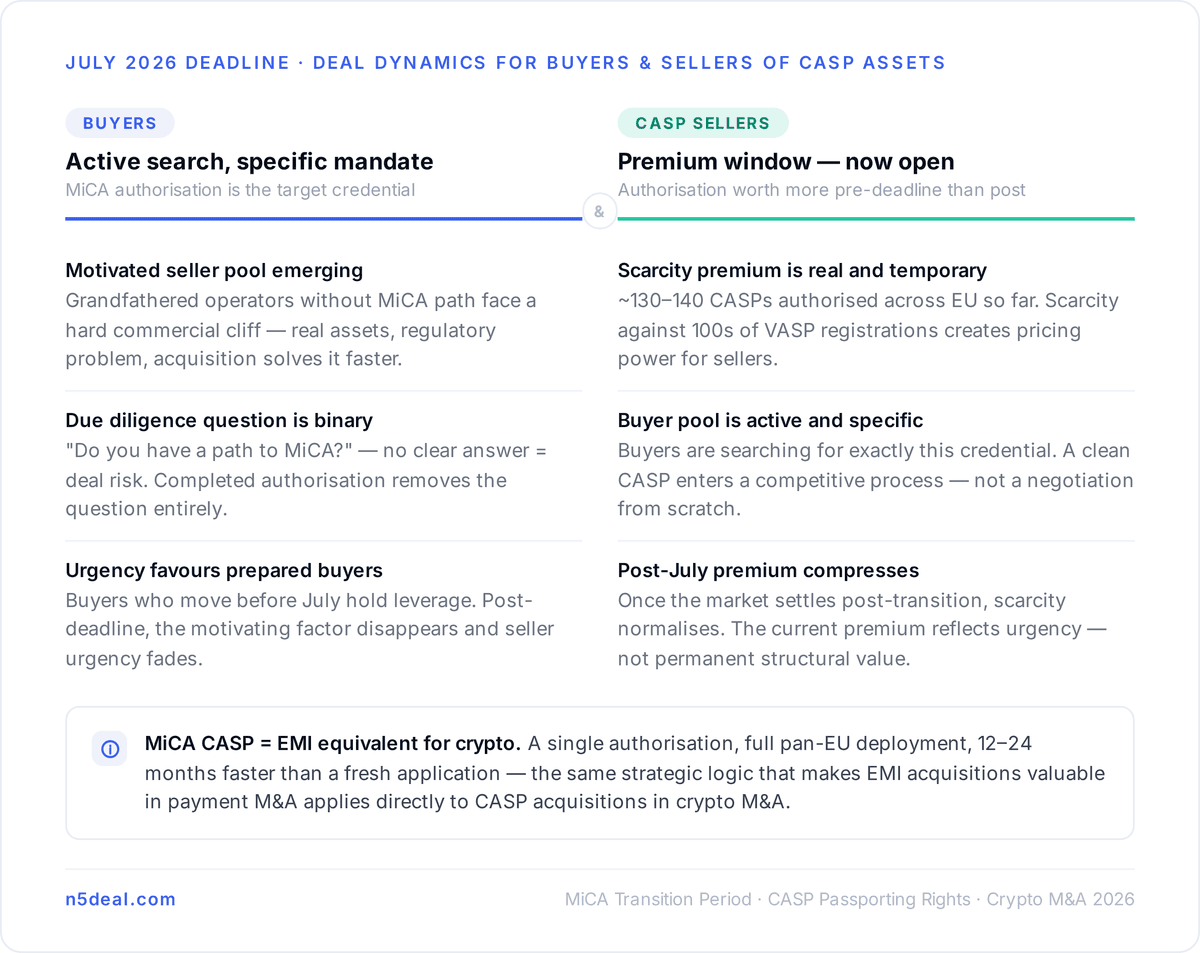
The July 1 2026 deadline creates a specific deal dynamic. Operators who are grandfathered but not yet MiCA-authorised face a hard commercial cliff: on that date, they must either have authorisation or cease EU crypto services. Smaller players might merge or get acquired by those who successfully navigate MiCA — for investors and venture capital in crypto, a key due diligence item will be "Do you have a path to a MiCA licence?"
For buyers, the July deadline creates a motivated seller population — operators who have built EU distribution under national registrations but haven't completed MiCA authorisation and don't have the resources or timeline to do so. Acquiring an entity with completed or advanced MiCA authorisation is faster than applying from scratch, and the window between now and July creates urgency on both sides.
For sellers who are MiCA-authorised, the same deadline creates a premium. A fully authorised CASP entering the market before July 2026 does so with a buyer pool that is actively looking for exactly that asset. The authorisation is worth more in the 12 months before the deadline than it will be in the 12 months after, when the market has settled into its post-transition structure.
Conclusion
EU passporting MiCA 2026 produces three categories of licensed entity with different commercial values: EMI and PI licences with unchanged full EEA passporting; grandfathered VASPs with domestic-only operating rights until July 2026; and MiCA-authorised CASPs with full pan-EU passport rights equivalent to the EMI structure. For founders and buyers making M&A decisions based on EU passporting access, the specific authorisation held by the target entity determines what the passport actually covers — and the July 2026 deadline makes that assessment time-sensitive. For buyers mapping where MiCA-ready and transitioning EU crypto assets are available for acquisition, N5Deal catalogues licensed entities with the regulatory documentation needed to assess authorisation status and passporting rights before formal processes begin.
Disclaimer
This page is for informational purposes only. It does not constitute legal, financial, or regulatory advice. Readers should consult qualified professionals before making any decisions.
Comments
Frequently Asked Questions
Clear, concise info to help you understand the process!