

VASP Registration vs Full Crypto License: What's the Difference and Why It Matters
VASP registration vs crypto license is not a semantic distinction. It's a commercial and legal difference that determines where a company can operate, which banking partners will work with it, whether it can passport across EU markets, and what it's worth in an M&A process. A surprising number of founders still treat the two as near equivalents. They are not. A VASP registration was built around anti-money laundering supervision. A MiCA CASP licence is a wider prudential and conduct framework for crypto-asset service providers across the EU. That difference changes the cost, complexity, and commercial value of authorisation.
Key Takeaways
VASP registration vs crypto license is not a distinction between two equivalent credentials — a VASP registration is an AML-focused national registration while a full CASP licence under MiCA is a formal EU-wide authorisation with passporting rights
As of spring 2026, roughly 130–140 CASPs have received full MiCA authorisation across all 27 EU member states — while hundreds of firms that were lawfully operating under pre-MiCA VASP registrations are still waiting or never filed at all
A grandfathered VASP cannot passport across EU member states — only full MiCA CASP authorisation unlocks pan-EU operating rights
Not holding a VASP or CASP licence can lead to fines, business shutdowns, and in certain jurisdictions criminal charges — access to banking services and key partnerships is also limited for unlicensed operators
In M&A, a MiCA-authorised CASP and a VASP registration are not comparable assets — the former commands a premium that the latter cannot justify
What a VASP Registration Actually Is
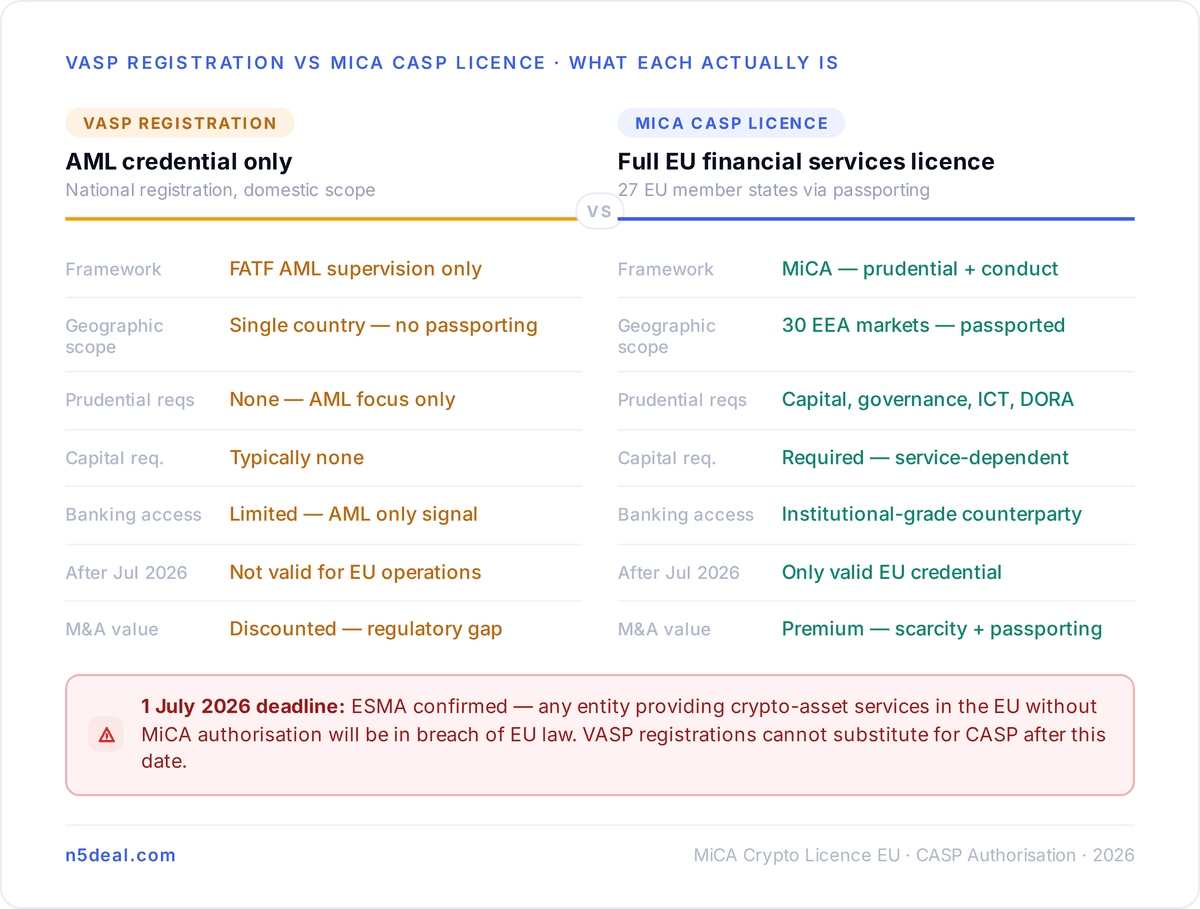
A VASP — Virtual Asset Service Provider — registration is a concept defined by the Financial Action Task Force (FATF) in its updated Recommendation 16 guidance on virtual assets. The FATF framework defines VASPs broadly as entities that conduct exchange, transfer, safekeeping, administration, or participation in financial services related to virtual assets.
At a high level, VASP registration usually meant permission to carry on certain virtual asset activities under local AML rules. Regulators focused on beneficial ownership, source of funds, AML policies, risk assessment, transaction monitoring, and governance around financial crime controls.
The critical limitation of a VASP registration is its scope: it is a national AML registration, not a financial services authorisation. A Lithuanian VASP registration permitted a company to operate in Lithuania under AML supervision. It did not authorise the company to operate in Germany, France, or any other EU member state. It did not provide passporting rights. It did not impose prudential requirements, conduct-of-business obligations, or the capital and governance standards that a formal financial licence requires.
What a Full Crypto Licence Is
A MiCA CASP licence goes further than VASP registration. It is not simply an AML gate — it is a formal licensing regime under the EU Markets in Crypto-Assets framework. That means organisational requirements, conduct obligations, complaint handling, prudential safeguards, outsourcing controls, governance standards, and more structured regulatory scrutiny. AML remains central, but it is no longer the whole story.
MiCA's requirements were built for regulated financial entities. A €5 billion exchange and a 10-person wallet product face identical capital, governance, and ICT demands. That symmetry is where most applications break down. The CASP application requires documented business plan, capital adequacy evidence, governance arrangements, complaint handling procedures, DORA-aligned ICT risk management, third-party vendor oversight, and safeguarding arrangements for client assets. It is, in scope and depth, comparable to an EMI or PI application — not a registration form.
The commercial return on that investment is EU-wide passporting. A CASP authorisation issued by one national competent authority — Lithuania, France, Ireland, or any other EU member state — passes across all 27 EU member states under the MiCA passporting mechanism. One licence, thirty markets.
The July 2026 Cliff and Its M&A Implications
By July 1, 2026, every firm providing crypto-asset services in the EU must hold a MiCA CASP authorisation. No exemptions, no extensions. How many operators will actually make it through is a different question.
The gap between the number of firms operating under pre-MiCA VASP registrations and the number that have successfully obtained CASP authorisation is the most consequential market dynamic in EU crypto in 2026. Italy held over 150 VASP registrations pre-MiCA; France had 104. Virtually none have converted. The gap isn't just a backlog — MiCA's requirements were built for regulated financial entities, not crypto startups.
For M&A buyers, this gap creates a specific acquisition opportunity. A VASP-registered entity facing the July deadline without a clear path to CASP authorisation is a motivated seller. The asset — customer base, technology, team — has real value. The regulatory problem is solvable through acquisition by an entity that already holds or is advancing toward CASP authorisation. The discount reflects the regulatory uncertainty, not the underlying commercial value.
For sellers, the implication is the reverse: a CASP-authorised entity entering the market before July 2026 does so with a buyer pool that is actively searching for exactly that credential. The premium commanded by a clean CASP authorisation in the current market reflects the difficulty and time required to obtain one — and the commercial value of operating across 27 EU markets from a single authorisation.
The Specific Differences That Affect M&A Due Diligence
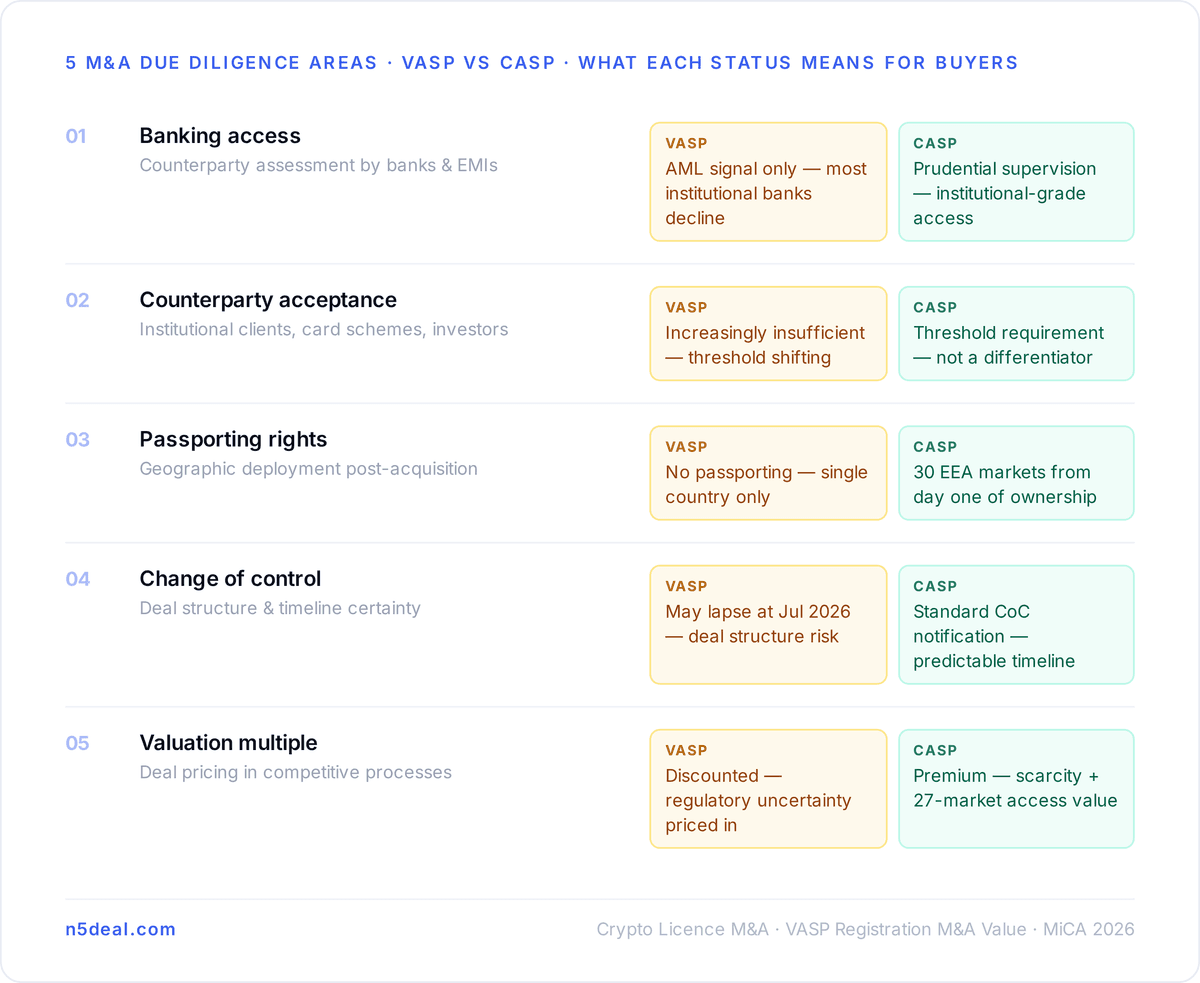
When a buyer evaluates a crypto entity in a deal process, the VASP registration vs CASP distinction surfaces in five specific areas.
Banking access. Banks and e-money institutions assess counterparty regulatory status before opening accounts. A CASP-authorised entity demonstrates prudential supervision, governance standards, and capital adequacy. A VASP registration demonstrates only AML compliance. Most institutional banking partners treat the difference as material.
Counterparty acceptance. Institutional clients, institutional investors, and card schemes conduct their own due diligence on crypto counterparties. CASP authorisation is increasingly the threshold requirement, not a differentiator.
Passporting. As established, grandfathered VASPs cannot passport. This limits the acquired entity's deployable geography from day one of ownership.
Change of control. A VASP registration that lapses at July 2026 creates a deal structure problem — the acquired entity's operating right may expire before or during the change of control process. A CASP authorisation subject to a standard change of control notification provides a more predictable timeline.
Valuation. A VASP or CASP licence opens doors to regulated markets and facilitates global growth and expansion — but the specific doors each opens are materially different. A CASP authorisation with EU passporting commands a premium multiple over a VASP registration with single-country operating rights. Buyers who conflate the two in their valuation model will either overpay for a VASP or underpay for a CASP.
Conclusion
VASP registration vs crypto license is one of the most consistently misunderstood distinctions in EU crypto M&A. A VASP registration is an AML compliance credential with domestic operating rights. A MiCA CASP authorisation is a formal financial services licence with EU-wide passporting rights, prudential requirements, and the commercial infrastructure that institutional partners require. The July 2026 deadline converts this distinction from an abstract regulatory point into a concrete commercial deadline — making CASP-authorised assets more valuable and VASP-registered entities without a transition path into motivated sellers. For buyers mapping where MiCA-authorised CASP assets are available across EU jurisdictions, N5Deal catalogues licensed crypto entities with the regulatory documentation needed to assess authorisation status before formal processes begin.
Disclaimer
This page is for informational purposes only. It does not constitute legal, financial, or regulatory advice. Readers should consult qualified professionals before making any decisions.
Comments
Frequently Asked Questions
Clear, concise info to help you understand the process!