

MSB License in Canada: The Underrated Gateway to North American Payments
Canada MSB license North American payments strategy has a straightforward commercial case that most European fintech founders miss: one FINTRAC registration covers all ten provinces and three territories, there is no minimum capital requirement, no application fee, and the framework explicitly covers virtual currency exchange and transfer alongside traditional money services. In 2026, Canada is one of the most predictable North American gateways for European fintechs — you do not need a bank charter, federal approval is national, and the entry cost is a fraction of a US multi-state Money Transmitter License rollout.
The comparison with US licensing makes the Canadian advantage concrete. A full US money transmission rollout requires separate MTL applications in 49 states, each with its own capital requirement, surety bond, and timeline. The total cost — legal, compliance, and bonding — regularly reaches six figures before a single customer is onboarded. Canada requires one registration, covers the second-largest economy in North America, and provides a credible FATF-aligned compliance foundation that US correspondent banks and institutional partners recognise.
Key Takeaways
The Canada MSB license North American payments gateway is one registration with FINTRAC covering all Canadian provinces — no minimum capital, no application fee, no pre-approval mechanism
Canada treats virtual asset services as part of its AML-regulated financial sector — MSB registration covers fiat-to-crypto exchange, crypto-to-crypto transactions, and certain custody functions, provided AML and reporting requirements are implemented correctly
Foreign MSBs (FMSBs) must register with FINTRAC if they actively target or service Canadian users — even without physical presence in Canada
FINTRAC registered 23 MSB revocations on a single day in March 2026 — enforcement is accelerating and a poorly maintained registration carries real commercial risk
Quebec adds a provincial AMF licence requirement for operators serving Quebec residents — typically 6 to 9 months, planned separately from the federal FINTRAC registration
Why Canada Is the North American Starting Point
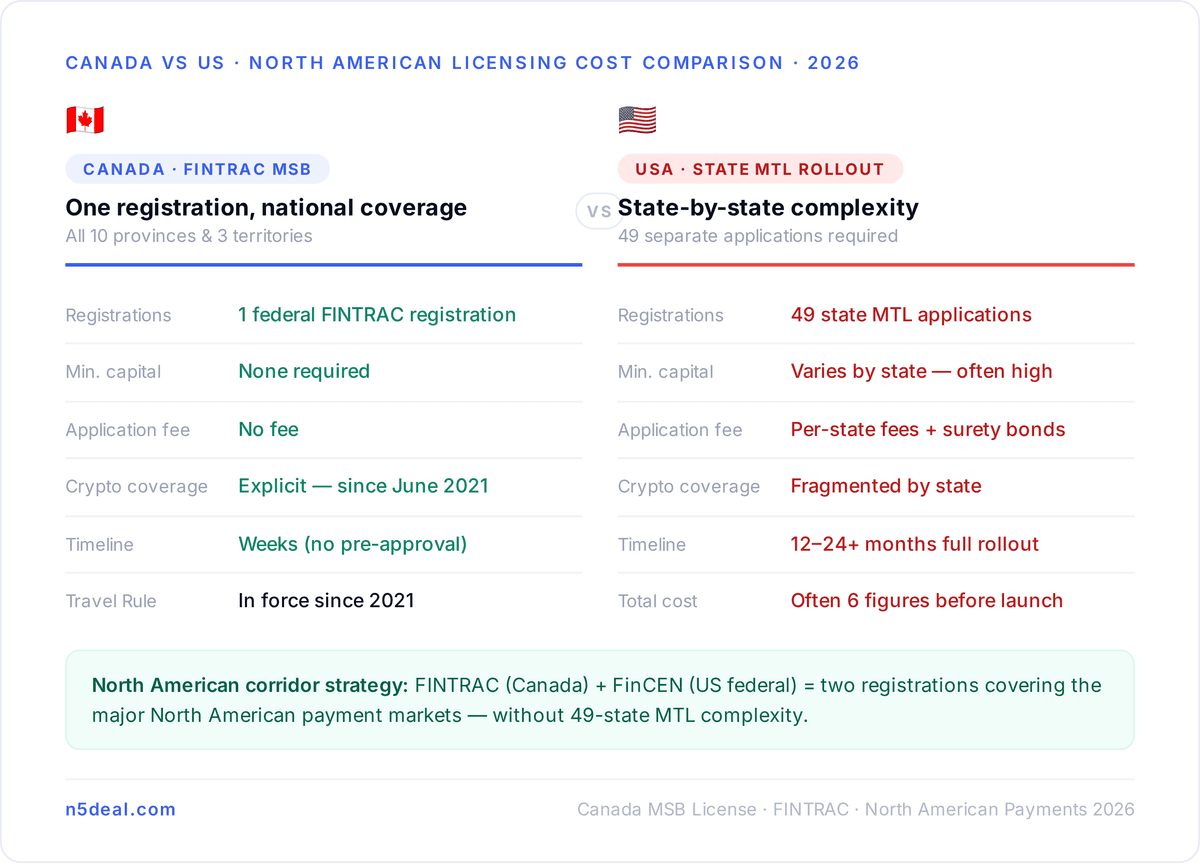
Canada has established itself as a jurisdiction where financial regulation follows a clear, predictable, and enforcement-driven model, rather than discretionary licensing or ad-hoc supervisory decisions. MSB registration enables lawful access to banking partners, payment infrastructure and cross-border settlement channels while preserving operational flexibility for international business models.
The banking access point is the practical one. Canadian correspondent banks — RBC, TD, BMO, Scotiabank — require counterparty MSB registration before opening accounts for payment companies. A FINTRAC-registered MSB with a functioning AML programme, clean compliance history, and documented KYC procedures is the baseline for those relationships. Without the registration, the banking relationship is unavailable. With it, the US-Canada payment corridor becomes accessible through a single regulatory relationship that Canadian banks already understand.
For European fintechs that have built US client relationships or are targeting the North American market, Canada provides a complementary entry point. A Canadian MSB registered with FINTRAC and a US FinCEN MSB registration cover the two major North American jurisdictions through two federal registrations — without the state-by-state MTL complexity that a US-only strategy requires.
What the Registration Covers
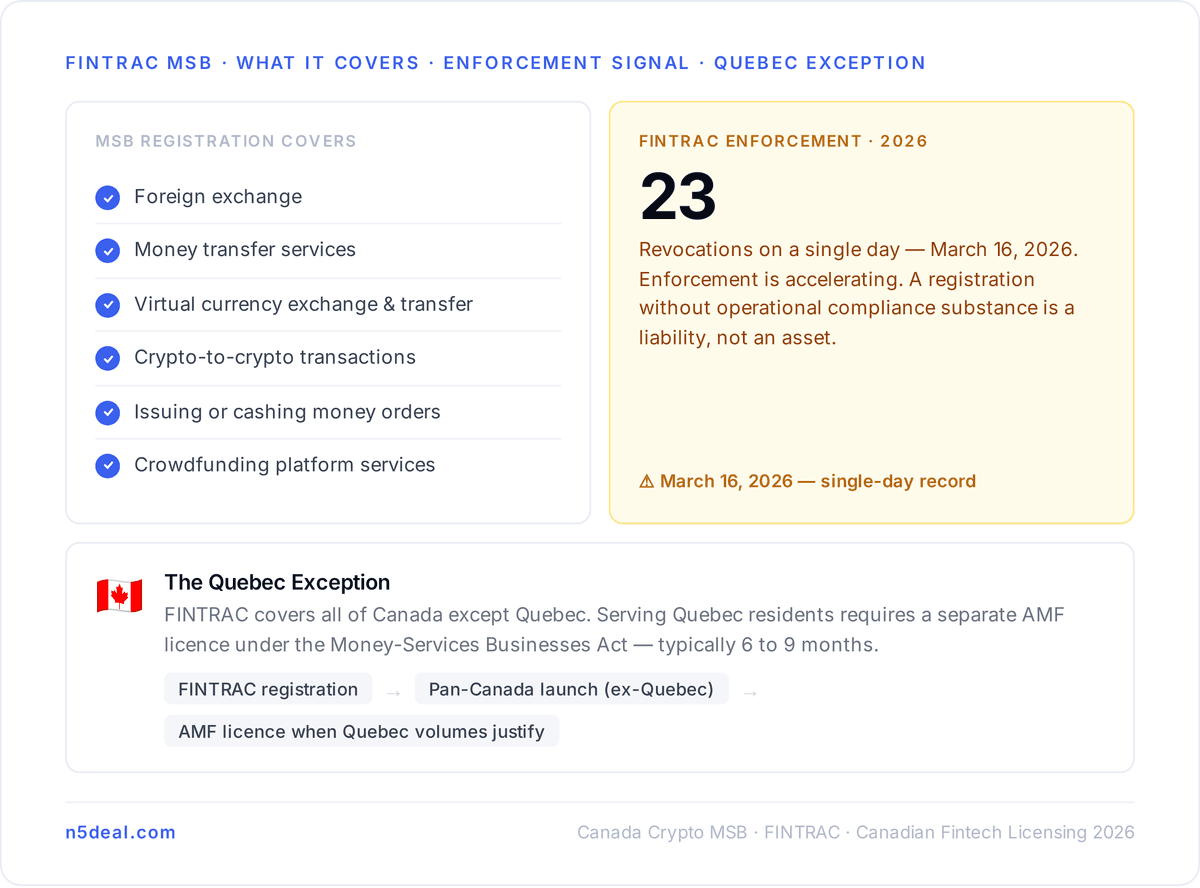
Since the 2020 and 2024–2025 amendments, the Canadian MSB perimeter covers foreign exchange, money transfer, issuing or cashing money orders, virtual currency exchange and transfer, and crowdfunding platform services.
The virtual currency explicit coverage is a specific differentiator. Canada brought virtual currency exchange and transfer within its MSB framework in June 2021, ahead of most comparable jurisdictions. A FINTRAC-registered MSB can lawfully operate crypto-to-fiat exchange, crypto-to-crypto transactions, and certain custody functions — with a clear, FATF-aligned compliance framework rather than the regulatory ambiguity that characterises crypto regulation in many other markets.
For virtual currency, the Travel Rule has been in force since June 2021 and was tightened through 2024–2026 guidance — an MSB transferring crypto on behalf of a client must include originator and beneficiary identifying information, and take reasonable measures when information is missing from inbound transfers.
What the Registration Requires
MSB registration in Canada does not require paid licensing fees, statutory minimum capital, or artificial staffing thresholds. The Canadian MSB regime is built around mandatory disclosure, transparency of ownership, and effective AML controls.
The registration process covers: legal incorporation or registered branch in Canada, completion of the FINTRAC MSB questionnaire covering services, products, and key personnel, submission of beneficial ownership information, and documentation of the AML compliance programme. There is no pre-approval stage — FINTRAC processes the registration and the registered entity then operates under ongoing compliance obligations.
Those ongoing obligations are where the substance sits. FINTRAC requires transaction records, suspicious transaction reporting, large cash transaction reporting, electronic funds transfer reporting above CAD 10,000, and regular compliance programme reviews. FINTRAC registration revocations are accelerating in 2026 — the financial intelligence unit registered 23 revocations on March 16, 2026, reflecting a markedly stricter regulatory environment. Companies failing to maintain their AML programme, reporting, and record-keeping obligations face registration cancellation without warning.
A FINTRAC registration that has been maintained with clean compliance history, documented AML programme reviews, and zero enforcement flags is a genuinely valuable asset. A registration that exists on paper without the operational substance behind it is a liability waiting to be discovered — in a regulatory examination or in M&A due diligence.
The Quebec Exception
Canada is federal for MSB registration, but Quebec adds a provincial licence. If you plan to serve Quebec residents or have a place of business in Quebec, you need a licence from the Autorité des marchés financiers under the Money-Services Businesses Act. In practice, the AMF process is slower and more intrusive than FINTRAC, often six to nine months. Teams that do not plan to target Quebec explicitly from day one usually launch Canada-wide ex-Quebec first, then add the AMF licence as volume justifies it.
For EU founders evaluating Canadian market entry, the practical sequence is: FINTRAC registration for pan-Canadian access excluding Quebec, then AMF licence once Quebec volumes justify the investment. Treating Quebec as a separate market for planning purposes prevents the AMF timeline from blocking a Canada-wide launch.
Conclusion
The Canada MSB license North American payments opportunity is underutilised by European fintechs that spend disproportionate planning time on US state-by-state MTL strategy. A single FINTRAC registration provides a national Canadian footprint, explicit virtual currency coverage, a FATF-aligned AML framework that correspondent banks recognise, and a credential that works alongside US FinCEN registration to cover the North American payment corridor without the complexity of 49 state MTL applications. The enforcement risk is real — 23 revocations in a single day in March 2026 confirms that — but it's manageable with a functioning compliance programme and clean ongoing reporting. For buyers evaluating Canadian-registered payment assets for acquisition, N5Deal catalogues FINTRAC-registered MSBs with the compliance documentation needed to assess registration status and AML programme quality before formal processes begin.
Disclaimer
This page is for informational purposes only. It does not constitute legal, financial, or regulatory advice. Readers should consult qualified professionals before making any decisions.
Comments
Frequently Asked Questions
Clear, concise info to help you understand the process!