

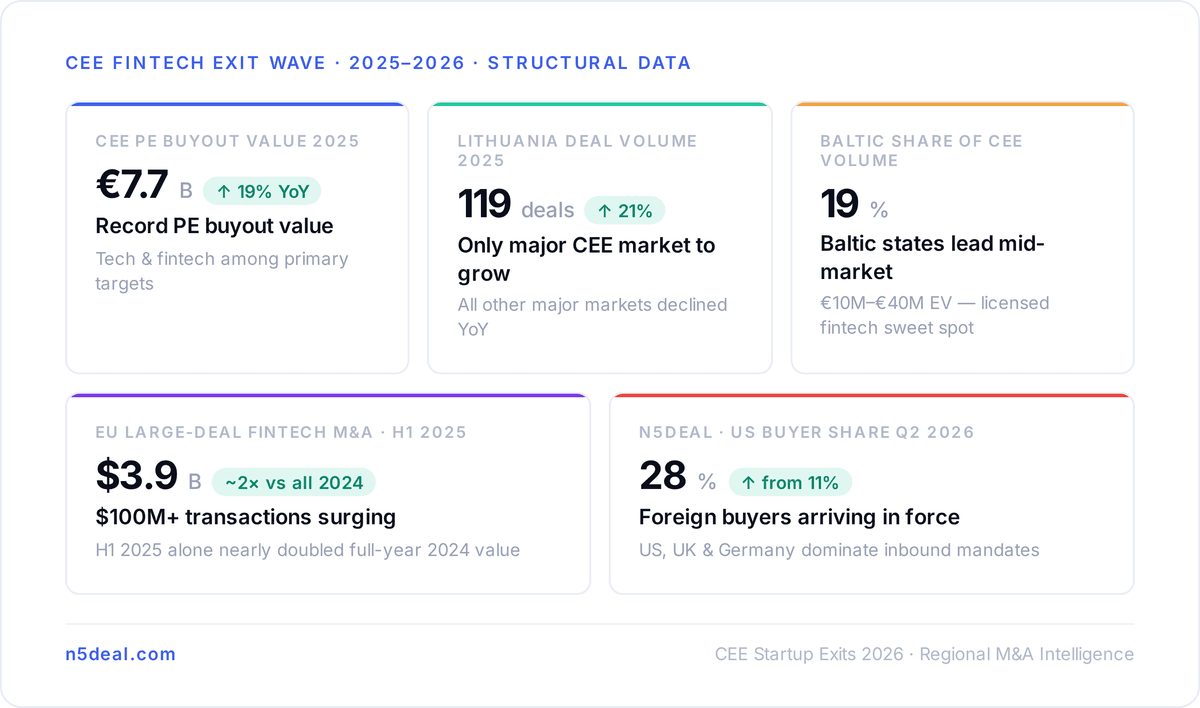
CEE fintech exits are no longer a prediction — they're a pattern with a data trail. Total PE buyout value in Central and Eastern Europe reached €7.7 billion in 2025, a 19% increase year-on-year despite a drop in deal volume. European fintech M&A value for $100 million-plus transactions nearly doubled in H1 2025 versus the whole of 2024. And in the Baltics specifically, Lithuania was the only major CEE market to record a year-on-year increase in transaction volume in 2025 — up 21% to 119 deal announcements. The exit wave isn't coming. For well-positioned fintech founders in this region, it's already arriving.
Key Takeaways
CEE fintech exits are supported by hard data — PE buyout value rose 19% to €7.7 billion in 2025, with tech and fintech among the primary targets
The Baltic states accounted for 19% of regional deal volume in 2025, driven by mid-sized transactions — the sweet spot for licensed fintech assets
Lithuania recorded a 21% year-on-year increase in transaction volume in 2025 — the only major CEE market to grow
Foreign buyers from the US, Germany, and the UK dominate inbound activity, drawn by valuation arbitrage and regulatory quality
Licensed fintech acquisition CEE is increasingly driven by buyers who want compliance infrastructure, not just revenue — regulation is the moat
The Data Behind the Exit Wave
The structural case for CEE fintech exits starts with who is buying. Western investors — especially from the US, Germany, and the UK — dominate inbound deal activity in CEE, drawn by strong fundamentals and high return potential. In 2023, nearly 40% of funding came from outside the region, especially from Western Europe and North America, increased from 2021's figure of 30%.
That inbound shift is accelerating in 2026. N5Deal's own Q2 2026 data shows US buyers rising from 11% to 28% of inbound mandates on the platform in a single quarter — a pattern consistent with the broader ION Analytics and EY data showing foreign capital growing more comfortable with CEE as an acquisition market. When US buyers triple their share of deal mandates in six months, that's not a trend. It's a market repricing.
European fintech M&A is enjoying a resurgence, powered by tactical acquisitions and attractive deal prices, with the trend expected to continue in 2026 as acquirers capitalise on stablecoins, embedded finance, and AI becoming more mainstream. The value of deals for $100 million-plus transactions hit $3.9 billion in H1 2025, across Europe — nearly double the total recorded for all of 2024.
Why Lithuania and Estonia Are the Specific Hotspots
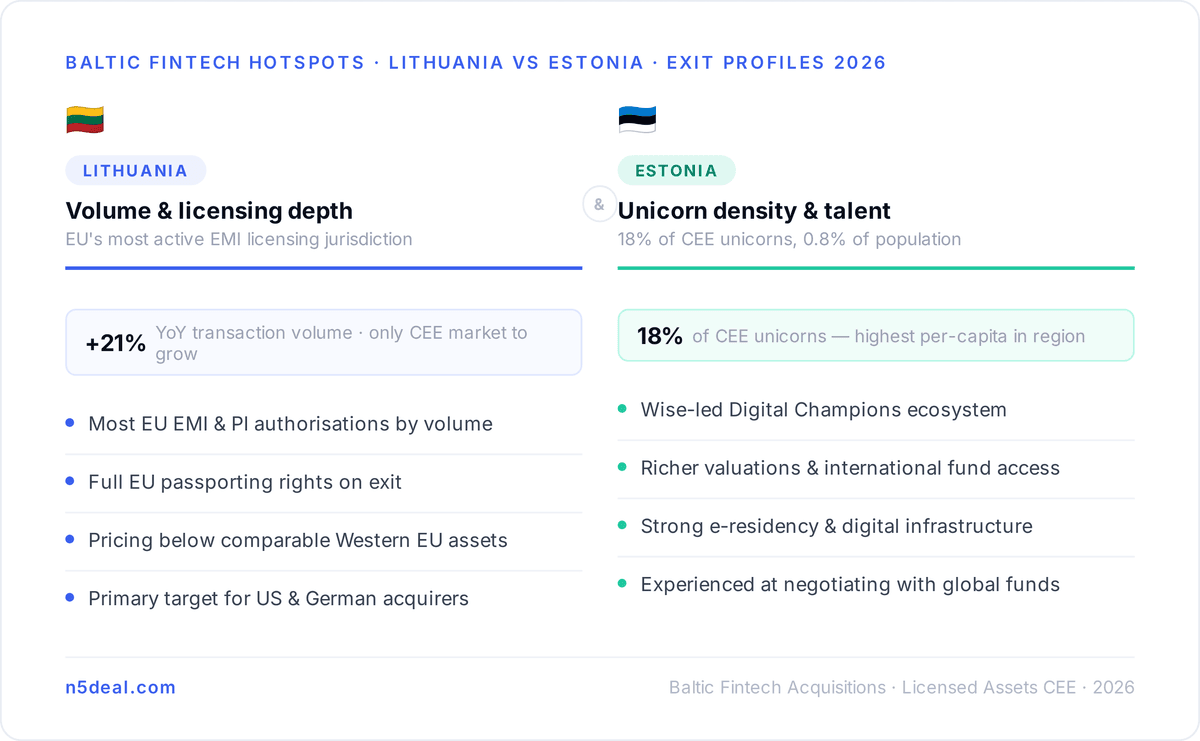
Not all of CEE is equally positioned for fintech exits. The data points to a specific geography. Poland, Austria, Romania, and Lithuania stand out as the region's most active M&A markets by volume in 2025. Lithuania was the only major market to record a year-on-year increase in transaction volume, rising by 21% to 119 deal announcements.
For fintech specifically, Lithuania's rise is not accidental. The country has become the EU's most active fintech licensing jurisdiction by application volume, processing more EMI and payment institution authorisations than any other EU member state in recent years. A licensed Lithuanian EMI comes with EU passporting rights, a CBI-equivalent regulatory reputation in many counterparty relationships, and pricing that remains below comparable Western European assets. That combination is exactly what foreign acquirers are targeting. The Baltic states accounted for 19% of regional deal volume in 2025, with deal flow primarily driven by mid-sized transactions in the €10 million to €40 million EV range — precisely the profile of licensed fintech assets seeking exits.
Estonia reinforces the pattern from a different angle. Estonia represents 18% of CEE's unicorns while accounting for only 0.8% of the region's population — with Wise topping the Digital Champions CEE 2025 list. Companies from the region are increasingly well prepared to negotiate with international funds and are receiving increasing funding flows at richer valuations.
What Buyers Are Actually Paying For
The Central Eastern Europe fintech M&A buyer profile has shifted. Early acquirers were chasing revenue multiples. Current acquirers are paying for compliance infrastructure, EU regulatory standing, and operational readiness. Acquirers are focusing on profitable or close-to-profitable fintechs generating between £50 million and £100 million in annual revenues — and are likely to execute more acquisitions focused on bringing specialist teams or proprietary tech and data to the acquirer as fintechs continue to focus on building out AI capabilities at scale.
For CEE founders, that buyer profile creates a specific preparation imperative. The companies commanding the best exit terms are not necessarily the largest by revenue. They are the ones where the compliance file is clean, the regulatory relationship is documented, the ownership structure is straightforward, and the technology layer can be integrated without a full rebuild. Those characteristics are acquirable by founders who build for exit deliberately — and they are independent of company size.
The Exit Cohort Is Maturing
The companies most likely to produce CEE startup exits in 2026 and 2027 are those that raised seed and early-stage capital between 2019 and 2022, built regulated products under Lithuanian, Estonian, or Polish frameworks, and are now approaching the revenue and operational maturity that strategic acquirers require. PE funds have raised new capital and are targeting tech and energy sectors specifically, with Lithuania showing the strongest transaction volume growth in the region.
That cohort is also the one most likely to attract the foreign buyer interest that N5Deal's own Q2 data confirms is accelerating. US buyers arriving in force, PE funds with fresh capital targeting CEE tech, and a regional deal ecosystem where mid-sized fintech transactions are the primary deal format — all three converge on the same outcome: a sustained fintech exit opportunities CEE window that is open now and will remain active through the near-term as the 2019-2022 vintage reaches exit readiness.
Conclusion
CEE fintech exits in 2026 are backed by the strongest structural conditions the region has seen: foreign buyer share is rising, PE buyout value grew 19% in 2025, Lithuania is the only major CEE market growing in transaction volume, and the Baltic states represent 19% of regional deal flow in the mid-market range where licensed fintech assets sit. The founders who will capture that window are the ones whose compliance documentation is clean, whose ownership structure is exit-ready, and whose regulatory standing is verifiable without a six-month diligence process. For buyers mapping where licensed fintech acquisition CEE targets are concentrated, N5Deal catalogues licensed fintech entities across the region with the structured documentation that makes early-stage screening efficient.
Disclaimer
This page is for informational purposes only. It does not constitute legal, financial, or regulatory advice. Readers should consult qualified professionals before making any decisions.
Comments
Frequently Asked Questions
Clear, concise info to help you understand the process!