

Latitude59 startup valuations don't get discussed in the same breath as Silicon Valley or London deal data — but they should. The 2026 competition in Tallinn drew 465 applications from 53 countries, the highest figure in the event's history. Seven finalists made the stage. Three walked away with a combined €450,000 from a syndicate of four Baltic and Nordic angel networks. And the companies that cleared that filter tell you something specific about what investors in this ecosystem are willing to price — and at what level.
Key Takeaways
Latitude59 startup valuations are shaped by one of the most rigorous early-stage filters in Europe — 465 applicants, 15 semi-finalists, 7 finalists
Over the past three years, pitch competition winners collectively raised more than €20 million in follow-on investment — the competition is a commercial springboard, not just a prize
The 2026 winning sectors — AI, deep-tech, and workflow automation — reflect what Baltic startup ecosystem investors are pricing at a premium
Estonia ranks 12th globally in the 2026 StartupBlink index, cementing the region's standing as a top-tier early-stage ecosystem
The follow-on data point from Mifundo — €1 million from the same investor six months after not winning, escalated to €10 million within 12 months — shows the competition's real valuation signal is durable
What the 465-to-7 Filter Actually Measures
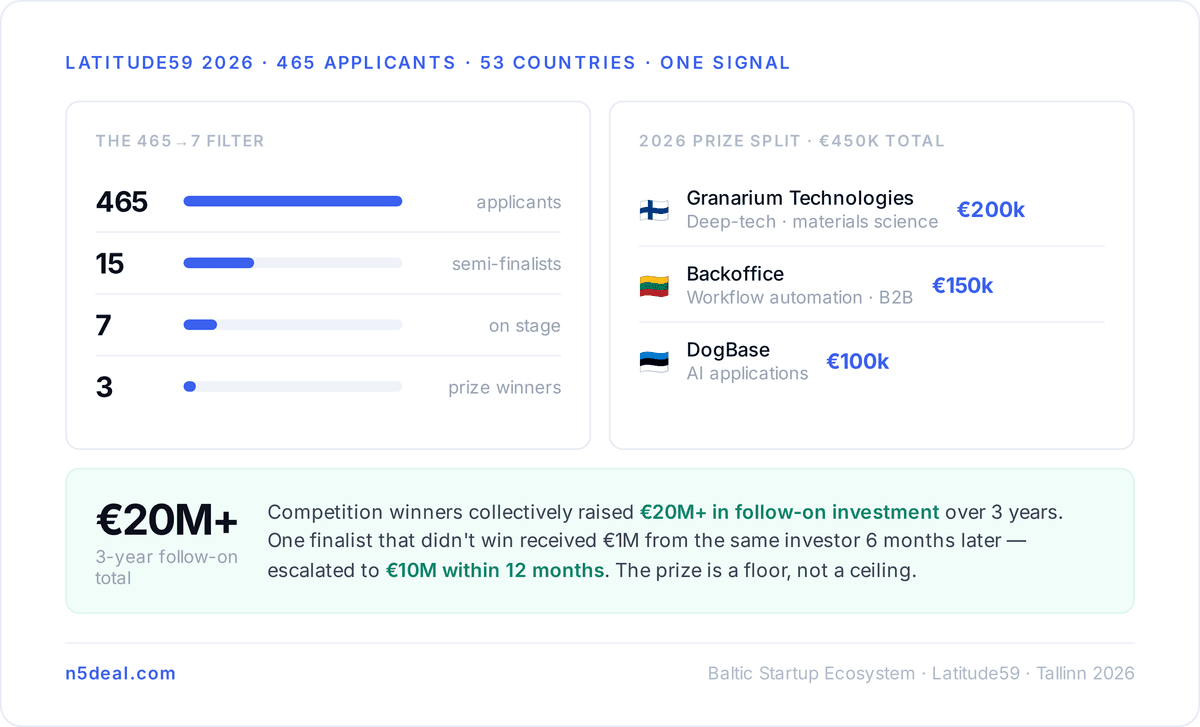
Latitude59 said 465 startups from 53 countries applied to its pitch competition in 2026, the highest number in the competition's history. The syndicated prize pool grew to at least €400,000, spanning four Nordic investor groups including, for the first time, Finland's FiBAN and Lithuania-based FIRSTPICK VC.
A 465-to-7 filter is a valuation instrument. It doesn't just select winners — it reveals the current consensus among Baltic and Nordic angel investors about what an investable early-stage company looks like in 2026. The companies that clear that filter are, by definition, companies the investor syndicate has agreed to price as credible. That agreement is harder to reach than it looks. Four separate angel networks across Estonia, Latvia, Lithuania, and Finland had to find common ground on seven companies out of nearly five hundred. The consensus that emerges from that process is more informative than any single investor's thesis.
What the 2026 Winners Tell Us About Sector Premiums
This year's winners are Estonian AI startup DogBase, Finnish deep-tech startup Granarium Technologies, and Lithuanian startup Backoffice. Finnish deep-tech company Granarium Technologies will receive up to €200,000, while Estonian AI startup DogBase will receive up to €100,000. Lithuanian venture capital fund FIRSTPICK will invest €150,000 in Lithuanian company Backoffice.
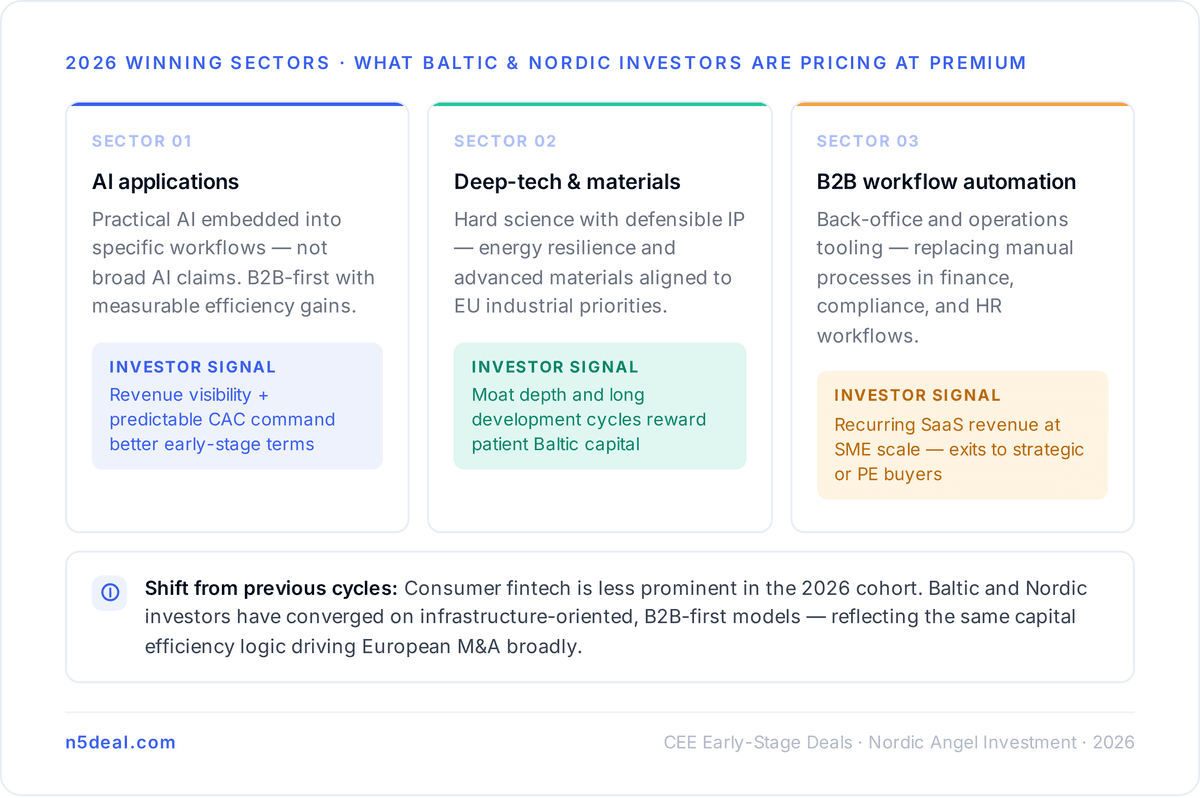
The sector composition of the 2026 winners — AI applications, deep-tech materials science, and back-office workflow automation — reflects a Baltic startup ecosystem that has moved away from early-stage consumer fintech and toward infrastructure-oriented, B2B-first models. The seven finalists reflect what Baltic and Nordic angel investors call the defining shape of European early-stage tech in 2026: defence and security applications, energy resilience, and workforce automation.
That sector concentration is a valuation signal. B2B infrastructure companies with demonstrated traction command better terms at early stage than consumer-facing applications, because the revenue visibility is higher and the customer acquisition cost is more predictable. Investors who have watched the Baltic ecosystem for multiple cycles are allocating accordingly.
The Follow-On Data Is the Real Number
The prize money at Latitude59 is not the valuation signal — the follow-on data is. Over the past three years, Latitude59 Pitch Competition winners have collectively raised more than €20 million in investments. Earlier cohorts include AskToSell, Flowstep, and ÄIO, whose investments from the 2023 and 2024 competitions totalled over €2 million.
One Latitude59 finalist that didn't win the main prize received the same investment amount from the same investor six months later — and after 12 months, the investment was escalated to €10 million. That data point is more useful than any single deal valuation. It demonstrates that the competition functions as a market-making event — exposing companies to capital that follows up independently of the prize outcome, at valuations determined by the commercial quality of the company rather than the competition result.
What This Says About Baltic Ecosystem Pricing
The 2026 StartupBlink Global Startup Ecosystem Index places Estonia 12th in the world — firmly atop Eastern Europe and the Baltics. A 12th-place global ranking from an ecosystem the size of Estonia's is a concentration signal. The companies being built and funded here are disproportionately high-quality relative to the market size, which is exactly the condition that produces the valuation arbitrage opportunity that CEE and Baltic assets have been offering international buyers for several years.
The 2026 Latitude59 cohort confirms that the quality signal is durable. Defence tech, AI applications, and deep-tech materials companies are clearing the 465-to-7 filter and then raising multiples of their prize amounts in follow-on rounds. For early-stage investors tracking where European startup quality is concentrated at rational pricing, the Baltic ecosystem continues to offer a specific and well-evidenced answer.
Conclusion
Latitude59 startup valuations in 2026 reflect a maturing ecosystem where the investor consensus has converged around B2B infrastructure, AI applications, and defence-adjacent technology — and where follow-on outcomes consistently outperform the headline prize figures. The competition's real function is not prize distribution. It's price discovery. Seven companies out of 465 applicants got a market-validated signal that their traction, team, and business model meet the current standard. That signal travels further and lasts longer than the €450,000 total prize pool suggests. For buyers mapping where early-stage Baltic and Nordic companies are positioned between first investment and M&A readiness, the Latitude59 cohort is worth tracking — as is the licensed fintech layer where earlier cohorts from the same ecosystem now operate at acquisition-relevant scale on N5Deal.
Disclaimer
This page is for informational purposes only. It does not constitute legal, financial, or regulatory advice. Readers should consult qualified professionals before making any decisions.
Comments
Frequently Asked Questions
Clear, concise info to help you understand the process!