

Why the Irish License Is Actually Worth More in M&A
An Irish license M&A value conversation starts with a single fact: on 1 January 2021, UK-authorised payment firms lost automatic passporting rights to serve EU customers. That event created a structural premium on CBI-licensed entities that has only deepened since. Stripe, Modulr, Square, Coinbase, and Gemini all chose Ireland for their EU entity after Brexit. The pattern isn't coincidence — it reflects a specific set of advantages that make a CBI authorisation worth more in a deal process than its FCA equivalent, at least for any buyer whose commercial strategy involves European operations.
Key Takeaways
Irish license M&A value is driven primarily by EU passporting — a single CBI authorisation covers all 27 EU member states and the EEA
FCA vs CBI M&A comparisons consistently favour Ireland for buyers targeting European expansion post-Brexit
CBI licensed fintech acquisition timelines are compressed compared to fresh applications — 6 to 12 months for a new licence vs a change-of-control process for an existing one
EU passporting post-Brexit has made Irish EMI and PI licenses the primary entry point for non-EU fintechs seeking pan-European market access
The CBI is one of the most thorough supervisors in the EU — which is precisely what makes its licence credible to counterparties, partners, and acquiring banks
What Passporting Actually Means in Commercial Terms
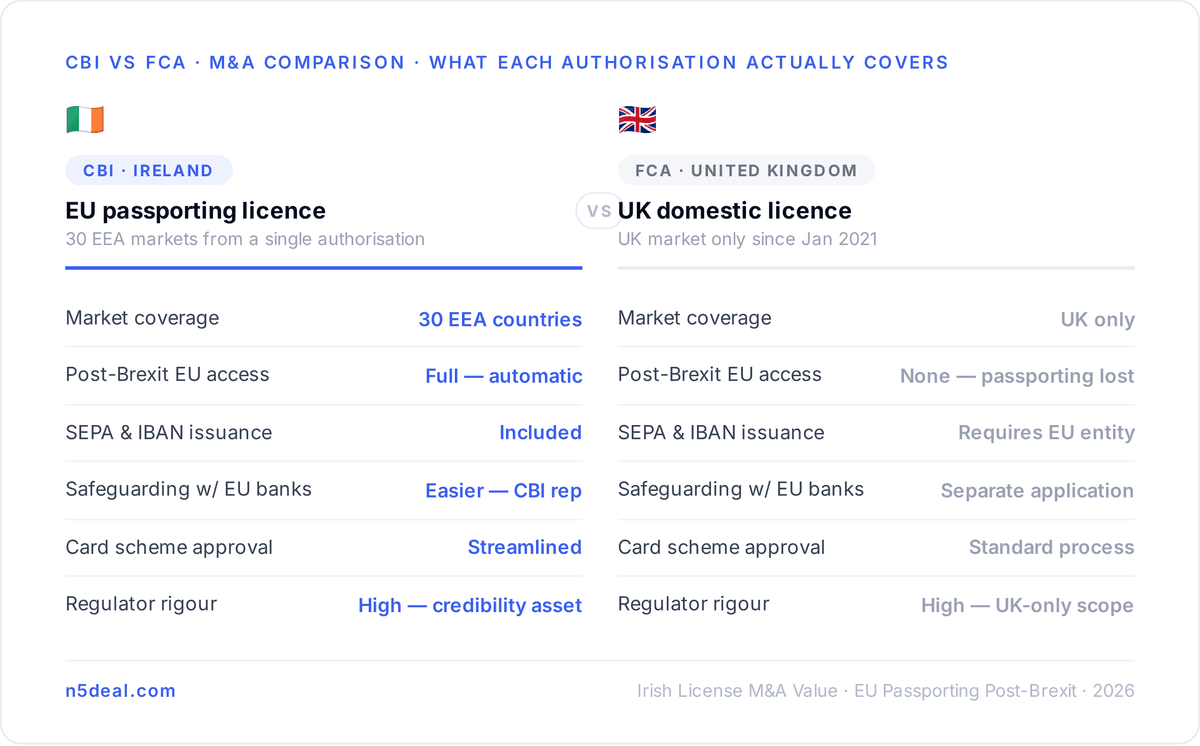
An Irish EMI license grants recognition across all EEA countries via passporting, allowing operations throughout the EEA with a single license — including the issuance of payment accounts with IBANs, participation in SEPA, and issuance of Visa or Mastercard payment cards to both personal and business customers.
In commercial terms, that means a single CBI authorisation eliminates the need for separate regulatory applications in Germany, France, the Netherlands, Poland, or any other EEA market a buyer wants to enter. The alternative — obtaining licences jurisdiction by jurisdiction — multiplies legal costs, compliance overhead, and timeline by the number of markets targeted. For a buyer with a pan-European strategy, the value of avoiding that process is measurable and substantial. It's not a soft benefit. It's a direct input into the deal model.
EU passporting enables the EMI to serve clients in all 30 EEA member states — 27 EU plus Iceland, Liechtenstein, and Norway — under the home country licence. This is the key commercial advantage over offshore payment licences — one authorisation covers the entire EU single market.
Why CBI Specifically Commands a Premium Over Other EU Licences
Not all EU licences passport equally in practice. The legal right to passport is uniform — the commercial credibility is not. The Central Bank of Ireland has a tier-1 reputation, and Ireland offers English as the working language, EU membership with the full PSD2 passport, and a deep local talent pool. The trade-off is that the CBI is one of the most thorough PI/EMI supervisors in the EU — timelines are longer than Lithuania or Malta, substance expectations are higher, and the application file is heavier.
That thoroughness is exactly what makes the licence valuable in a deal process. When a CBI-authorised entity presents its compliance file to an acquiring bank, a card scheme, or an enterprise client, the response is categorically different from what a lighter-touch jurisdiction produces. Banks that won't open safeguarding accounts for Maltese or Lithuanian EMIs will open them for Irish ones. Card schemes that require additional documentation for some EU applicants wave Irish entities through. The CBI's rigour creates the credibility that makes the licence commercially deployable from day one of ownership.
The steady stream of post-Brexit relocations from the UK to Ireland — including Stripe, Modulr, Square, Coinbase, and Gemini — reflects those four factors: language, EU membership, CBI reputation, and talent pool. Each of those companies had the resources to choose any EU jurisdiction. They chose Ireland. That pattern is a market signal about where institutional fintech buyers place the highest operational trust.
FCA vs CBI: The M&A Calculation
FCA vs CBI M&A comparisons come down to one question: where does the buyer's customer base sit? If the answer is primarily the UK, the FCA authorisation is sufficient and the CBI premium is irrelevant. If any material portion of the intended customer base is in the EU — now or as part of the acquisition thesis — the CBI authorisation pays for its premium within the first year of operation.
UK EMIs lost automatic passporting rights to serve EU/EEA customers on 1 January 2021. The main alternatives are establishing an EU-authorised subsidiary, partnering with an EU-licensed firm, or applying for authorisation in an EU member state. Lithuania and Ireland remain the most popular EU jurisdictions for UK firms seeking a new EU licence.
The operational reality for a UK-only buyer acquiring an Irish entity is that it pays for passporting it may not immediately use. The operational reality for a buyer with European ambitions is that the Irish licence eliminates the need to build a parallel EU structure post-acquisition — which is one of the most common sources of post-deal cost overrun in fintech M&A. The value of the licence in M&A is therefore directly proportional to the acquiring entity's European ambition.
What the Premium Looks Like in Practice
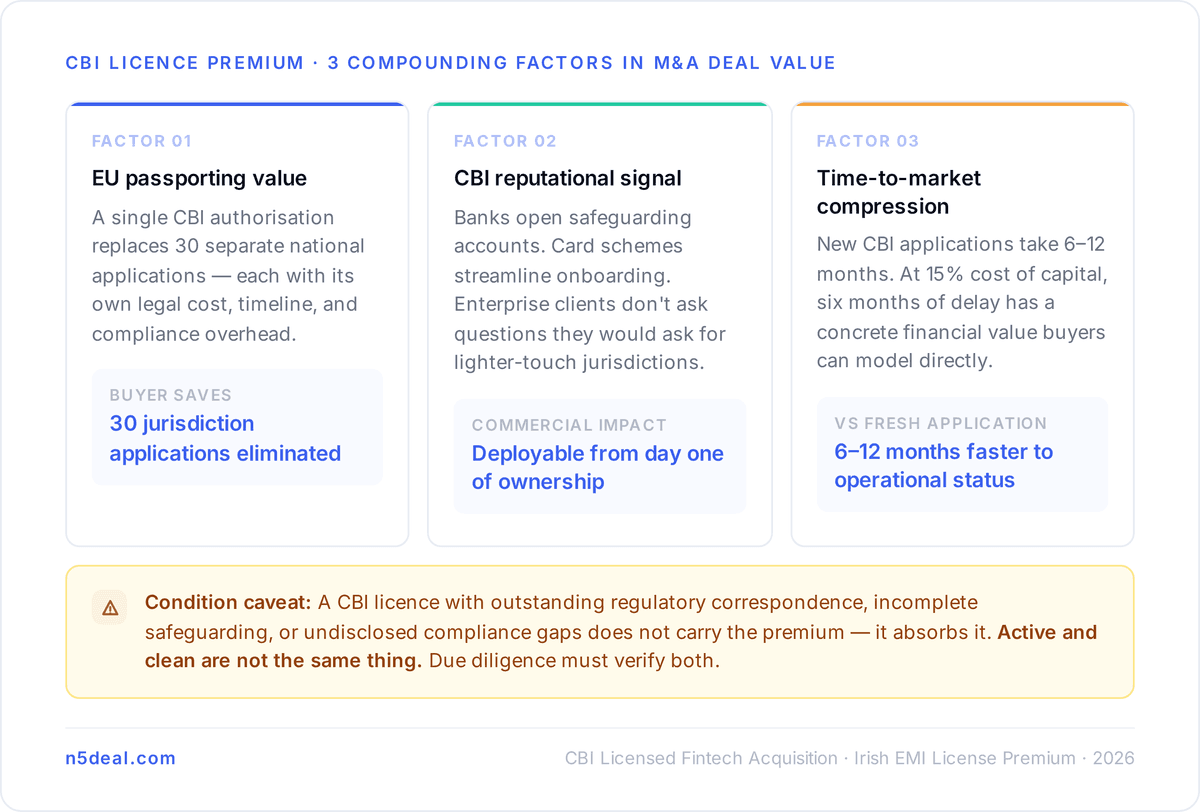
CBI licensed fintech acquisition candidates trade at a measurable premium over comparable FCA-authorised entities in competitive deal processes. The premium reflects three compounding factors: the passporting value, the CBI reputational signal to counterparties, and the time-to-market compression relative to a fresh application.
New applications take 6 to 9 months under CBI review. Purchasing a ready-made entity with clean records can reduce time-to-market significantly. At a cost of capital of 15%, six months of delay has a concrete financial value that a buyer can calculate. Add the legal fees, internal resources, and management distraction of a fresh application, and the acquisition premium for a clean existing CBI entity typically looks reasonable by comparison.
The caveat is condition. A CBI licence with outstanding regulatory correspondence, incomplete safeguarding arrangements, or undisclosed compliance gaps does not carry the premium — it absorbs it. Due diligence on an Irish entity needs to confirm that the licence is genuinely clean, not just currently active. Active and clean are not the same thing, and the difference matters in what the entity is actually worth to a buyer.
Conclusion
The Irish license M&A value premium is structural, not sentimental. It reflects EU passporting across 30 EEA markets from a single authorisation, a regulator whose thoroughness is respected by banks and card schemes globally, and a post-Brexit dynamic that has made CBI authorisation the default entry point for non-EU fintechs targeting European customers. For buyers whose commercial strategy is European, the premium is justified. For buyers focused exclusively on the UK domestic market, it may not be. The question is not whether Irish licences are worth more — they demonstrably are for the right buyer. The question is whether the specific buyer is the right buyer for the premium they're being asked to pay. For founders and advisors mapping available CBI licensed fintech assets, N5Deal catalogues licensed entities across Ireland and the UK with the documentation needed to assess that question before engaging in a formal process.
Disclaimer
This page is for informational purposes only. It does not constitute legal, financial, or regulatory advice. Readers should consult qualified professionals before making any decisions.
Comments
Frequently Asked Questions
Clear, concise info to help you understand the process!