

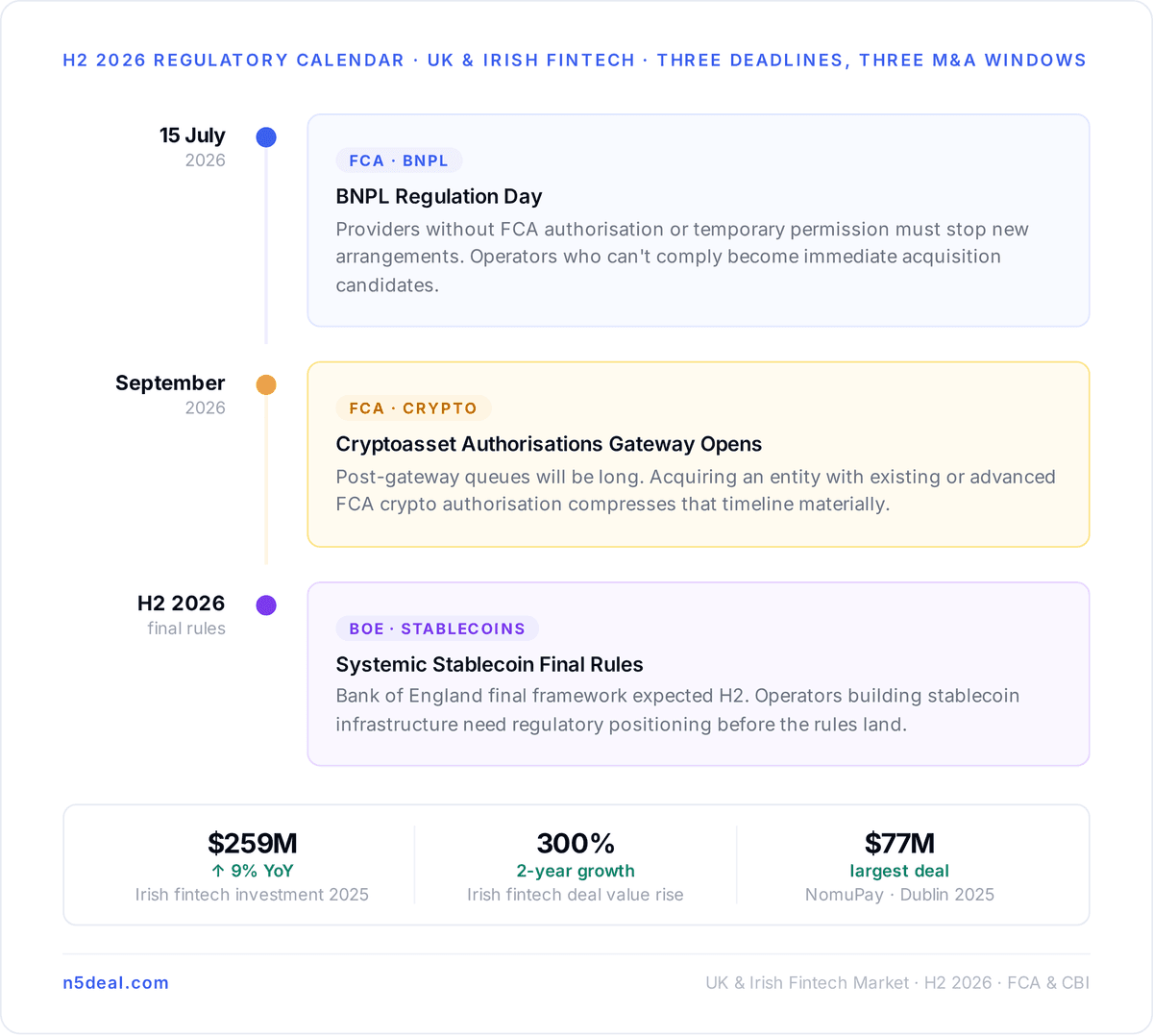
The UK and Irish fintech market in H2 2026 is being shaped by three regulatory deadlines that will produce deal flow whether or not the companies involved planned for it. July 15 brings BNPL Regulation Day. September brings the FCA cryptoasset authorisations gateway. H2 brings the Bank of England's final rules on systemic stablecoins. Each deadline separates compliant operators from those who need a faster path to authorisation — and that separation is where M&A activity concentrates.
The UK and Irish fintech market H2 2026 is defined by regulatory-driven consolidation — three major FCA deadlines create M&A windows for well-positioned assets
Irish fintech investment reached $259.38 million in 2025, up 9% year-on-year and 300% over two years according to KPMG
CBI licensed fintech entities attract premium interest from post-Brexit buyers seeking EU single market access
FCA fintech regulation is tightening around BNPL, crypto, and stablecoins simultaneously — operators that can't meet the new standards become acquisition candidates
Dublin fintech deals in 2025 included NomuPay ($77m), Teybridge Capital Europe ($58.6m), and Wayflyer ($35m)
Irish Fintech Investment Is Compounding Year on Year
Irish fintechs attracted $259.38 million in deals in 2025, up 9% from $237.95 million in 2024, continuing a rise of more than 300% over just two years according to KPMG's Pulse of FinTech H2 2025 report. The composition of that growth matters as much as the headline. The largest transactions — Teybridge Capital Europe at $58.6 million, NomuPay at $77 million across two rounds, and Wayflyer at $35 million — are institutional-scale deals in payments infrastructure, trade finance, and revenue-based lending.
These are not early-stage bets. They are strategic positions in businesses with operating history and regulatory standing under the Central Bank of Ireland. The pattern reflects a broader shift: international capital is no longer testing the Irish fintech market — it is deploying into it at scale, with clear sector preferences toward infrastructure, payments, and compliance-adjacent models that benefit from CBI authorisation.
For buyers tracking Dublin fintech deals, this trajectory signals a maturing market. The assets available for acquisition in Ireland in H2 2026 carry compliance frameworks already tested by a regulator widely respected by EU counterparties. That combination — EU passporting capability, CBI authorisation, and a documented operating track record — is increasingly difficult to replicate through fresh applications, which is what sustains Dublin fintech assets at a premium over equivalent unlicensed structures.
UK Regulatory Deadlines Are Creating Deal Flow
FCA fintech regulation in H2 2026 is not a background condition. It is a sequence of specific events that will force decisions across the market simultaneously. BNPL providers need to be authorised for the relevant consumer credit services they offer or have temporary permission by 15 July 2026, otherwise they will be required to stop providing new arrangements. Companies that cannot meet that deadline have a narrow window to either obtain authorisation or find a buyer who already has it — making July 15 a structural catalyst for consolidation.
The crypto calendar runs in parallel. The authorisations gateway for cryptoasset firms is expected to open in September 2026, with the Bank of England's final rules on systemic stablecoins also expected in H2 2026. For operators who have been building in anticipation of these frameworks, September is a commercial inflection point. For those who haven't, it is a deadline problem that acquisition can solve faster than a fresh application.
UK fintech M&A in H2 2026 will therefore run on two distinct tracks: strategic acquirers using regulation to consolidate positions in BNPL and crypto infrastructure, and operators using acquisition to reach compliance faster than the regulatory timeline allows. Both dynamics produce deal flow — and both favour sellers who enter the market before the deadlines rather than after.
FCA vs CBI: What the Divergence Means for Acquirers
The structural difference between UK and Irish authorisations has become one of the defining considerations in H2 2026 deal structuring. Post-Brexit, an FCA authorisation covers Great Britain and Northern Ireland — but it no longer provides automatic passporting rights into any EU member state. A CBI authorisation in Ireland retains full access to the EU single market under the passporting mechanism.
For a buyer whose commercial strategy involves serving clients across France, Germany, the Netherlands, or any other EU jurisdiction, that asymmetry is material. A CBI-licensed fintech entity with clean regulatory history and active EU passporting is structurally more valuable than a comparable FCA-authorised entity for any buyer who needs EU market access. That gap explains why Dublin-headquartered licensed assets command premium positioning in deal processes — and why it will continue into H2 2026.
Conversely, for buyers focused on the UK domestic market or global expansion outside the EU, the FCA framework remains the natural choice. The two authorisations are not interchangeable. Buyers who conflate them in early-stage screening typically discover the mismatch in due diligence — which is an expensive place to find it.
What Buyers Are Actually Looking For
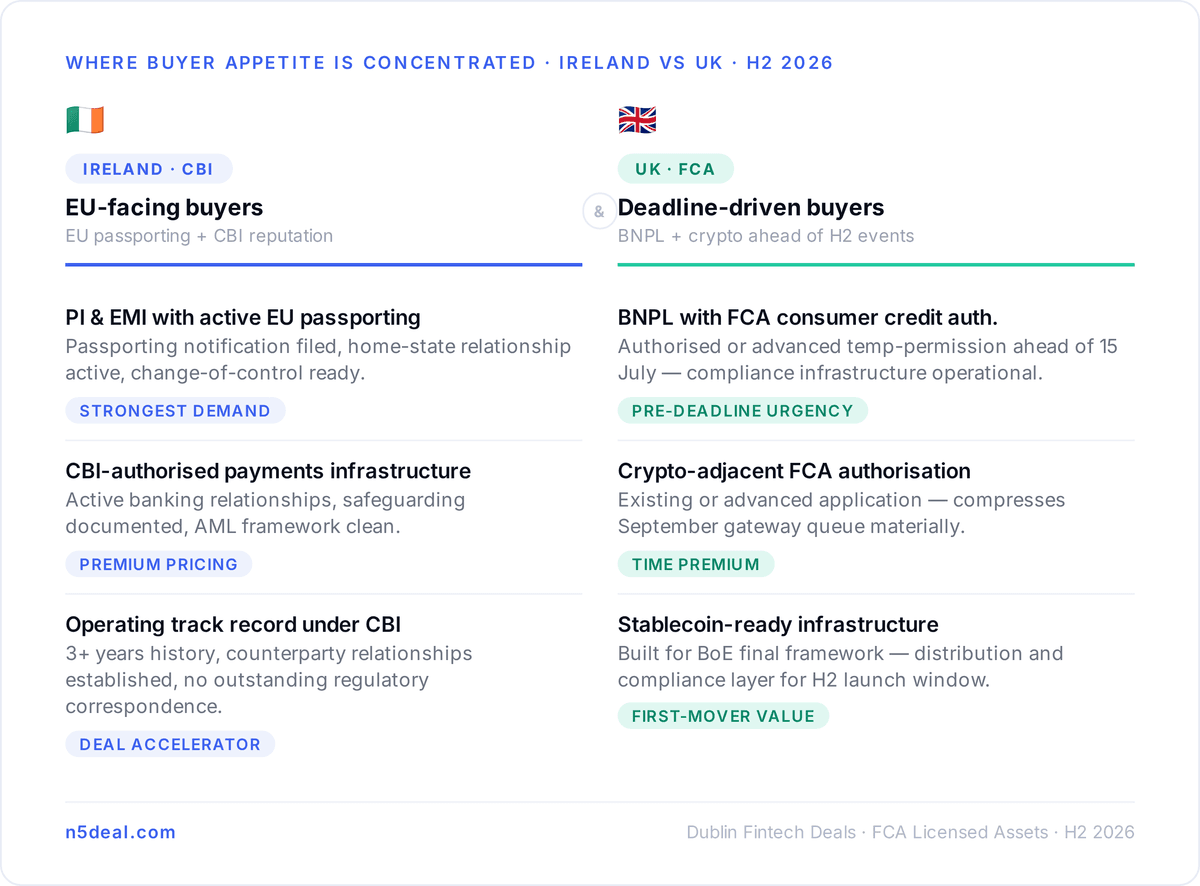
Buyer appetite across both markets in H2 2026 is concentrated in a small number of asset categories. Payments infrastructure — specifically entities with PI or EMI authorisation, active banking relationships, and clean AML documentation — generates the strongest inbound interest. Compliance-heavy models that would take 12 to 18 months to license from scratch are attracting buyers willing to pay a premium for the time saving alone.
In Ireland specifically, the assets generating the most structured interest are CBI-authorised entities that can demonstrate EU passporting in practice, not just on paper. Buyers are verifying that the passporting notification has been filed, that the home-state supervisor relationship is active, and that the compliance infrastructure would survive a change-of-control review without triggering remediation requirements.
In the UK, BNPL and crypto-adjacent assets with FCA authorisation or advanced applications are the primary targets ahead of the H2 deadlines. The July 15 and September events create a defined window in which these assets are worth more to a motivated buyer than they will be once the regulatory landscape settles.
What Sellers Should Prepare Before H2 2026
Sellers entering either market in H2 2026 face a buyer pool that is disciplined and specific. The sellers who close successfully are those who have addressed the questions buyers ask first: is the regulatory file clean, is the compliance history documented, is the ownership structure straightforward, and does the asset do what the listing says it does.
For Irish assets, this means ensuring the CBI authorisation is current, safeguarding arrangements are properly documented, EU passporting notifications are on file, and any outstanding regulatory correspondence has been resolved. For UK assets entering ahead of July 15, it means demonstrating FCA authorisation status clearly and providing compliance infrastructure that a new owner can operate without requiring a full rebuild.
The practical sequence is documentation first, valuation second, market entry third. Sellers who reverse that order — going to market before the regulatory file is fully in order — encounter repricing at the due diligence stage that consistently erodes the headline number they were targeting.
Conclusion
The UK and Irish fintech market H2 2026 is defined by deadlines, not sentiment. Three FCA regulatory events will produce motivated buyers and motivated sellers on a timeline that doesn't accommodate delay. Irish deal values have compounded for two years running, reaching $259 million in 2025. The buyer pool for compliant UK and Irish assets is active, specific, and prepared to move quickly when the documentation supports it.
For founders and advisors positioning assets in either market, the preparation window is now rather than after Regulation Day. For buyers mapping where licensed assets are concentrated across the UK and Ireland, N5Deal catalogues FCA and CBI licensed fintech entities available for acquisition with structured asset information to support early-stage screening.
Disclaimer
This page is for informational purposes only. It does not constitute legal, financial, or regulatory advice. Readers should consult qualified professionals before making any decisions.
Comments
Frequently Asked Questions
Clear, concise info to help you understand the process!