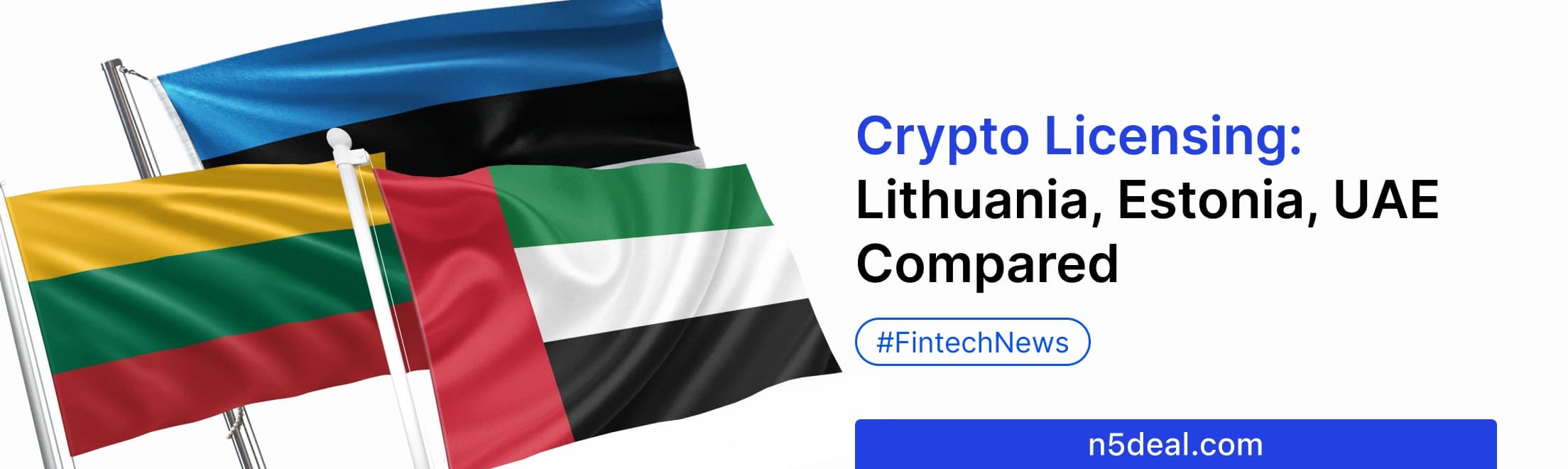
As cryptocurrency businesses look for clear and credible regulatory homes, Lithuania, Estonia, and the United Arab Emirates (UAE) are among the most discussed options. Each offers different trade-offs in terms of cost, speed, regulatory intensity, and market access.
Lithuania: EU-Based Crypto Gateway
Lithuania has built a strong reputation as a crypto-friendly EU jurisdiction with a developed fintech ecosystem.
Crypto activities are supervised primarily under anti–money laundering (AML) legislation, with registration and oversight handled by the Financial Crime Investigation Service (FCIS/FNTT). In practice, the market often refers to this as a “crypto license,” although technically it is a registration/authorization rather than a classic prudential license from the central bank.
Key Features (Lithuania):
Two main activities:
Virtual Currency Exchange Operator
Depository Virtual Currency Wallet Operator
Typical minimum capital for a standard UAB structure: around €125,000
AML/CTF framework, local compliance officer, and robust KYC/monitoring required
Indicative timeline from project start to full setup: often around 3–6 months, depending on readiness of documents and regulator feedback
Strong fintech and payments ecosystem; several hundred virtual asset firms already established
MiCA Perspective:
Lithuania is part of the EU and is preparing to transition towards the EU-wide MiCA regime. In the future, a MiCA CASP license obtained in an EU state will allow passporting across the EU. Current Lithuanian VASP registration, however, does not yet equal a MiCA CASP license and does not itself provide automatic EU passporting.
Best for:
EU-oriented exchanges, wallet providers and crypto-fintechs seeking an EU base with relatively pragmatic, AML-driven regulation and a mature fintech environment.
Estonia: Tightened but Credible EU Regime
Estonia was one of the earliest adopters of crypto licensing and attracted a large number of providers. Following money-laundering concerns, the rules were significantly tightened, and many legacy licenses were revoked or surrendered.
Crypto businesses are licensed and supervised by the Estonian Financial Intelligence Unit (FIU) under a stricter, substance-focused framework.
Key Features (Estonia):
Virtual Asset Service Provider (VASP) license covering exchange, transfer and other virtual asset services
Physical presence required:
Office in Estonia
Local management / board presence and designated AML officer
Substance expectations: real operations, staff and decision-making in Estonia
Minimum share capital significantly increased:
Commonly from ~€100,000 up to around €250,000+, depending on business model and services
Enhanced due diligence on shareholders, UBOs, and management
Regulatory reforms have made Estonia a more demanding and more expensive EU option compared to the first “easy license” wave, but also one that is viewed as more robust by regulators and banking partners.
Best for:
Projects that want an EU license with high credibility, are comfortable with real local substance and higher capital, and see value in Estonia’s strong digital infrastructure and e-governance culture.
UAE: Regional Hub with Multiple Crypto Frameworks
The UAE has positioned itself as a leading regional hub for virtual assets, particularly through Dubai and Abu Dhabi. Unlike a single nationwide framework, the UAE offers multiple regulatory regimes, each with its own rules, costs and expectations.
Key players include:
VARA (Dubai Virtual Assets Regulatory Authority) – Dubai’s dedicated virtual assets regulator
ADGM (Abu Dhabi Global Market – FSRA) – full financial services regulator with detailed virtual asset rules
DMCC, DIFC and other free zones – each with differing requirements and scopes
Key Features (UAE):
Multiple licensing options across VARA, ADGM, DMCC, DIFC, etc.
Activity-based licensing categories (exchange, brokerage, custody, advisory, etc.)
Minimum capital requirements vary widely:
Some free zones (e.g. DMCC) may have relatively modest share-capital thresholds (often in the tens of thousands of USD equivalent)
More systemically important activities (e.g. exchanges, major broker-dealers or custodians under VARA/ADGM) can require substantially higher capital, up to and including high six- or seven-figure USD equivalents, depending on the license type and risk profile
Corporate tax: the UAE now has a federal 9% corporate tax, with special regimes where qualifying free-zone entities may enjoy a 0% rate on certain “qualifying” income and 9% on non-qualifying income
Strong access to GCC, Middle East and Asian markets, HNW and institutional client base, and favorable business environment
Best for:
More capitalized or institution-focused projects targeting Gulf / Middle East / Asia, willing to invest in a higher-cost but globally visible regime (particularly VARA/ADGM), or projects seeking a complementary hub alongside an EU license.
Comparative Snapshot
1. Speed to Market (Indicative)
Lithuania: Often one of the faster EU routes; full project (company + registration) can frequently be achieved within a few to several months, assuming good preparation.
Estonia: Generally slower and more involved than Lithuania due to higher scrutiny, substance checks and capital; timelines of 6–12 months are not unusual.
UAE: Widely variable. Some free-zone setups can be relatively fast, but full authorization under VARA or ADGM for higher-risk activities can be lengthy and detailed.
2. Cost & Capital Intensity (High-level):
UAE: Typically the most expensive overall, especially under VARA/ADGM, with higher capital, advisory and ongoing compliance costs.
Estonia: Higher cost than it used to be, mainly due to capital and substance; often mid- to high-range in Europe.
Lithuania: Often more cost-efficient on a like-for-like basis versus Estonia and UAE for many standard exchange/wallet businesses, though real budgets will still be in the tens or hundreds of thousands of euros.
3. Market Access & Positioning:
Lithuania & Estonia: Both provide an EU footprint and sit within the future MiCA framework, which is attractive for firms targeting the European market.
UAE: Offers strong regional access (GCC, Middle East, parts of Asia) and a growing reputation as a global virtual assets hub, but is outside the EU/MiCA framework.
4. Regulatory Philosophy:
Lithuania: AML-centric registration with increasing alignment to EU standards; business-friendly but tightening.
Estonia: Strong emphasis on substance and risk mitigation after past scandals; fewer but more serious licensees.
UAE: Ambitious, innovation-driven but quite sophisticated and demanding at the top tier (VARA/ADGM), with a strong focus on institutional market integrity and investor protection.
Conclusion
There is no “one-size-fits-all” best jurisdiction; the right choice depends on a combination of factors, including your target markets (whether you focus on the EU, the Gulf/Middle East/Asia, or a broader global mix), your business model (retail or institutional, exchange, custody, brokerage, DeFi or CeFi), your budget and capital (from lean startup to well-funded scale-up), and your willingness to build local substance and work within more or less intensive regulatory frameworks. Lithuania is often ideal for EU-focused crypto businesses that want a balance between regulatory rigour and practicality. Estonia is better suited to firms seeking a more demanding but highly credible EU license and that are prepared to invest in real local presence and higher capital. The UAE is particularly attractive for projects targeting regional and global institutional markets that are ready to accept higher capital and compliance requirements in exchange for access to a strategic financial hub. If you share your target markets, product set and approximate budget, I can suggest which of these three jurisdictions is likely the best primary option and which could serve as a strong secondary hub.