
Spot trading means buying and selling at today's price. Simple, fast, and clear. Learn how it works and start trading smarter today.
Key Takeaways
Spot trading involves buying or selling financial assets at current market prices with immediate settlement
Transactions are executed "on the spot" with delivery typically occurring within two business days
Spot markets include forex, commodities, stocks, and cryptocurrencies, each with unique characteristics
Unlike futures or margin trading, spot trading provides direct asset ownership without leverage
Transparency, simplicity, and immediate execution make spot trading ideal for beginners and conservative investors
What is Spot Trading?
Spot trading represents the most straightforward form of financial market participation. The term "spot" refers to transactions executed at the current market price, with settlement and delivery happening immediately or within a very short timeframe. When you engage in a spot trade, you're buying or selling an asset at its present value, not at some future date or predetermined price.
The fundamental principle behind spot trading is simplicity. Unlike complex derivative instruments that involve contracts, leverage, or future obligations, a spot transaction is a direct exchange: you pay the current price and receive the asset, or you sell the asset and receive payment. This directness makes spot trading accessible to newcomers while remaining a core strategy for experienced traders and institutional investors.
In spot trading, the "spot price" reflects real-time market conditions based on supply and demand dynamics. This price changes continuously throughout trading hours as buyers and sellers interact in the marketplace. The spot market serves as the foundation for price discovery, establishing the baseline value that other financial instruments reference.
Core Characteristics of Spot Trading:
Immediate execution - Transactions occur at current market prices in real-time
Direct ownership - You receive actual assets, not contracts or derivatives
Transparent pricing - Spot prices reflect real-time supply and demand dynamics
Quick settlement - Delivery typically within seconds to two business days
No expiration dates - Hold assets as long as you want without rollover concerns
The settlement period for spot trades varies by asset class. In foreign exchange markets, spot transactions typically settle within two business days (T+2). Stock markets often follow similar settlement timelines, though some markets have moved to T+1 or even same-day settlement. Cryptocurrency spot markets generally offer near-instantaneous settlement, with assets transferred to your wallet within minutes or even seconds.
Spot trading differs fundamentally from other trading methods because it involves actual ownership transfer. When you execute a spot buy order for gold, stocks, or Bitcoin, you become the legal owner of that asset. This ownership comes with both rights and responsibilities, including the ability to hold the asset indefinitely, transfer it to others, or use it as you see fit.
How Does Spot Trading Work?
The mechanics of spot trading follow a straightforward process that begins when a trader places an order on a spot market platform. Whether you're trading through a traditional brokerage, a forex platform, or a cryptocurrency exchange, the fundamental workflow remains consistent: you specify the asset, quantity, and order type, then the platform matches your order with a counterparty.
Market orders execute immediately at the best available current price. When you place a market order to buy, the system matches you with the lowest available sell order. Conversely, a market sell order matches with the highest available buy order. This immediate execution guarantees your trade completes quickly, though the exact price may vary slightly from what you saw when initiating the order, especially in fast-moving markets.
Types of Spot Trading Orders:
Market orders - Execute immediately at best available current price
Limit orders - Specify maximum buy price or minimum sell price
Stop-loss orders - Automatically sell when price drops to predetermined level
Stop-limit orders - Combine stop and limit order features for precise control
Limit orders provide more price control by specifying the maximum price you're willing to pay when buying or the minimum price you'll accept when selling. Your limit order sits in the order book until market conditions meet your specified price. This approach gives you better price certainty but doesn't guarantee execution if the market never reaches your target price.
Liquidity plays a crucial role in spot trading efficiency. Highly liquid markets with many active buyers and sellers offer tighter bid-ask spreads and faster execution. Major currency pairs in forex markets, large-cap stocks, and leading cryptocurrencies typically provide excellent liquidity. Less liquid assets may have wider spreads and slower execution, potentially impacting your trading costs and strategy effectiveness.
The settlement process completes the spot trade by transferring ownership and payment between parties. In traditional financial markets, clearinghouses facilitate this process, managing counterparty risk and ensuring both sides fulfill their obligations. Cryptocurrency spot markets often use blockchain technology for settlement, providing transparent, immutable records of ownership transfer.
Price discovery in spot markets occurs through continuous interaction between supply and demand. When more buyers enter the market than sellers, prices rise. When selling pressure exceeds buying interest, prices fall. This dynamic equilibrium reflects collective market sentiment, economic data, news events, and countless individual trading decisions happening simultaneously.
Types of Spot Markets
Spot markets exist across virtually every asset class, each with distinct characteristics and trading conventions. The foreign exchange spot market represents the world's largest financial market, with daily trading volumes exceeding $6.6 trillion according to the Bank for International Settlements. Forex spot trading involves exchanging one currency for another at current exchange rates, serving both commercial needs and speculative trading strategies.
Commodity spot markets facilitate trading in physical goods like gold, silver, crude oil, natural gas, and agricultural products. These markets connect producers, consumers, and speculators, establishing prices that reflect current supply-demand conditions. While some commodity spot trades involve actual physical delivery, many participants close positions before settlement to avoid logistical complexities.
Stock spot markets enable buying and selling shares of publicly traded companies at current market prices. When you purchase stock through your brokerage account, you're typically executing a spot trade that gives you ownership rights in that company. Stock spot markets operate through centralized exchanges like the New York Stock Exchange or NASDAQ, providing regulated, transparent trading environments.
Cryptocurrency spot markets have emerged as significant trading venues over the past decade. Platforms like Binance, Coinbase, and Kraken facilitate spot trading in Bitcoin, Ethereum, and thousands of other digital assets. Crypto spot markets operate 24/7, offering continuous trading opportunities and near-instant settlement through blockchain technology. The decentralized nature of cryptocurrencies creates unique dynamics compared to traditional spot markets.
Bond spot markets allow trading fixed-income securities at current prices, though these markets often operate differently than equity markets. Many bond transactions occur over-the-counter rather than on centralized exchanges, with dealers facilitating trades between buyers and sellers. Government bonds typically offer high liquidity, while corporate bonds may trade less frequently.
Key Features of Spot Trading
Immediate settlement stands as the defining characteristic of spot trading. Unlike futures contracts that specify delivery months in advance or options that provide rights without obligations, spot trades complete quickly. This immediacy reduces uncertainty and eliminates the time-based risks associated with derivative instruments.
Price transparency in spot markets benefits all participants. Current spot prices are publicly visible, allowing traders to make informed decisions based on real-time market conditions. This transparency contrasts with some over-the-counter markets where pricing may be less accessible or standardized. Modern electronic trading platforms display order books showing available buy and sell orders at various price levels, providing deep insight into market depth and liquidity.
Benefits of Spot Trading for Investors:
Simplicity - Straightforward buy-low-sell-high approach without complex terms
Price transparency - Real-time visibility of current market prices and order books
Risk limitation - Maximum loss limited to invested capital (without leverage)
Flexibility - Hold assets indefinitely or sell whenever market conditions favor
Accessibility - Suitable for beginners with minimal trading experience
Simplicity makes spot trading accessible to beginners while remaining effective for professionals. The straightforward nature of buying low and selling high requires no complex understanding of contract specifications, expiration dates, or leverage calculations. This simplicity reduces the learning curve and minimizes the potential for costly mistakes that can occur with more sophisticated instruments.
Real asset ownership provides tangible value and flexibility. When you own spot assets, you can hold them indefinitely without worrying about contract expirations or rollover costs. This ownership allows you to participate in long-term appreciation, receive dividends or interest payments where applicable, and use your assets as collateral if needed.
No leverage requirement means spot trading doesn't expose you to the amplified risks associated with borrowed capital. While some platforms offer margin accounts that allow leveraged spot trading, traditional spot transactions require full payment upfront. This capital requirement naturally limits potential losses to your invested amount, preventing the catastrophic losses possible with highly leveraged positions.
Lower complexity in risk management makes spot trading suitable for conservative investors. Without expiration dates, time decay, or leverage to monitor, risk management focuses primarily on position sizing and stop-loss strategies. This simplified risk profile allows traders to concentrate on market analysis and timing rather than managing complex derivative positions.
Spot Trading vs. Other Trading Methods
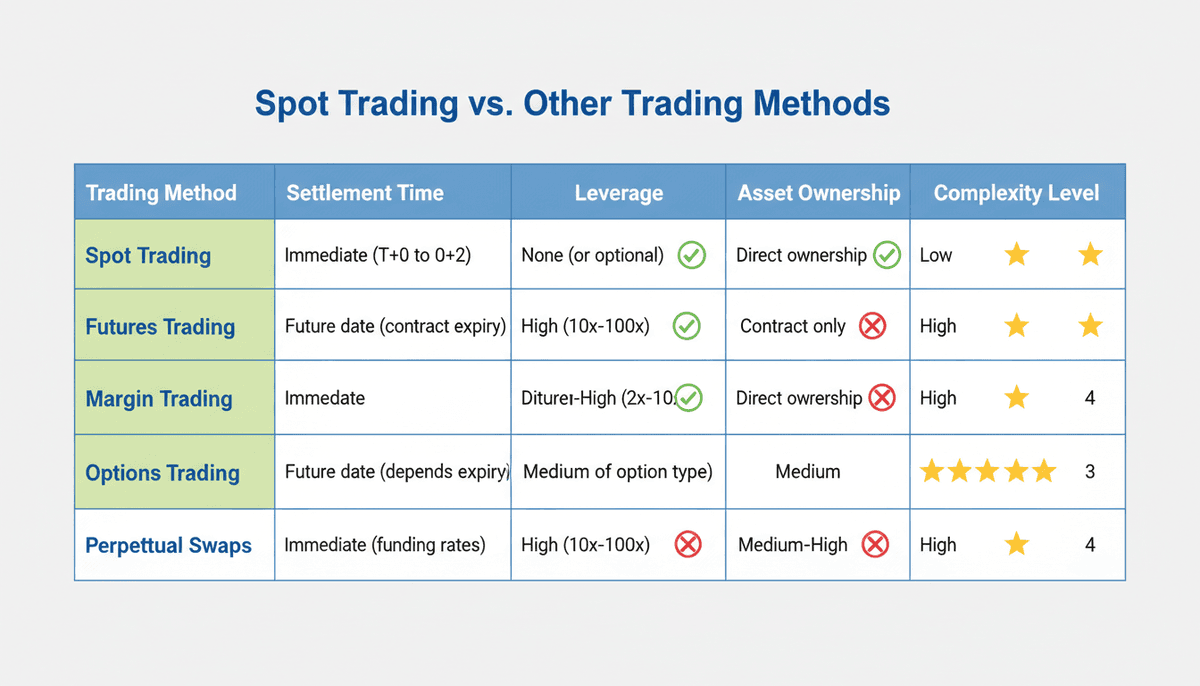
Understanding how spot trading compares to alternative approaches helps traders select appropriate strategies for their goals and risk tolerance. Futures trading involves contracts to buy or sell assets at predetermined prices on specific future dates. While futures provide leverage and hedging capabilities, they require understanding contract specifications, margin requirements, and rollover procedures. Spot trading's immediate settlement and direct ownership offer simplicity that futures lack.
Margin trading amplifies both potential gains and losses by allowing traders to borrow capital to increase position sizes. A spot trader with $10,000 can buy $10,000 worth of assets, while a margin trader might control $50,000 or more with the same capital. This leverage magnifies returns when trades move favorably but can lead to rapid losses and margin calls when markets move against positions. Spot trading without leverage provides more predictable risk profiles.
Options trading grants rights to buy or sell assets at specified prices without obligations to execute. Options strategies can be highly sophisticated, involving multiple contracts with different strike prices and expiration dates. While options offer unique risk-reward profiles and hedging capabilities, they introduce time decay and require understanding complex pricing factors. Spot trading's straightforward execution appeals to those seeking simpler approaches.
Contract for Difference (CFD) trading allows speculation on price movements without owning underlying assets. CFDs offer leverage and the ability to profit from falling prices, but they're derivative instruments that don't provide actual asset ownership. Spot trading gives you real assets that you can hold, transfer, or use as you choose, providing tangible value beyond speculative positions.
The choice between spot trading and alternatives depends on your objectives, experience level, and risk appetite. Spot trading suits investors seeking direct ownership, long-term holding strategies, and straightforward risk management. Traders pursuing short-term speculation, hedging strategies, or leveraged returns might find derivatives more appropriate, though these instruments require greater expertise and risk tolerance.
Disclaimer
This article provides educational information about spot trading and should not be considered investment advice. Financial markets involve risk, and past performance doesn't guarantee future results. Always conduct thorough research and consider consulting with qualified financial advisors before making trading decisions.
Comments
Frequently Asked Questions
Clear, concise info to help you understand the process!