

Discover about the difference between primary and secondary markets. We break down the advantages of both markets and offer some practical advice for investors.
Key Takeaways
The investment market consists of primary markets where new securities are issued and secondary markets where existing securities are traded
Primary markets allow companies to raise capital directly from investors through IPOs and new bond issues
Secondary markets provide liquidity, enabling investors to buy and sell securities among themselves
Each market offers distinct advantages: primary markets offer potential early-stage gains, while secondary markets provide flexibility and price discovery
Successful investors often utilize both markets strategically based on their goals, risk tolerance, and investment timeline
What is the Investment Market?
The investment market represents the complex ecosystem where capital flows between those who need funding and those seeking to grow their wealth. At its core, this market serves as the financial backbone of modern economies, enabling businesses to expand, governments to fund projects, and individuals to build wealth over time. Understanding how this market functions is essential for anyone looking to make informed investment decisions.
Investment markets facilitate the transfer of capital from savers to borrowers, creating value for both parties. Companies seeking to expand operations, develop new products, or enter new markets require substantial capital that often exceeds what they can generate internally. Rather than relying solely on bank loans, these companies can access investment markets to raise funds from a broad base of investors. In return, investors receive ownership stakes or debt instruments that offer potential returns through appreciation, dividends, or interest payments.
The investment market's significance for economic growth cannot be overstated. According to the World Bank, well-functioning capital markets contribute significantly to GDP growth by efficiently allocating resources to their most productive uses. When capital flows freely to promising ventures, innovation accelerates, employment increases, and living standards rise. Countries with developed investment markets consistently demonstrate stronger economic performance than those with underdeveloped financial systems.
Investment markets are broadly divided into two fundamental categories: primary markets and secondary markets. While these markets are interconnected and complementary, they serve distinctly different functions and offer unique opportunities for investors. The primary market is where securities are created and sold for the first time, directly connecting issuers with investors. The secondary market is where previously issued securities change hands among investors, providing liquidity and continuous price discovery.
Both markets play crucial roles in maintaining a healthy financial ecosystem. The primary market enables capital formation, allowing companies and governments to fund their activities. The secondary market ensures that investors can exit positions when needed, making the initial investment in primary markets more attractive. Without robust secondary markets, investors would be reluctant to participate in primary offerings, knowing they might be locked into illiquid positions indefinitely.
What is the Difference Between the Primary and Secondary Market?
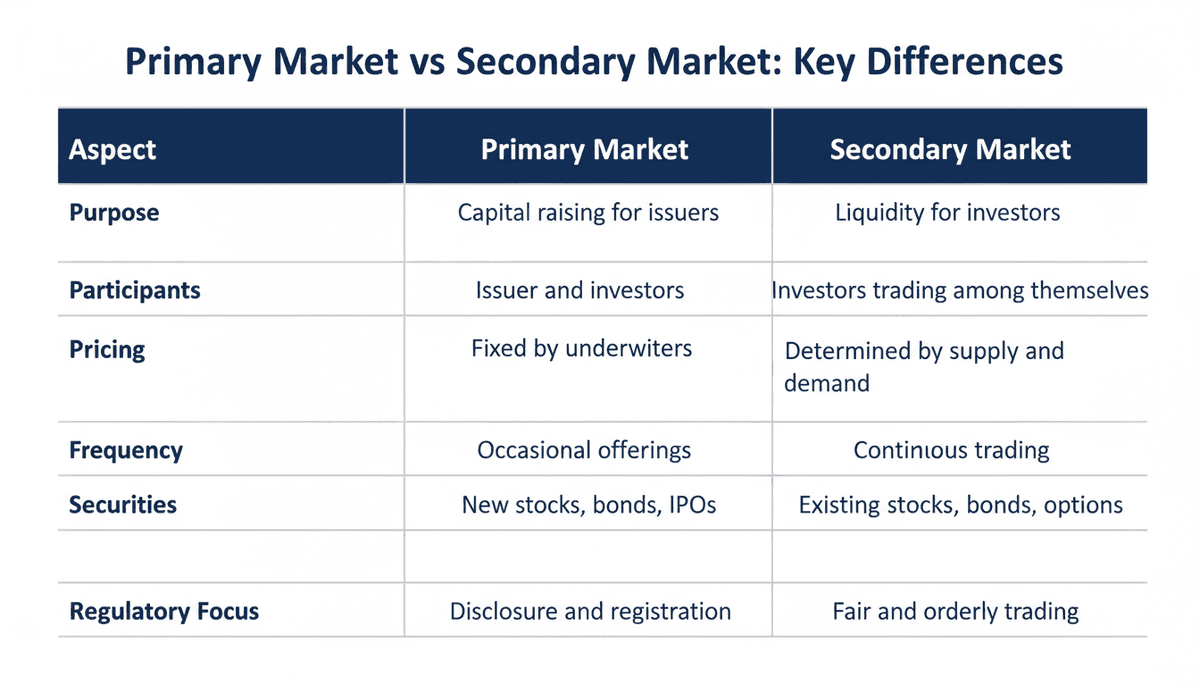
Understanding the fundamental differences between primary and secondary markets is essential for developing an effective investment strategy. These markets operate on different principles, serve different purposes, and offer distinct opportunities and risks for investors.
Primary Market: Creating New Securities
The primary market is where securities are born. When a company decides to raise capital by issuing new shares or bonds, it enters the primary market. This is the only market where the issuing company directly receives funds from investors. The most visible example of primary market activity is an Initial Public Offering (IPO), where a private company offers shares to the public for the first time.
Primary market transactions involve direct interaction between the issuer and investors, typically facilitated by investment banks that underwrite the offering. These intermediaries help determine appropriate pricing, ensure regulatory compliance, and market the securities to potential investors. The issuer receives the proceeds from the sale, minus underwriting fees and other costs.
Key characteristics of the primary market include:
Securities are sold directly by the issuer to investors
Prices are predetermined through negotiation between issuers and underwriters
The issuing company receives the capital raised
Transactions are typically large and involve institutional investors
Limited availability, as offerings occur only when companies need capital
Higher minimum investment requirements in many cases
Beyond IPOs, primary market activities include follow-on offerings where public companies issue additional shares, private placements targeting accredited investors, and bond issuances by corporations and governments. Each of these mechanisms allows entities to raise fresh capital for specific purposes like expansion, debt refinancing, or funding operations.
Secondary Market: Trading Existing Securities
The secondary market is where the vast majority of daily trading activity occurs. Once securities are issued in the primary market, they begin trading in the secondary market, where investors buy and sell among themselves. The issuing company receives no proceeds from these transactions; instead, value transfers between investors based on current market prices.
Stock exchanges like the New York Stock Exchange, NASDAQ, and London Stock Exchange are the most recognizable secondary markets. However, secondary markets also include over-the-counter (OTC) markets where securities trade directly between parties without centralized exchange oversight. Bond markets, for instance, primarily operate in OTC secondary markets.
Key characteristics of the secondary market include:
Securities trade between investors without issuer involvement
Prices fluctuate continuously based on supply and demand
High liquidity allows investors to enter and exit positions easily
Lower barriers to entry with smaller minimum investments
Continuous trading during market hours
Transparent pricing through public exchanges
The secondary market's primary function is providing liquidity. Knowing they can sell securities relatively quickly at fair market prices makes investors more willing to purchase them initially. This liquidity premium reduces the cost of capital for issuers in primary markets, creating a virtuous cycle that benefits the entire financial system.
Price discovery represents another critical secondary market function. Through continuous trading, the market aggregates information from millions of participants, reflecting collective assessments of securities' values. These prices signal to companies how the market values their performance and prospects, influencing management decisions and future capital-raising activities.
Primary or Secondary Market: The Advantages of Each
Both primary and secondary markets offer unique advantages that appeal to different investor profiles and strategies. Understanding these benefits helps investors determine which market aligns better with their goals, risk tolerance, and investment timeline.
Advantages of the Primary Market
Early access to growth opportunities: Investing in primary offerings allows you to acquire securities at their initial offering price, potentially before significant appreciation occurs. Companies going public or issuing new securities often do so when they're poised for growth, offering investors the chance to participate from the ground floor.
Direct capital contribution: Primary market investors directly fund company growth, expansion, and innovation. This direct relationship can be particularly appealing to investors who want their capital to have tangible impact, supporting job creation, product development, or infrastructure projects.
Potential for allocation advantages: In highly anticipated IPOs or offerings, getting an allocation can be valuable if the security trades above the offering price immediately. While retail investors often face challenges securing allocations in hot deals, those with relationships to underwriting brokers may access opportunities unavailable in secondary markets.
Structured pricing: Primary market prices are set through careful analysis by underwriters who evaluate company fundamentals, market conditions, and investor demand. This structured approach can provide more stability than secondary market volatility, though it doesn't guarantee the price is "correct."
Access to exclusive opportunities: Some primary market investments, particularly private placements and pre-IPO rounds, are available only to accredited investors or institutions. These exclusive opportunities may offer terms unavailable in public secondary markets, including preferential pricing, special rights, or unique security structures.
Advantages of the Secondary Market
Superior liquidity: The secondary market's greatest advantage is the ability to buy or sell securities quickly at transparent market prices. This liquidity provides flexibility to adjust your portfolio in response to changing circumstances, market conditions, or investment goals.
Continuous price discovery: Real-time pricing in secondary markets reflects the collective wisdom of all market participants. This transparency allows you to make informed decisions based on current valuations rather than relying solely on initial offering prices that may quickly become outdated.
Lower barriers to entry: Secondary markets accommodate investors of all sizes, from those purchasing a single share to institutions deploying billions. This accessibility democratizes investing, allowing individuals to build diversified portfolios with modest capital.
Extensive choice and diversification: Secondary markets offer access to thousands of securities across industries, geographies, and asset classes. This variety enables portfolio diversification that would be impossible if limited to primary market opportunities, which occur sporadically and unpredictably.
Established track records: Securities trading in secondary markets have performance histories, financial disclosures, and analyst coverage that help investors make informed decisions. This information advantage contrasts with primary offerings where historical data may be limited, especially for newly public companies.
Flexibility in timing: Unlike primary offerings with fixed subscription periods, secondary markets allow you to invest when you choose. This flexibility enables strategic timing based on market conditions, personal circumstances, or technical analysis rather than being constrained by offering schedules.
Practical Advice for Investors
Successfully navigating between primary and secondary markets requires strategic thinking, disciplined execution, and realistic expectations. Here are practical guidelines to help you make informed decisions across both markets.
Define clear investment objectives before allocating capital. Your goals fundamentally determine which market suits your needs. Long-term wealth building through diversified holdings typically favors secondary markets where you can construct balanced portfolios. If you're seeking potentially higher returns and can accept illiquidity and higher risk, selective primary market participation might complement your strategy. Retirement investors generally emphasize secondary market liquidity, while those with longer time horizons and higher risk tolerance might allocate a portion to primary opportunities.
Understand and respect your risk tolerance. Primary market investments often carry higher risk due to limited historical data, lock-up periods, and uncertainty about how securities will perform once trading begins. The Securities and Exchange Commission notes that many IPOs experience significant volatility in their first months of trading. Secondary markets, while still risky, offer more information for risk assessment and easier exit strategies if investments underperform. Honest self-assessment of your risk capacity prevents emotional decision-making during market turbulence.
Build a financial safety net before investing in either market. Financial advisors typically recommend maintaining three to six months of living expenses in easily accessible savings before committing significant capital to investments. This emergency fund prevents forced liquidation of investments at inopportune times, allowing you to maintain long-term strategies despite short-term financial pressures.
Diversification remains crucial regardless of which market you emphasize. Concentrating too heavily in primary market opportunities exposes you to company-specific risks and liquidity constraints. Similarly, over-concentration in any secondary market sector or security creates vulnerability to market-specific downturns. A balanced approach spreading investments across asset classes, industries, and geographies reduces portfolio volatility and improves risk-adjusted returns.
Conduct thorough research before committing capital. Primary market investments require careful analysis of offering documents, prospectuses, and company fundamentals. Understand the company's business model, competitive position, management quality, and use of proceeds. Secondary market investments benefit from analyzing financial statements, earnings trends, valuation metrics, and technical indicators. Never invest in securities you don't understand, regardless of how attractive they appear.
Consider the role of AI in modern investing. Artificial intelligence is increasingly valuable for analyzing vast amounts of market data, identifying patterns, and assessing risks. AI-powered tools can screen thousands of securities based on your criteria, analyze sentiment from news and social media, and even predict price movements with varying degrees of accuracy. While AI shouldn't replace human judgment, it can enhance your research process and help identify opportunities you might otherwise miss. Many brokerage platforms now offer AI-driven insights, portfolio recommendations, and risk assessments that complement traditional analysis.
Understand fee structures in both markets. Primary market investments often involve underwriting fees, legal costs, and other expenses that reduce the capital actually deployed. Secondary market trading incurs brokerage commissions, bid-ask spreads, and potentially management fees for funds. These costs compound over time, significantly impacting long-term returns. Seek cost-efficient investment vehicles and platforms that align with your trading frequency and investment size.
Maintain realistic expectations about returns. While stories of IPO investors earning massive returns capture headlines, many primary offerings underperform secondary market indices. Similarly, secondary market investing requires patience, as short-term volatility can test even disciplined investors. Historical data shows that diversified equity portfolios have returned approximately 10% annually over long periods, but individual results vary widely based on timing, selection, and market conditions.
Disclaimer
This article provides educational information about primary and secondary markets and should not be considered investment advice. All investments carry risk, including potential loss of principal. Market conditions, company performance, and economic factors can significantly impact investment returns. Always conduct thorough research and consider consulting with qualified financial advisors before making investment decisions. Past performance does not guarantee future results.
Comments
Frequently Asked Questions
Clear, concise info to help you understand the process!