

Discover the role of a liquidity provider in Forex trading — how they ensure fast order execution, tight spreads, and market stability for traders and brokers.
Key Takeaways
Liquidity providers are financial institutions that supply buy and sell prices in the forex market, enabling smooth order execution
They significantly impact trading conditions by influencing spreads, execution speed, and market depth
Different types of liquidity providers include Tier-1 banks, non-bank institutions, ECNs, and prime brokers
Quality liquidity providers offer tighter spreads and faster execution, but risks like "last look" policies exist
Evaluating liquidity providers requires assessing spread stability, execution quality, transparency, and regulatory compliance
What Is a Forex Liquidity Provider?
A forex liquidity provider is a financial institution or entity that supplies buy and sell quotes to the foreign exchange market, ensuring that traders and brokers can execute orders quickly and efficiently. In the world's largest financial market, where daily trading volumes exceed $7.5 trillion according to the Bank for International Settlements, liquidity providers serve as the essential backbone that keeps currency pairs flowing smoothly.
At its core, a liquidity provider acts as a market maker, continuously quoting both bid prices (what they'll pay to buy a currency) and ask prices (what they'll charge to sell it). This two-sided pricing creates the market depth necessary for traders to enter and exit positions without significant price slippage. Without liquidity providers, the forex market would experience wider spreads, slower execution, and increased volatility that would make trading far more challenging and expensive.
The primary function of liquidity providers is ensuring order execution. When you place a trade through your broker, that order ultimately gets matched with liquidity from one or more providers. These institutions maintain large inventories of various currencies and use sophisticated algorithms to manage their exposure and risk. By aggregating orders from multiple sources and offsetting positions internally, they can offer competitive pricing while managing their own risk profiles.
Liquidity providers operate at different levels of the market hierarchy. At the top tier are major international banks like JPMorgan Chase, Citibank, Deutsche Bank, and HSBC, which trade directly with each other in the interbank market. These Tier-1 banks have the deepest liquidity pools and typically offer the tightest spreads. Below them are smaller banks, non-bank financial institutions, and specialized forex liquidity providers that source their liquidity from multiple upstream providers.
The relationship between brokers and liquidity providers determines the trading conditions retail traders experience. Brokers with access to multiple high-quality liquidity providers can offer better spreads, faster execution, and greater price stability. Conversely, brokers relying on limited or lower-quality liquidity sources may pass along wider spreads and slower fills to their clients.
Understanding liquidity providers helps traders appreciate why trading conditions vary between brokers and why certain market conditions affect execution quality. During major news events or periods of low market activity, liquidity can temporarily dry up as providers widen spreads or reduce the size of orders they're willing to fill. This dynamic nature of liquidity explains why spreads aren't fixed and why execution quality can vary throughout the trading day.
How Liquidity Providers Influence the Market
Liquidity providers exert profound influence on forex market dynamics, affecting everything from the spreads traders pay to the stability of currency prices during volatile periods. Their impact extends far beyond simply facilitating trades; they actively shape market conditions and trading experiences.
Spread determination represents the most visible way liquidity providers influence markets. The bid-ask spread—the difference between buying and selling prices—directly reflects the liquidity provider's pricing. Providers with deeper liquidity pools and more efficient operations can offer tighter spreads, reducing trading costs for end users. Major currency pairs like EUR/USD typically have spreads measured in fractions of a pip when sourced from top-tier providers, while exotic pairs may have spreads of several pips due to lower liquidity.
Competition among liquidity providers benefits traders by driving spreads tighter. Brokers that aggregate liquidity from multiple providers can offer the best available bid and ask prices at any moment, creating a more competitive environment. This aggregation model, common in ECN (Electronic Communication Network) brokers, allows traders to access institutional-grade pricing that was previously available only to large financial institutions.
Execution speed and quality depend heavily on liquidity provider infrastructure and technology. Modern liquidity providers use co-located servers positioned physically close to major trading venues, reducing latency to milliseconds or even microseconds. This technological advantage enables near-instantaneous order execution, critical for strategies like scalping or high-frequency trading where every millisecond matters.
Order fill quality varies significantly between liquidity providers. The best providers can fill large orders with minimal slippage, even during fast-moving markets. They achieve this through deep liquidity pools and sophisticated risk management systems that allow them to absorb substantial order flow without dramatically moving prices. Lower-quality providers may struggle to fill large orders at desired prices, resulting in partial fills or significant slippage.
Market depth—the volume of orders available at various price levels—directly reflects liquidity provider participation. Greater market depth means larger orders can be executed without moving prices significantly. Liquidity providers contribute to market depth by continuously quoting prices for substantial volumes across multiple currency pairs. During normal market conditions, this depth provides stability and predictability for traders planning their entries and exits.
Market stabilization during volatility represents a crucial but often underappreciated role of liquidity providers. When major economic announcements occur or geopolitical events shake markets, liquidity providers continue quoting prices even as uncertainty spikes. While they may widen spreads and reduce order sizes to manage their risk, their continued presence prevents complete market breakdowns that could occur if liquidity disappeared entirely.
However, liquidity providers also contribute to volatility in certain circumstances. During extreme events, providers may temporarily withdraw liquidity or dramatically widen spreads, creating gaps and rapid price movements. The "flash crash" phenomenon, where prices suddenly plunge and recover within minutes, often results from temporary liquidity withdrawal by multiple providers simultaneously.
Price discovery in the forex market depends on liquidity providers aggregating information from countless sources and reflecting it in their quotes. Their pricing incorporates order flow data, economic indicators, technical levels, and sentiment analysis. This continuous price discovery process ensures that forex rates reflect the collective assessment of market participants worldwide.
Types of Liquidity Providers
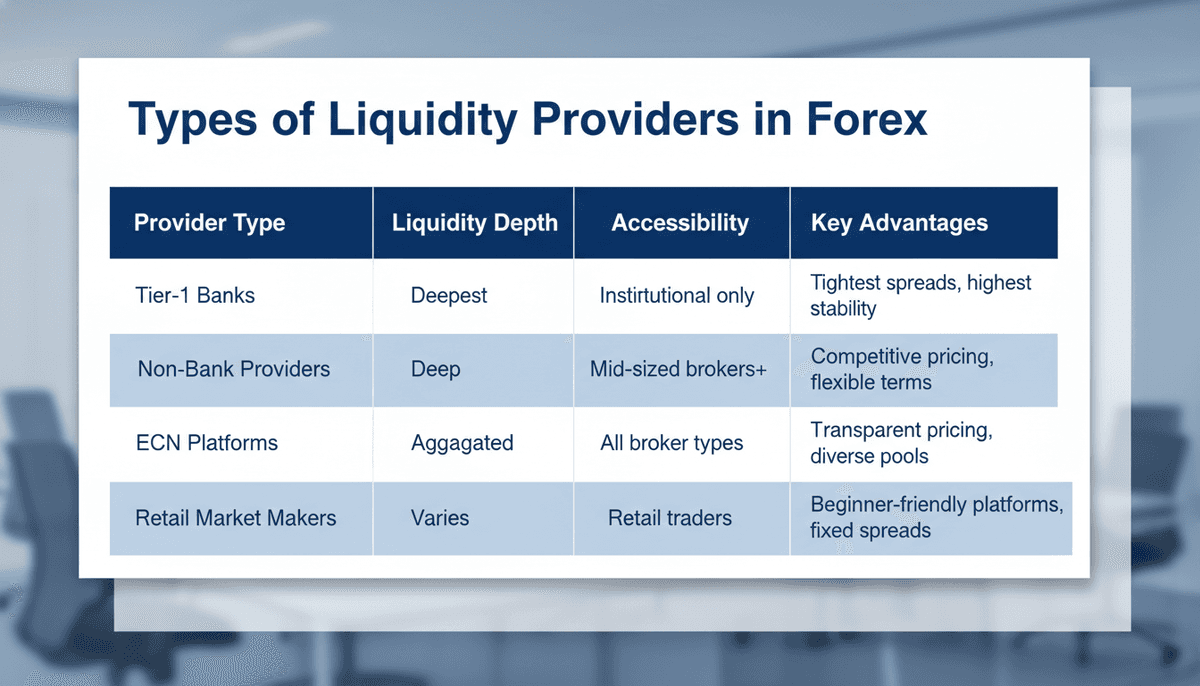
The forex liquidity ecosystem comprises several distinct types of providers, each with unique characteristics, advantages, and roles in the market structure. Understanding these differences helps traders and brokers select appropriate liquidity sources for their needs.
Tier-1 Banks
Tier-1 banks represent the apex of forex liquidity provision. These major international banks—including JPMorgan Chase, Citibank, Deutsche Bank, HSBC, Barclays, and UBS—trade directly with each other in the interbank market and serve as primary liquidity sources for the entire forex ecosystem.
Key characteristics of Tier-1 banks include:
Deepest liquidity pools with ability to handle extremely large orders
Tightest spreads, especially on major currency pairs
Direct market access without intermediaries
Highest credit ratings and financial stability
Comprehensive currency pair coverage including exotics
Advanced technology infrastructure with minimal latency
Tier-1 banks typically require substantial capital commitments and established relationships, making them accessible primarily to large brokers, institutional clients, and other financial institutions. Their pricing serves as the benchmark that other liquidity providers reference when setting their own quotes.
Non-Bank Liquidity Providers
Non-bank liquidity providers have emerged as significant market participants, offering competitive alternatives to traditional banks. These specialized firms focus exclusively on providing forex liquidity without the broader banking services that Tier-1 institutions offer.
Companies like XTX Markets, Citadel Securities, and Jump Trading have become major liquidity providers by leveraging technology and quantitative strategies. They often match or exceed bank pricing on major pairs while offering more flexible partnership terms and innovative technology solutions.
Non-bank providers typically feature lower barriers to entry than Tier-1 banks, making them accessible to mid-sized brokers. They often specialize in specific currency pairs or market segments, allowing them to offer particularly competitive pricing in their areas of focus. However, they may have less diverse currency coverage than major banks and potentially higher counterparty risk due to smaller balance sheets.
Electronic Communication Networks (ECNs)
ECNs aggregate liquidity from multiple sources—including banks, non-bank providers, and even other traders—into a single pool accessible to participants. Rather than acting as principals who take the other side of trades, ECNs function as matching engines that connect buyers and sellers.
Popular ECN platforms like EBS and Reuters Matching provide transparent, anonymous trading where participants can see market depth and execute against the best available prices. ECNs offer several advantages including price transparency, no conflict of interest (since they don't trade against clients), and access to diverse liquidity sources.
Brokers offering ECN accounts pass through this aggregated liquidity to retail traders, typically charging a small commission per trade rather than marking up spreads. This model appeals to active traders who prioritize raw spreads and execution quality over zero-commission trading.
Prime Brokers
Prime brokers serve as intermediaries that provide smaller brokers and institutions with access to Tier-1 bank liquidity they couldn't access directly. They aggregate credit relationships with multiple banks, allowing clients to trade with major liquidity providers without establishing individual credit lines with each bank.
Prime brokerage services include credit intermediation, risk management tools, reporting, and often technology infrastructure. This arrangement enables smaller brokers to offer competitive pricing and deep liquidity without the capital requirements and operational complexity of managing multiple bank relationships directly.
The prime brokerage model has democratized access to institutional-grade liquidity, allowing retail brokers to compete more effectively with larger competitors. However, it adds an additional layer between the end trader and ultimate liquidity source, potentially introducing slight delays or costs.
Benefits and Risks of Using Liquidity Providers
Quality liquidity providers deliver substantial benefits to traders and brokers, but the relationship also involves risks that require careful management and understanding.
Benefits of Quality Liquidity Providers
Tighter spreads reduce trading costs significantly. The difference between paying a 2-pip spread versus a 0.5-pip spread compounds dramatically over hundreds or thousands of trades. For active traders, access to tight spreads from quality liquidity providers can mean the difference between profitability and losses. Institutional-grade liquidity often provides spreads that are 50-80% tighter than retail market makers.
Faster execution improves trade outcomes. In fast-moving markets, delays of even a few hundred milliseconds can result in slippage or missed opportunities. Top liquidity providers with co-located servers and optimized technology infrastructure execute orders in single-digit milliseconds, ensuring traders get filled at or very near their intended prices.
Greater market depth enables larger position sizes. Traders and institutions executing substantial orders need deep liquidity to avoid moving the market against themselves. Quality providers can fill multi-million-dollar orders with minimal price impact, something impossible with shallow liquidity pools.
Improved price stability during normal conditions. Consistent liquidity provision creates smoother price action and more predictable trading conditions. Traders can rely on spreads remaining relatively stable during typical market hours, allowing for more accurate cost calculations and strategy planning.
Access to diverse currency pairs. Comprehensive liquidity providers offer competitive pricing across major, minor, and exotic currency pairs. This breadth enables traders to diversify strategies and capitalize on opportunities across the global forex market rather than being limited to a handful of major pairs.
Risks Associated with Liquidity Providers
"Last look" policies can result in rejected orders. Some liquidity providers reserve the right to reject orders after receiving them, a practice called "last look." While providers argue this protects against latency arbitrage, it can frustrate traders whose orders get rejected during favorable price movements but accepted when prices move against them. This asymmetry effectively creates hidden costs.
Liquidity withdrawal during news events. Major economic announcements often cause liquidity providers to dramatically widen spreads or temporarily stop quoting prices altogether. Traders holding positions through these events may find themselves unable to exit at reasonable prices or facing spreads ten times wider than normal.
Counterparty risk with smaller providers. While Tier-1 banks have substantial capital and regulatory oversight, smaller liquidity providers may pose counterparty risk. If a provider becomes insolvent, brokers and traders with exposure could face losses. This risk is generally managed through diversification across multiple providers and careful due diligence.
Potential conflicts of interest. Some liquidity providers also operate proprietary trading desks, creating potential conflicts where they might trade against their own clients. While regulations and reputation concerns limit this behavior, the structural conflict exists and requires monitoring.
Technology failures and connectivity issues. Reliance on electronic systems means that technology failures, whether at the liquidity provider or in connecting infrastructure, can disrupt trading. Redundant connections and backup providers mitigate but don't eliminate this risk.
Price manipulation concerns. In less regulated markets or with unscrupulous providers, there's potential for price manipulation through quote stuffing, spoofing, or other practices. Choosing well-regulated, reputable providers reduces but doesn't entirely eliminate this risk.
How to Evaluate or Choose a Liquidity Provider
Selecting the right liquidity provider represents a critical decision for brokers and, indirectly, affects the trading experience of retail traders. Several key factors should guide this evaluation process.
Spread stability and competitiveness should be assessed across different market conditions. Request historical spread data for your most-traded currency pairs during various times of day and market conditions. The best providers maintain relatively stable spreads during normal trading hours and don't widen excessively during routine volatility. Compare spreads across multiple providers for the same currency pairs at the same times to identify truly competitive pricing.
Execution speed and quality require technical testing and analysis. Measure average execution times, slippage rates, and rejection rates across different order sizes and market conditions. Quality providers should execute the vast majority of orders within 50 milliseconds with minimal slippage during normal conditions. Request execution quality reports and, if possible, conduct trial periods to assess real-world performance.
Order fill rates and partial fills indicate provider reliability. Providers should fill the vast majority of orders completely at requested prices during normal market conditions. High rates of partial fills or frequent rejections suggest inadequate liquidity depth or problematic policies.
Transparency and reporting separate professional providers from questionable operators. Quality providers offer detailed execution reports, clear pricing methodologies, and transparent policies regarding last look, order handling, and risk management. They should willingly explain their technology infrastructure, liquidity sources, and business model.
Regulatory compliance and reputation provide essential safeguards. Verify that providers are regulated by respected authorities like the FCA (UK), ASIC (Australia), or equivalent jurisdictions. Research their reputation through industry forums, reviews, and references from existing clients. Established providers with long track records generally pose lower risk than new entrants with limited history.
Technology infrastructure and redundancy ensure reliability. Inquire about server locations, co-location arrangements, backup systems, and disaster recovery plans. Providers should have redundant systems and multiple connectivity options to minimize downtime risk.
Currency pair coverage should match your trading needs. If you trade exotic pairs or emerging market currencies, ensure providers offer competitive pricing and adequate depth in those instruments. Some providers excel with majors but offer poor conditions on less common pairs.
Credit terms and capital requirements affect accessibility. Understand minimum deposit requirements, credit line terms, and any collateral requirements. Balance the desire for top-tier providers with realistic assessment of your capital and trading volume.
Customer support and relationship management matter more than many realize. Responsive support that can quickly address technical issues, explain unusual market conditions, or resolve disputes adds significant value. Providers offering dedicated relationship managers typically provide better service than those with only generic support channels.
Disclaimer
This article provides educational information about liquidity providers in forex trading and should not be considered trading or investment advice. Forex trading involves substantial risk of loss and is not suitable for all investors. Market conditions, liquidity, and execution quality can vary significantly. Always conduct thorough research and consider consulting with qualified financial professionals before engaging in forex trading.
Comments
Frequently Asked Questions
Clear, concise info to help you understand the process!