

The raise or sell fintech startup decision is rarely about timing alone — it is about positioning, risk, and optionality. A structured founder exit decision framework helps remove emotion from high-stakes choices. The real trade-off in fintech fundraising vs exit is control versus certainty. Market conditions in 2026 reward clarity, not optimism, in fintech founder decision-making. The best outcomes come from preparing both paths simultaneously, not sequentially.
Why This Decision Is Harder in 2026
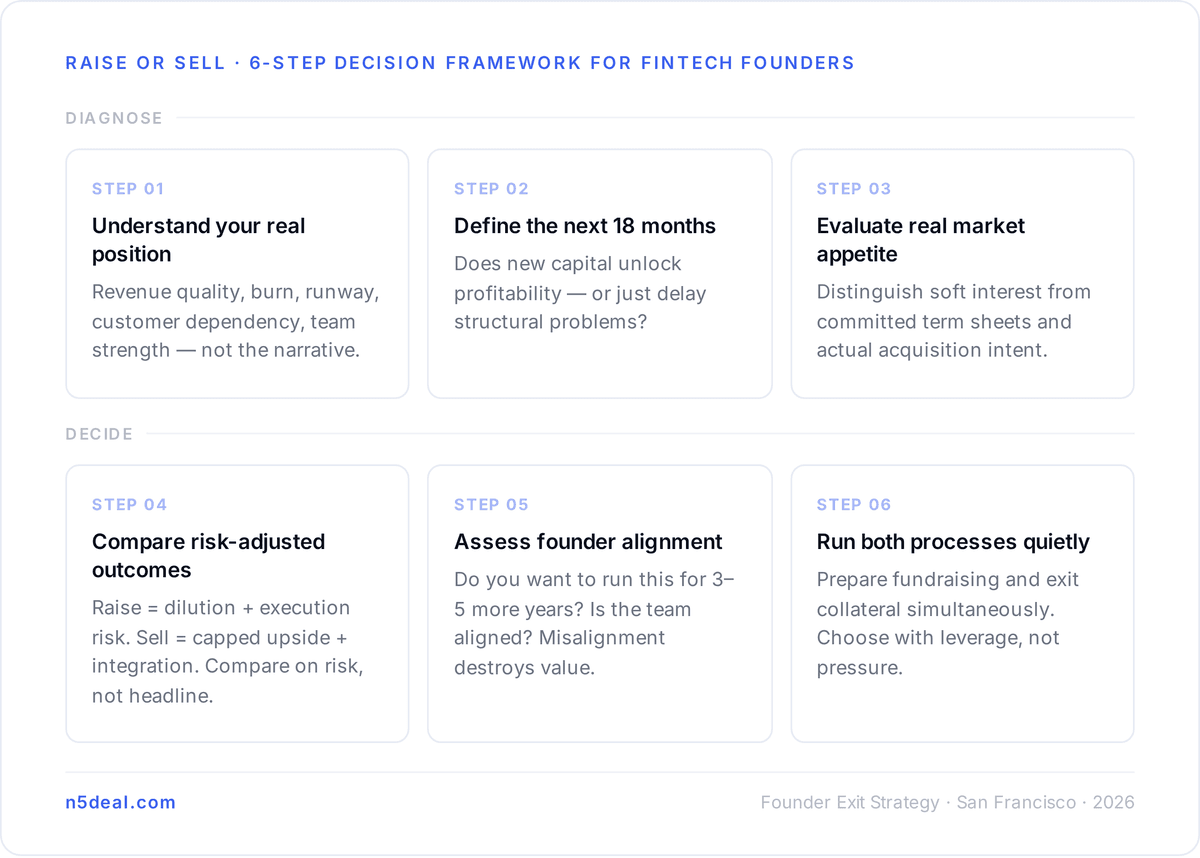
In previous cycles, the default answer was simple: raise more capital and grow. Today, that assumption no longer holds. Capital is more selective, valuations are more grounded, and buyers are more disciplined. That makes the raise or sell fintech startup question one of the most important strategic decisions founders face. In San Francisco conversations, one pattern is consistent: the founders who navigate this well do not guess — they use a framework.
Step 1: Understand Your Real Position, Not Your Narrative
Before choosing between fintech fundraising vs exit, founders need an honest view of where the company actually stands. This means assessing current revenue quality rather than just growth, burn rate and remaining runway, dependency on key customers or partners, regulatory and operational risk, and the strength of the management team. This is the foundation of any founder exit decision framework. Without it, decisions are driven by hope rather than reality.
Step 2: Define What the Next 18 Months Actually Look Like
Raising capital only makes sense if it meaningfully improves your position. The right questions are whether new capital unlocks profitability or simply extends runway, whether you can materially improve valuation metrics in that window, and whether you are solving core issues or just delaying them. If the answers are unclear, the raise or sell fintech startup decision starts to tilt toward exploring exit options. Many founders assume time will fix structural problems. In most cases, it does not.
Step 3: Evaluate Market Appetite — Not Just Investor Interest
Inbound interest is not the same as real demand. In fintech fundraising vs exit thinking, founders must distinguish between soft interest and committed term sheets, strategic curiosity and genuine acquisition intent, and valuation discussions versus executable deals. A strong startup exit strategy starts with understanding who would actually buy the business and why — not who has taken a meeting.
Step 4: Compare Risk-Adjusted Outcomes
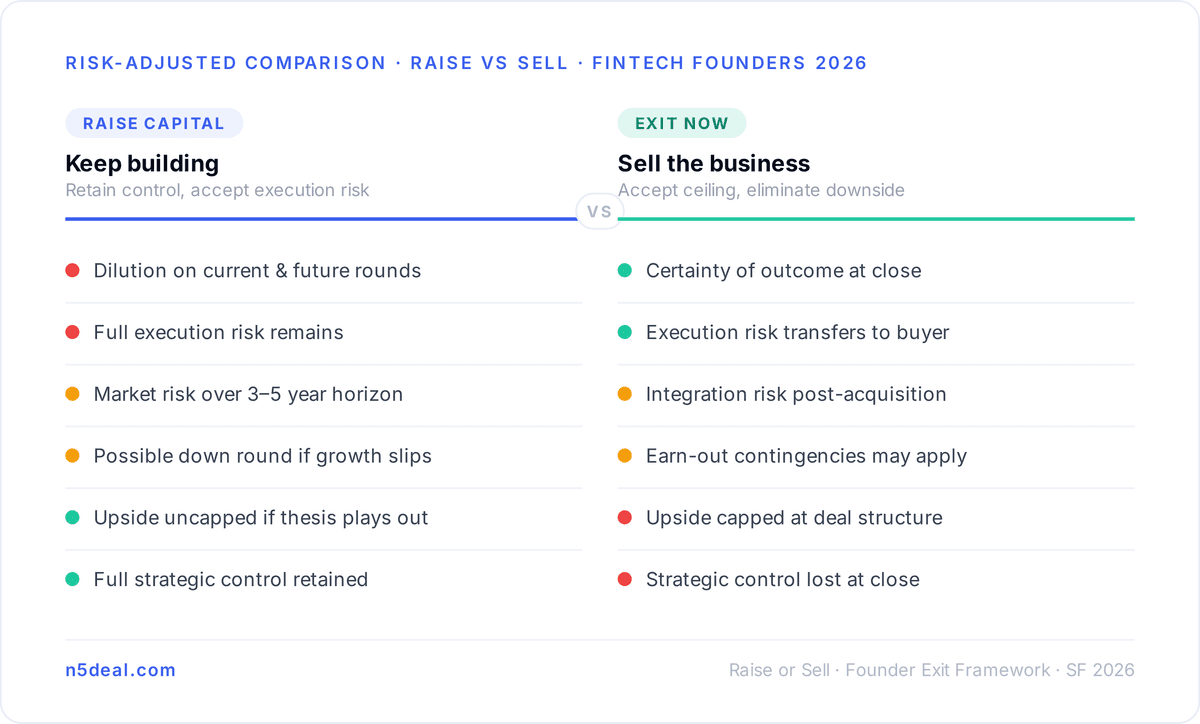
This is the core of the founder exit decision framework. The choice is not between a bigger outcome later and a smaller outcome now — it is between different risk profiles. Raising capital involves dilution, execution risk, market risk, and the possibility of a down round. Selling involves loss of control, capped upside, and integration risk. The right fintech founder decision-making approach is to compare these paths on a risk-adjusted basis, not on headline valuation alone.
Step 5: Assess Founder Alignment and Energy
This factor is consistently underestimated. The honest questions are whether you want to run this company for another three to five years, whether you are genuinely motivated to go through another scaling phase, and whether the leadership team is aligned in direction. Many decisions around when to sell your startup are not purely financial — they are human. Misalignment at the founder or leadership level destroys value if left unaddressed.
Step 6: Run Both Processes — Quietly
One of the most practical insights from SF is this: the best founders do not choose early. They create optionality by preparing fundraising materials, testing investor appetite, engaging potential buyers discreetly, and building collateral that works for both paths simultaneously. This dual-track approach improves outcomes because it creates leverage. You are not choosing under pressure — you are choosing with real information.
Conclusion
The raise or sell fintech startup decision is not binary — it is strategic. The founders who get it right use a clear framework, evaluate real market signals, and focus on risk-adjusted outcomes rather than narratives. In 2026, clarity beats optimism, and preparation beats timing. Whether you raise or sell, the goal is the same: maximize long-term value while managing downside risk.
Disclaimer:
This article is for informational purposes only and does not constitute legal, financial, or investment advice. Decisions around fundraising and exits depend on individual circumstances. Founders should consult qualified legal, financial, and M&A professionals before making strategic decisions.
Comments
Frequently Asked Questions
Clear, concise info to help you understand the process!